Apple said to hold 'iPad 3' event first week in March

  • Apple employee says upcoming new iPad 3 to have "truly amazing" screen

  • Pictured Sharp LCD panel claimed to be Retina Display for Apple's 'iPad 3'

  • Doubts cast on likelihood of quad-core A6 CPU in third-gen iPad

  • Lowest Prices ANYWHERE on MacBooks with exclusive AI coupons: Mac Price Guide updated Feb. 9th. (Find the best prices on Macs)
    Thursday, July 15, 2010

    Inside Apple's changes to the iPhone's signal strength visual bars

    By Josh Ong

    Published: 10:05 PM EST (07:05 PM PST)


    With the release of iOS 4.0.1 on Thursday, Apple instated changes to the way its iPhone handsets visualize bars representing cellular signal strength, doing away with a previously optimistic approach that compressed the dynamic range of bars to make it appear that a user's reception was much stronger than it actually was.

    In fact, AnandTech, which has been following the matter closely for weeks, discovered that Apple had compressed the dynamic range to such an extent that cradling the company's new iPhone 4 with the so-called "death grip" would make all of its bars disappear from just a 24 dB drop in signal.

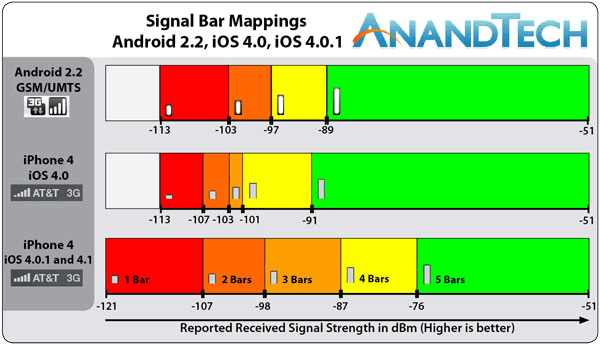
    Extensive testing of iOS 4.0.1 indicated a drastic change in the cutoffs for the 5 signal bar strength indicators. The pair that authored the report concluded that "Apple’s mappings have gone from having probably the most compressed dynamic range among handset vendors to less compressed than Android." iOS 4.0.1 also broadens the range for displaying a signal, with the lower limit shifting from -113 dBm to -121 dBm.  Both testers were able to keep calls connected at the lower limit of -121 dBm when testing with an iPhone 4. They theorized that the increase in display range was to accommodate the iPhone 4's increased sensitivity.

    Compared to iOS 4.0, iOS 4.0.1 spreads the signal bars much more evenly throughout the range. It also significantly reduces the range of bar 5, from a range of 40 dB to a range of 25 dB. Bars 4 and 5 in iOS 4.0.1 now cover almost the same range as just bar 5 in iOS 4.0.

    With the broader range between bars, users will see less of a drop when experiencing a loss of signal from gripping the phone. As reported earlier, the distance between the low end of bar 5 and no bars in iOS 4.0 was 24 dB (-91 dBm to -113 dBm). In iOS 4.0.1, the distance between the low end of bar 5 and no bars is now 45 dB (-76 dBm to -121 dBm).

    The report warned that users will most likely experience an across-the-board apparent loss in signal with the new software update. "The new signal strength visualization in iOS 4.0.1 is simply going to be more honest with iPhone users."

    Signal Bar Compare


    As expected, Apple changed the heights of the signal strength bars. Bars 1, 2, and 3 are taller, making the relative heights appear exponential, rather than linear. Although bars 1 and 2 changed the most, "their respective cutoffs are virtually unchanged."

    Although the new display is easier to read, the heightened bars without a corresponding change in cutoff value may lead users to believe that they have better signal than before. According to the report, this change in either the height or cutoff of some of the signal strength visual bars could potentially cause confusion and anger among users.

    Anandtech had also conducted tests to verify the loss in signal from contact with the iPhone 4 antenna, as compared to a drop due to a hand simply being close enough to the phone to block signal.

    After wrapping high-insulation tape around the stainless steel band, the drop in signal from gripping the phone improved from a drop of 24 dB to a drop of 16.6 dB.  When the tester wore a latex glove, the signal drop reduced even further to a drop of 14.7 dB. While the tape and gloves weren't presented as potential solutions, they did bring the signal drop "in league with the Nexus One's worst case drop, and almost in league with the iPhone 3GS worst case drop." 

    Filed under : iPhone 25 Comments ] 
    Story topics: iPhone 4, iOS 4, iPhone 4 Antenna Problem   Print ] [ Story Link ] 


    RSS
    Mac Connection End of Summer Sale
    MacBook Pro Model
    Apple
    Price
    Discount
    2.4GHz dual 13" MacBook Pro $1,199.00 $1,096.05* $102.95
    2.8GHz dual 13" MacBook Pro $1,499.00 $1,382.19* $116.81
    2.2GHz quad 15" MacBook Pro $1,799.00 $1,647.06* $151.94
    2.4GHz quad 15" MacBook Pro $2,199.00 $1,983.65* $215.35
    2.4GHz quad 17" MacBook Pro $2,499.00 $2,288.23* $210.77
    Early 2011 MacBook Pro Model
    Apple
    Price
    Discount
    2.7GHz dual 13" MacBook Pro $1,499.00 $1,258.53* $240.47
    2.0GHz quad 15" MacBook Pro $1,799.00 $1,503.49* $295.51
    2.2GHz quad 15" MacBook Pro $2,199.00 $1,695.99* $503.01
    2.2GHz quad 17" MacBook Pro $2,499.00 $2,035.49* $463.51
    *Instant 3% AppleInsider Reader Discount Applied When Adding Items To Your Cart

    AppleInsider Features
    Hot Forum Topics

    Recent Articles
    Apple said to be in 'crunch mode' to ready 'iPad 3' apps for on-stage demos, ads
    Google reportedly working on wireless home entertainment system
    Samsung Galaxy 10.1N cleared for sale in Germany
    Apple deadline for sandboxing in Mac App store arrives March 1
    AT&T throttling unlimited data users starting at 2 GB per month based on location
    Apple employee says upcoming iPad 3 to have "truly amazing" screen
    Workers' rights petitions delivered to Apple's Grand Central store
    US NOAA ditches BlackBerry, chooses Apple's iPhone and iPad
    FBI file on Steve Jobs reveals he was considered for White House position
    Apple now worth more than Google and Microsoft combined [u]
    Apple exploring 3D frame-of-reference iOS interface based on eye, light location
    Apple said to hold 'iPad 3' event first week in March
    Pictured Sharp LCD panel claimed to be Retina Display for Apple's 'iPad 3'
    Leaked photo allegedly shows outside back cover of Apple's next iPad
    Alleged Foxconn hack allowed bogus orders to be placed for vendors
    White MacBook sales come to close as Apple ceases sales to education institutions
    Google says it won't support fair licensing in open standards as Apple, Microsoft, Cisco have
    Cisco backs Apple's ETSI request for fair and open licensing of standards patents
    Doubts cast on likelihood of quad-core A6 CPU in third-gen iPad
    Path apologizes, offers opt-out for address book uploading
    iTunes Match generates 'magic money' for music copyright holders
    Siri rumored to gain support for Mandarin, Japanese and Russian in March
    US Air Force may buy 18,000 Apple iPads for cargo aircraft
    Purported 'iPad 3' back panel shows space for larger battery, new LCD
    Worker abuse petitions to be delivered Thursday at Apple's Grand Central store
    Microsoft joins Apple in pledging support for injunction free, FRAND patent licensing
    iPhone best at retaining resale value and offers lowest total cost of ownership
    iTunes-sponsored live Paul McCartney concert to stream for free on Apple TV
    Mobile carriers hate not having iPhone, pay premiums to get it
    Viacom deal brings MTV, Comedy Central, Nickelodeon shows to Amazon Prime
    European Apple resellers say lack of inventory is putting them out of business
    Sprint sold 1.8M iPhones in holiday quarter, 40% to new subscribers
    Apple continues adding Lion Internet Recovery support to 2010 Macs
    Amazon nears deal with Viacom as it readies standalone video subscriptions
    Apple asks ETSI standards body to set rules for standards essential patents
    Path app under fire for unauthorized address book upload
    Google to continue Motorola's FRAND licensing that seeks to monopolize H.264, UMTS
    App developers forced to submit Retina Display screenshots
    Final Cut Pro X named PCMag's Editors Choice for high-end video editing
    Apple-sparked 'App Economy' created 466K U.S. jobs in 4 years


    AppleInsider RSS Feed
    AppleInsider © 1997-2011
    Please review our Privacy Policy.
    Written/Edited/Compiled by the AppleInsider Staff.