Apple iOS, Google Android feared to be hitting middle age as five year old platforms
 Daniel Eran Dilger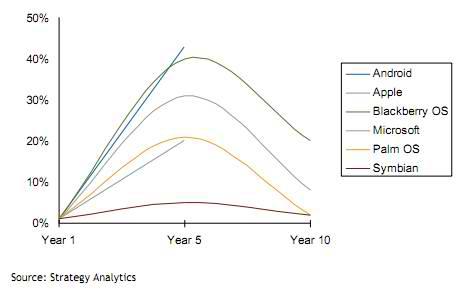
Market research group Strategy Analytics and RBC Capital Market analyst Mark Sue both highlighted a trend in comparing RIM's beleaguered Blackberry OS, Microsoft's abandoned Windows Mobile, the dead Palm OS and Nokia's now comatose Symbian, all of which were first introduced as smartphone operating systems around 2002.
A graphic produced by Strategy Analytics shows a particularly convincing lines that suggest Apple's iOS and Google's Android might be fated to follow the same paths, given that both turn five later this year.
"History shows that operating systems peak in the middle of a 10-year cycle," Sue wrote in a note to investors, adding that while iOS and Android are both currently selling lots of devices, their "sustainability beyond five years remains to be seen."
The chart doesn't depict why mobile operating systems of the past peaked after just a few years, nor does it delve into details related to market trends, such as the mass conversion of PDAs to smartphones ten years ago, or the tremendous shift from basic feature phones to smartphones going on today.
A brief history of smartphones for analysts
The Palm OS was actually developed in 1996 to run handheld organizers, and didn't start to become a smartphone platform until the Handspring Treo was introduced in 2002, at which point its underlying technology was already five years old.
Microsoft's Windows Mobile was similarly an effort to sell the company's Windows CE mobile "handheld PC" platform to drive phones. Its WinCE core similarly originated in 1996 and wasn't used in smartphones until 2002.
Nokia's Symbian also originated as an OS behind pocket organizers, first by Psion in the late 80s. The initial Nokia Symbian smartphones were released in 2001, at which the core technology behind them was already over a decade old.
RIM's Blackberry OS first originated in the company's pagers in 1999 and started being used in the company's smartphones in 2002.
That means the world's "old" smartphone operating systems all came into their current role when smartphones began as an observable trend almost exactly ten years ago.
Their actual "ages" in 2002 ranged from about three to 13 years, and each developed in wildly different circumstances. BlackBerry and Palm OS were originally completely proprietary, essentially embedded operating systems while Windows Mobile (and later Palm OS) were broadly licensed, while Symbian evolved from an embedded OS to a broadly licensed platform to an open source project.
In addition to these well known smartphone platforms, a variety of embedded platforms created by Motorola, LG, Samsung and other smartphone vendors over the past decade have combined custom code, Linux, Java and Adobe's Flash Lite to deliver smartphone products, all of which also suddenly began to decline in popularity exactly five years ago.
From that perspective, there is zero correlation between age and the sudden nosedive of all these operating systems five years ago, the date Apple introduced the iPhone.
Unless another company introduces a new product with the ability to suddenly disrupt the public's interest in today's five year old iOS and Android, Apple and Google should not have too much to worry about.
Other evidence that doesn't support a ten year life span
Speaking for Strategy Analytics, Alex Spektor, told Fortune in an interview that "no single platform has consistently dominated for eternity. Something better and newer comes along and pushes it out of leadership position."
Spektor also noted that "after operating systems drop from their 5-year peak" their vendors suddenly refresh and replace them, acknowledging such revitalizing efforts such as Palm's webOS in 2009, Microsoft's Windows Phone 7 toward the end of 2010, and RIM's efforts to deliver its new QNX-based BlackBerry X last year.
So far, none of these efforts have turned things around; RIM is still struggling to deliver its new OS for its smartphones, while Palm sold itself off to HP and its new technology was largely scuttled due to a management crisis. Microsoft's valiant efforts to promote WP7 over the past year have only resulted in the company losing the remains of its existing market share.
Nokia's initial efforts to modernize Symbian within an ambitious open source project, and its parallel efforts to launch Maemo/Meego Linux, were both abandoned last year after failing to turn things around quickly enough. None of these efforts were anywhere near reaching a five year apex; they simply failed to introduce the same level of disruption in the market that Apple's iOS caused five years ago.
Is iOS getting old?
While all of the original smartphone operating systems now in decline are based on code that is least a decade old this year, Apple's iOS is based on a core platform that outdates all of them. From its kernel to its APIs to its developer tools, the iOS has a direct lineage dating back to 1988, when Steve Jobs first showed off the NeXT Computer.
Rather than age, the biggest differentiation between Apple's iOS and the initial wave of smartphone operating systems was that Apple's iOS was derived from a platform-agnostic desktop operating system founded on Unix and an advanced object oriented development system, rather than being an embedded mobile OS with a pedigree of running PDAs, pagers, and handheld organizers.
It was actually this "age" and sophistication that enabled Apple to disrupt the smartphone market with a brand new product, because the iPhone greatly benefited from having a mature kernel, APIs and development tools.
Google's Android, while based on existing Danger technology and incorporating existing Linux and Java technology, still changed enough of its core design so that it has taken years for the platform to achieve a level of stability and maturity that it can be compared in some respects to Apple's iOS.
The platform that can, does
Unlike any other smartphone operating system, iOS still shares significant kernel, API and development tool technology with both the desktop Mac OS X and with other successful mobile devices outside of the smartphone, including iPad, iPod touch and Apple TV.
HP, Palm, Microsoft and RIM have all failed in their attempts to introduce tablet or handheld PC products beyond smartphones. Even Google's Android platform hasn't managed to drive significant sales of tablets or set top boxes, despite major initiatives over the past two years seeking to achieve that.
Additionally, when Google attempted to enter the notebook market with Chromebook, it didn't even try to use Android, but rather developed a parallel effort. Similarly, Microsoft's next efforts to sell PCs and tablets will revolve around Windows 8, which bears little in common with its WP7 smartphone platform on a kernel, API or development tool level.
After expressing morbid concerns about the fate of Apple's nearly five year old iOS, Spektor acknowledged that "the outcome isn’t the same for all platforms."



 William Gallagher
 Malcolm Owen
 Mike Wuerthele