Feature: iPhone 4 and iOS vs. Android on Verizon
 Daniel Eran Dilger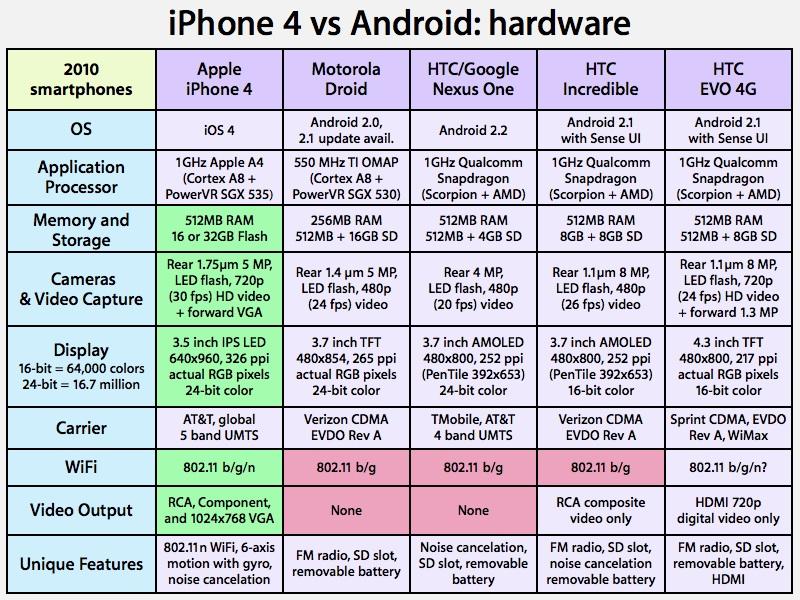
A series of articles have looked at how Apple's iPhone 4 stacks up against other smartphones, principally those running Google's Android OS. As the largest Android carrier in the US, Verizon's new ability to sell Apple's iPhone 4 threatens to shake up the smartphone business and dramatically change the options subscribers have available to them.
Verizon's phone comparison website, built in Adobe Flash, doesn't make it very easy to see how its dozens of phones compare in features and price. While the company's offers differ slightly among regions of the country, this general overview shows what options shoppers have among the carrier's offerings.
In 2009, Verizon's smartphones were almost entirely BlackBerry models; reportedly 95%, according to analyst sales data. Starting at the end of 2009 however, Verizon bet big on Android, unleashing a "Droid" branded ad campaign that helped shift its smartphone mix decidedly toward Android, resulting in less than 20% of its smartphone subscribers sticking with BlackBerry devices thoughout 2010, with most of the balance jumping to Android.
Verizon's Android offerings
One of the biggest winners of Verizon's Android push was Motorola, which made the original Droid and now makes the more modern Droid X, Droid Pro, Droid 2, the StarWars branded Droid R2D2, as well as the low end Devour and Citrus smartphones.
Another initial partner in Verizon's Droid push was HTC, a former Windows Mobile licensee that embraced Google's new Android platform from the beginning. Last year, Verizon sold HTC's Droid Eris, which has now been replaced by the HTC Droid Incredible.
A more recent beneficiary of Verizon's Android push is Samsung, which recently introduced the Samsung Fascinate and Continuum (both versions of the Galaxy S), as well as the Galaxy Tab, an oversized "tweener" smartphone-like device lacking mobile phone connectivity apart from 3G data, SMS, and WiFi, which is offered as an alternative to Apple's iPad or iPod touch.
Verizon also sells LG's Android-based Vortex and Ally (although the former is currently out of stock). Android models change so quickly that it can be hard to keep up with what the different names and models mean in terms of features and performance. Unlike the iPhone, which is refreshed every summer with a newer, faster model, Android phones ship from a variety of makers on different schedules, and not all new phones are better and faster.
A variety of new Android models are introduced as low end models with lagging performance and old software, and many are simply not upgradable to the latest version of Android, something that's impossible to find out at the time you buy the device.
Verizon's other smartphones
Most of LG's Verizon smartphone offerings are not Android-based and instead use LG's own embedded OS (including the enV Touch) or use Microsoft's now discontinued Windows Mobile 6.x (such as the LG Fathom).
Verizon currently does not carry any Windows Phone 7 devices, but does still offer the related, dead-end Microsoft Kin. Verizon also offers the low end HTC Ozone, which is also a Windows Mobile 6.x device.
Among BlackBerry phones, Verizon offers the Curve and Bold, both button-oriented devices, and Storm 2, an iPhone-like touch screen model. Verizon also offers HP's Palm webOS-based Pixi Plus, which mixes a touch screen with a small keyboard.
How Verizon compares as a smartphone carrier
Upon closer examination, it's not hard to see why Verizon was willing to make sacrifices to get iPhone 4. Two of its four smartphone platforms are essentially on extended life support (the waning webOS and the outdated Windows Mobile 6.x). The carrier's former star platform, while recently updated to BlackBerry OS 6, simply hasn't kept pace with the iPhone and Android and instead offers features closer to 2008's iPhone OS 2.0. However, despite a strong marketing push behind Android in 2010, Verizon's Android offerings aren't looking very competitive.
Among other things, no Android model Verizon currently carries offers a front facing camera suited to making video calls. That will make iPhone 4 and its FaceTime video calling a key new feature for the carrier to promote. Verizon has not yet made public whether it will support FaceTime calls over 3G however; AT&T does not, restricting video calls to WiFi. Front facing cameras are available on Android devices on other US carriers, including Sprint's HTC EVO Shift 4G and Samsung Epic 4G.
Verizon's Android offerings are also overshadowed by much faster devices on the new Sprint and T-Mobile networks. Sprint's HTC EVO Shift 4G takes advantage of that carrier's fast (but sparsely available) Clearwire WiMAX service offering download speeds of about 3-6Mbps and peaking to 10Mbps, while T-Mobile's new Samsung Vibrant 4G will take advantage of that carrier's fledgling new HSPA+ service to deliver blazing fast downloads at up to 21Mbps, among the fastest wireless networks in the world.
Verizon debuted its own "4G" branded LTE network last month, and introduced a series of new Android smartphones that will take advantage of it in the second half of this year, but for now its fast data network is only available as a WWAN service for notebooks and MiFi personal hotspot devices. Verizon needs a good smartphone now, and all it has to offer is its robust but relatively slow CDMA EVDO network, which delivers closer to 1Mbps downloads.
That's not very fast by any standard, but it is considered to be very reliable, widely available in terms of coverage, and capable of supporting tethering and unlimited data use by users (features AT&T doesn't offer). When trading reliability for fast spots of service, it's only easy to opt for the faster network if you happen to live and work in places where it's available.
AT&T's 3G network is also faster than than Verizon's, but again only if you're lucky enough to be in range of its best service areas. For many iPhone users in rural or dense urban areas, particularly New York and San Francisco, Verizon simply offers better overall service. Users who want faster data downloads than Verizon provides can do what AT&T users already do: simply rely on WiFi for data at work and home.
How Verizon's smartphones stack up
Every smartphone is only as good as its carrier, and vice versa. In fact, how well a smartphone works compared to other models depends upon the sum of a stack of interrelated features, rather than simply a hardware specification comparison.
These factors include the hardware features of the device itself, the features and usability of its core software (including its operating system and web browser), the availability and quality of its third party apps, its usability in terms of media (music, movies, photos and other content), and how well the device works on a given network (a factor that includes issues such as speed caps, bandwidth limits, software updates, installation of junkware, pricing and ability to roam on other networks).
The last time AppleInsider compared smartphone hardware six months ago, we pitted the then-new iPhone 4 against four popular Android models from a variety of US carriers (summary below). This time, we'll focus on Verizon itself, with the largely unchanged iPhone 4 taking on Verizon's existing Android, BlackBerry, Palm and Windows Phone devices.
iPhone/iOS: Until now, it was easy to compare Apple's iPhone because it was only offered by one US carrier, one hardware maker, and in one basic set of features and configurations that changed as Apple updated the iOS or released a new annual model. Now, iPhone users in the US have two carriers to choose from (each with slightly different service plans); other factors still remain nearly identical, making it easy to generalize the experience the iPhone delivers.
As noted earlier, Apple unveils just one new iPhone model once a year, making it easy to qualify its features. For example, AT&T still offers the iPhone 3GS as a low end option, but it's easy to recall that phone delivers the performance of a smartphone from the second half of 2009, with features that are pretty clearly differentiated from the newer iPhone 4.
RIM's BlackBerry is somewhat similar, but is offered in two major form factors, one classic to RIM (the Verizon Curve and Bold) and the other emulating the iPhone (the Verizon Storm 2). RIM releases more model variations however, each with slightly different features that are harder to keep straight. Unlike Apple, RIM updates its phones' software via the carrier, which each carrier distributing a custom build for each model. Verizon adds its own software to these updates, something BlackBerry users just have to accept, as RIM does not restrict the bundled software Verizon seeks to force upon its subscribers.
BlackBerry has improved its browser, but it still lags behind in usability overall, and the quality and scope of third party apps is a far cry from what the iPhone has in Apple's iOS App Store. BlackBerry tends to appeal to people who have always used a RIM device and are simply unaware of how far their platform has fallen behind.
On page 2 of 2: Verizon's mixed bag of Android models.
Android, like BlackBerry, is also updated by the carrier, meaning that updates might never arrive for some older or cheaper models, might be delayed for months after the official Android OS release by Google, and will certainly be bundled with Verizon's chosen mix of hard-to-remove apps from partners, including annoying nagware for subscription services. A variety of reviews of Verizon phones specifically note "Verizon bloatware" as a major negative.
The most responsive Android licensees (in terms of delivering new updates for their phone users) are Motorola and HTC, but both take on average nearly two months to get Google's latest updates pushed down to their users. Other Android makers take even longer to update their phones, with Samsung sitting on updates for around five months and LG continuing to delay the most recent update for its low end Verizon Ally; its now been more than six months since 2.2 Froyo shipped, and LG says it will likely be another month before it can roll it out.
Sony Ericsson's Xperia X10 isn't even a low end smartphone, and it was released three months after Google debuted Android 2.2 Froyo. Despite that, the company shipped the Xperia with the older 2.1 software and later announced that it won't ever be offering its users an update to Android 2.2 Froyo, which has already been replaced by Google's latest Android 2.3 Gingerbread.
In sharp contrast, Apple issues regular iOS updates that iPhone users can install themselves on the same day. Software updates are important not only for the new features and refinements they bring, but also because updates fix bugs and patch security issues. A variety of the latest apps also require the latest software update, ranging from some games to the official Flickr app to Adobe Flash Player to Google Voice Actions to Yahoo Messenger video calling. Despite this, a few of Verizon's Android phones still ship with Android 2.1 from last summer.
Verizon's mixed bag of Android models
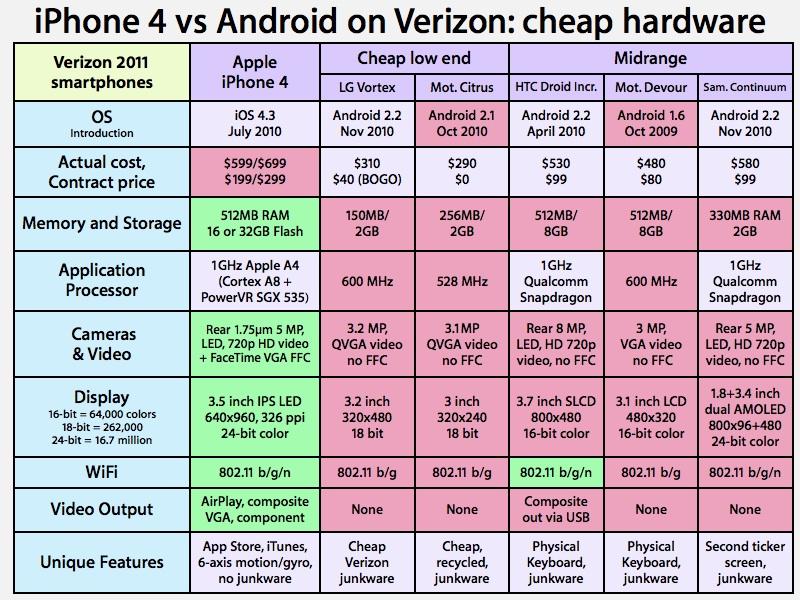
Unlike the iPhone or RIM's BlackBerry, Android ships on a variety of phones from different makers, so you can't generalize about the feature set you're getting, just because a phone runs Android. For example, HTC has historically used cheaper, lower quality 16-bit displays compared to Motorola, while Samsung frequently opts for its own high quality AMOLED displays, although those have their own drawbacks related to use in bright daylight.
Thus, while "iPhone" conveys a clear meaning about what features and standard of quality are going to be available, "Android" does not; it only refers to the shared code used across a variety of extremely different products from very different manufacturers, making the brand nearly meaningless to shoppers.
Another major difference among various Android models is the version of Android OS they use. Many new phones ship with an old version, and won't be updated within three to six months of the next Google release. Many cheaper models ship with software that is a year old, and users can't typically install their own software updates in the same way iPhone users can. Verizon's lineup (apart from the low end models) are just now getting around to all being updated to Android 2.2 (Samsung models are getting their updates this week). But Android 2.2 Froyo was released last summer, and Google has since released Android 2.3 Gingerbread.
Verizon's Android updates are not only slow to roll out, but are also packed with third party trial-ware and other apps users can't easily remove. That only aggravates the problem of Android licensees typically installing less memory on their phones than Apple does, as well as Android's less sophisticated use of storage memory compared to Apple's iOS.
In addition to the related bloatware issue, hardware manufacturers and carriers may also decide to include or exclude Google's own apps. For example, Verizon ships a variety of its phones, from the low end LG Vortex to the Samsung Fascinate, with Bing search and maps apps instead of Google as part of a deal with Microsoft.
That results in a very different experience compared to other Android phones "with Google," further illustrating that "Android" is not a very meaningful description of the overall feature set a given phone will deliver. Verizon also sets up the contacts app to launch its own VZ Navigator, a subscription based GPS mapping app, in preference to finding a contact in the free Google Maps Navigation even if users install that themselves.
Apple offers one iPhone 4 model on Verizon, and a second, older iPhone 3GS option on other carriers. Apple also prevents carriers from removing core iOS apps or bundling their own or partner-affiliated apps. Apple supports Google, Yahoo and Bing search according to the users' preferences, rather than just picking one for search as most Android devices do (depending upon the carrier and their affiliates).
In general, Android phones are harder to compare as a class because they range from high end models in the range of iPhone 4, to new but very low end models that are slow and lack key features, and may only ever run the outdated version of Android OS they ship with.
Verizon's fragmented Android software market
Verizon's wide range of Android phones also result in fragmentation in terms of third party software. Getting a new Android phone doesn't mean it will be able to use the latest apps, again because the latest phones may be low end models offering inadequate performance and running antiquated versions of Android that will never be updated.
That issue is also a problem for users who want to buy the fastest high end Android models, because it means that developers targeting the Android platform may want to aim for the lowest common denominator to make the most sales.
But there's another fragmentation problem affecting Android users: there's no good software store. Google has clearly failed to deliver an app marketplace, no surprise given the company's complete lack of experience in retail.
Verizon is running its own parallel store for Android apps, and it offers some exclusive titles that aren't available to Android users on other carriers (including, originally, Bing and Skype clients). However, Verizon's store isn't as visible to developers and multiple stores combined don't deliver the same kind of economies of scale that Apple offers in its one store for iOS apps and iTunes music and video.
Verizon also operates a VCAST video subscription service that costs $10 per month, including Rhapsody music, video on demand, and mobile TV channels, and bundles Amazon's MP3 app as an alternative to Apple's iTunes Store. These apps, intended to provide media organization for users' music and movies to cover a shortcoming of Android itself, are not equivalent to the iOS iPod and iTunes apps by any stretch of the imagination.
One of Android's weakest links is is inability to offer a direct challenge to Apple's savvy in music and video playback. From the store, to the content available, to free content options, to working with your own personal media files, to using new features such as AirPlay wireless streaming to your TV or stereo, the Android platform just doesn't stack up to Apple's iOS media offerings.
Amazon to the rescue?
Amazon is working to help improve this situation with its new Amazon Appstore for Android. It hopes to apply its online retailing expertise to build the software store Google fumbled. The only problem is that neither Google nor Verizon has a direct interest in giving away their potential software revenues.
Google created Android as a mobile platform for delivering its ads. If it hands its software store over to Amazon, its ad revenue may be displaced by iOS-style direct purchases instead. Google also risks having its search rivals (including Microsoft) replace it on its own platform (and one that it makes no direct licensing revenues from). Verizon is rumored to be wanting to do just that.
Verizon also already operates an Android app market, so promoting Amazon's store would be a curious strategy for the carrier. That tilts reality away from favoring Amazon's new effort, because Android users will likely have to find it themselves, rather than getting it bundled on their phone or by their carrier.
Again, with lots of small stores, Android won't gain the critical mass to attract unique development. Currently, Android only gets ports of the most popular iOS puzzle games like Angry Birds and Cut the Rope, and does not get the more interesting iOS titles simultaneously, if ever, ranging from cutting edge games (such as Infinity Blade and Firemint Real Racing) to innovative apps like Word Lens or Hipstamatic, to apps requiring more security than Android delivers (including Netflix and full Exchange Server support), to, of course, Apple's own titles ranging from iMovie and Remote to its iTunes and MobileMe offerings.
There's also no integration between Android's existing but mostly hobbyist or junkware app market, and the platform's intended leap to tablets. When mainstream Android tablets arrive running the first tablet-savvy version of Android 2.3 Honeycomb this summer, they'll have their own unique user interface and won't share integrated compatibility nor Universal Binary packaging in the same way that the iPhone does with iPad apps.
And again, the Android smartphone platform offers little hope for thinking that Android tablets will in any way rival the iPad in terms of apps, certainly lacking Apple's own Pages, Keynote, and Numbers productivity apps, with no vendor able or interested in offering alternatives of similar quality.
Verizon's Android strengths
Android does offer some competitive strengths over Apple's iPhone. Android users will be quick to point out that their phones can run content created in Adobe Flash. Again, that's only true for some models, as Flash Player requires Android OS 2.2. While that came out the middle of last year, many of Verizon's phones still ship with OS 2.1 and don't offer available updates.
Those that can install the player are still stuck with the core problem of running Flash on mobile devices: it's simply not optimized for mobile use, and most content developed in Flash was intended for playback on desktop PCs, and subsequently doesn't work well on a mobile device. Still, for users with casual needs for access Flash content, Android offers something iOS doesn't.
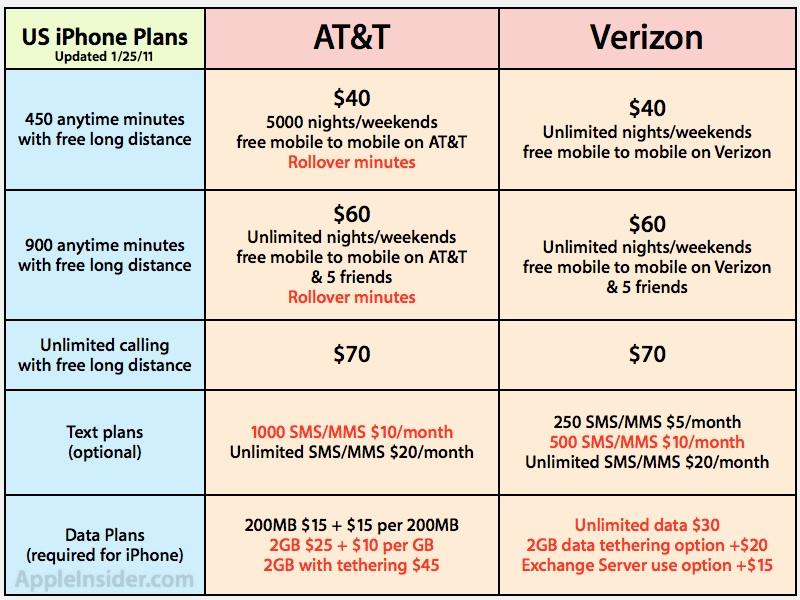
Verizon also offers some Android models for free, or even in "buy one, get one" offers intended to sell smartphone contracts. Its cheapest iPhone option will be $199 with a contract, providing a minor barrier for some users interested in upgrading to a smartphone. To get a cheaper iPhone, users will have to opt for AT&T's $49 iPhone 3GS. Of course, the Android products Verizon offers for significantly less than the iPhone 4 are also very low end models, as detailed below.
Two features AT&T has touted (the ability to use data service while on a phone call and the ability to use the iPhone to roam on foreign GSM/UMTS networks) won't apply to the Verizon iPhone. Verizon does sell Android phones that can accommodate a GSM SIM card, enabling them to be used in Europe and Asia just like AT&T's phones. This might not be a major competitive feature for most users, particularly given the outrageous cost of global roaming, but might appeal to some business users as a convenience.
One feature that has been unique to Verizon Android users, personal hot spot sharing (aka WiFi tethering), is a feature of Verizon's network that isn't yet available on AT&T. With the Verizon iPhone 4, that will change, erasing a key reason for preferring Android.
Google also offers some features that are unique to Android, including voice recognition for search and text input, free turn-by-turn GPS via Maps Navigation (if Verizon doesn't take the app off to replace it with its own service), and integrated support for its other services, such as Latitude friend tracking and Google Voice (which are separate downloads for iOS devices).
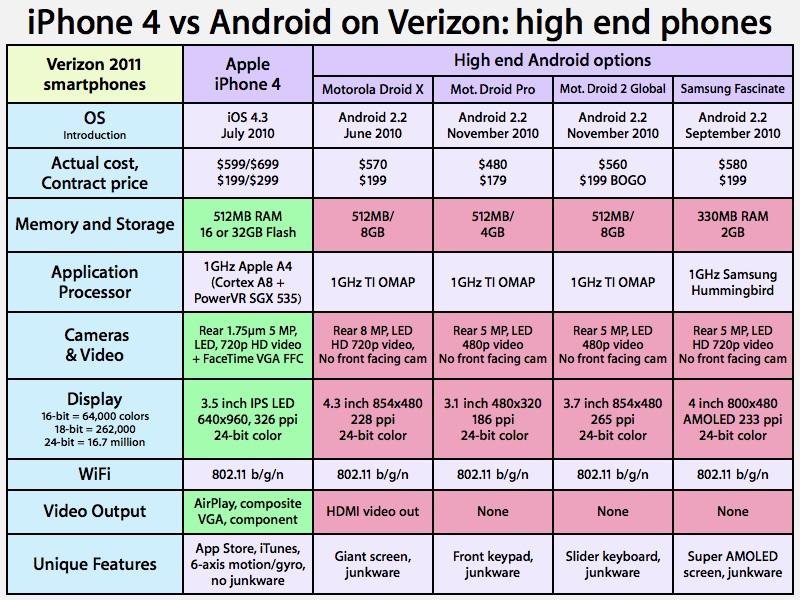
However, even Verizon's best Android models don't match iPhone 4's Retina Display, installed memory, camera features (most notably its front facing FaceTime camera), and video output features. Combined with other elements of the iOS ecosystem (including Apple's far superior iPhone App Store, iTunes and compatibility with iPad), Apple's rapidly rolled out frequent software updates for iOS, all the same features of Verizon's network without the junkware, and a consistent, hardware optimized experience managed by a single vendor, and Verizon now has a very clear and obvious flagship smartphone to promote.
Previous articles have compared aspects of the Android and iOS platforms in greater detail:
 Mike Wuerthele
 Malcolm Owen
 Chip Loder
 William Gallagher
 Christine McKee
 Michael Stroup