Why Apple axed Xserve, and how it can reenter the server market
 Daniel Eran Dilger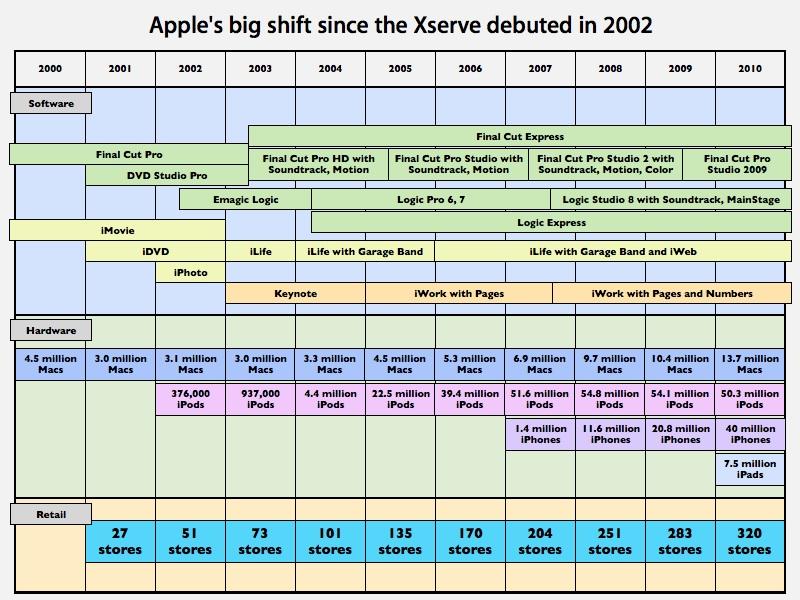
Apple was a very different company when it launched the Xserve in 2002. It had just started to recover from its mid-90s brush with death, only to be hit hard by the bursting of the dotcom bubble in 2001, a shock that aborted the high priced, stylish Power Mac G4 Cube and sent the company scrambling back into its defensive bunker to create products that would reliably sell.
The company had been investing in a variety of potential new revenue engines to keep itself afloat. It had just started a new push in application software with the purchase of Final Cut from Macromedia in 1997, which quickly snowballed into a series of Pro Apps and what would turn into the iLife suite and later help spawn iWorks.
It had also just ventured into a new retail initiative, opening its first two stores in May 2001. Apple also launched the iPod in October 2001 as its first major foray into personal electronics products outside the definition of "computers and peripherals."
At the same time, the company was investing heavily in notebook development, having just launched the new Titanium G4 PowerBook at the beginning of 2001, and was now floating the Xserve its first dedicated server hardware since discontinuing the Apple Workgroup Server in 1998.
At the center of each of these efforts was Apple's combination of existing goodwill and established markets around the Mac, and the NeXT software the company had acquired along with the return of its founder, Steve Jobs. The epicenter of Apple was Mac OS X, a product it still wasn't ready to sell as its mainstream operating system until 2002.
Server ready to go: 1998-2002
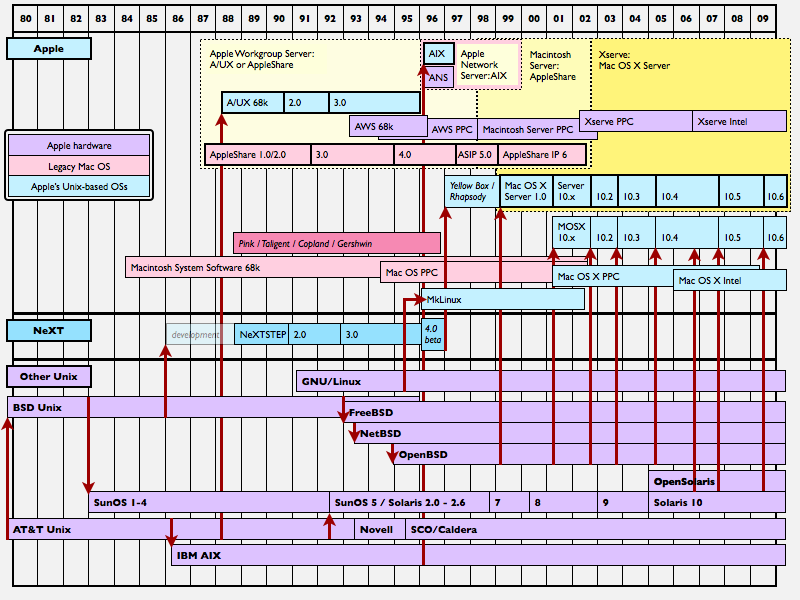
In the meantime, Apple worked to sell consumer hardware running the classic Mac OS 8 and 9. But major Mac developers fought the company over its original plans to migrate from classic Mac APIs to an entirely new development platform based on NeXTSTEP, called YellowBox and then later Cocoa (named to associate it with the existing hype around Java).
That forced Apple to repeatedly delay Mac OS X on the consumer desktop until it could fold in enough compatibility with the old Mac OS to enable existing software to run comfortably. NeXTSTEP also needed to be updated to serve the needs of consumers, as under Jobs' former company it had morphed into a niche role as a higher-end workstation and server solution.
It appeared that the fastest route to market for Mac OS X was to sell it as a server operating system, which Apple had been doing since 1999. By 2002, Apple was ready to release the Xserve as a dedicated hardware product aimed at broadening the installed base of the new operating system as an easy to use distribution of Unix.
Three months after the release of Xserve, Mac OS X for the desktop had finally worked its way from early adopter betas into being a mainstream OS for consumers with the release of Mac OS X 10.2 Jaguar.
Why Xserve hardware?
Apple likely didn't expect to sell that many Xserves, but it didn't need to sell a lot to expand its installed base into strategically important directions. It was currently selling between 750,000 and 810,000 Macs per quarter. Having just announced Mac OS X to be its official, primary OS at the beginning of 2002, the company said it expected to have an installed base of 5 million Mac OS X users by the end of the year.
Having a server product in place to support those new Mac OS X clients was critically important, particularly because Mac OS X was still emerging as a suitable file print services client for Windows-based servers and had some issues with generic Unix file servers as well. Companies running a Windows server infrastructure with Mac OS X and legacy Mac OS clients often found it easier to set up a dedicated Mac OS X Server rather than messing around with Microsoft's archaic "Services for Macintosh" or other third party server software capable of serving file shares in the Mac's native Apple Filing Protocol.
And so, when Xserve appeared it existed as a new product category for the expanding Apple, one that promised a significant new potential for growth, particularly in Apple's core education market. While the costs for developing Xserve were significant, there were few opportunity costs spent on it; the company didn't have anything else offering better sales prospects to spend its money on.
A lot changes at Apple: 2002-2006
From 2002-2006, Apple's consumer Mac sales began to gain traction but were overshadowed by the dramatic explosion of iPod and iTunes. While pundits continued to bet that Microsoft and its Windows Media / PlaysForSure program would at some point steal Apple's iPod business, that never happened. Their parallel, contradictory guess/advice/wishful thinking that the success of iPod would cause Apple to scuttle Mac OS X and begin selling Windows-based Macs was also wrong.
Instead, iPod sales continued to grew exponentially. Thanks to the parallel growth of the new Apple Stores in retailing the hot gadgets, Macs hardware sales also began to grow, leaping from a baseline around 750,000 per quarter to 1.6 million per quarter by the end of 2006.
While Apple continued to develop new Mac OS X Server hardware as a way to broaden the installed base of Mac OS X users, it also began a new project to develop mobile devices running a slimmed down version of Mac OS X.
This time, rather than trying to woo existing Mac developers with a "does it all" platform that supported native Unix apps, legacy Carbon apps, cross platform Java apps, Apple's own Cocoa apps, and supported a variety of third party platforms such as Flash, Apple set out to build a mobile platform with a clean, modern development API built exclusively upon Cocoa.
On page 2 of 3: iOS Explosion, Who was using the Xserve?
When the iPhone was announced, Apple targeted a goal of taking 1% share of the phone market. That sounded like either a modest goal or a presumptuously aggressive one, depending on how much one knew about the mobile market.
More important than achieving some percentage of the overall phone market however, Apple targeted and successfully acquired a strategically significant chunk of the smartphone market; it was the most sophisticated and profitable segment, and the one where most growth was and will be occurring.
Sales of iPhones ramped up dramatically, followed by supporting sales of the iPod touch. Both were in fact Mac OS X devices, even if Apple chose to brand them independently. Apple also chose to count its existing iPod sales separately from iPhone sales, obscuring the fact that iPhone were adding to iPod sales, rather than growing along independently.
Seeking for something negative to report, pundits had fixated on the flat growth of non-iOS iPods, failing to realize that Apple had actually expanded the premium MP3 player market it had essentially invented, adding (in the most recent quarter) over 14 million iPhones and 4.2 million iPads to the flat 9 million iPods it sells in a quarter.
They also seem to have failed to realize that Apple not only ramped up its sales of Macs from 0.8 million computers per quarter in 2002 to 3.89 million Macs in the last quarter, but that it has also added nearly 25 millions new mobile devices that run a version of Mac OS X's Cocoa, albeit disguised as the iOS brand.
Evolving strategy and opportunity costs
Today, Apple's decade-ago investments in notebook design, consumer electronics, direct retail, and software development all seem prescient, and clearly paid off very well. In contrast, the company's efforts in servers haven't done very much at all, largely because Apple's core competencies in managing user experience don't translate well into the business of selling server hardware. Other companies do a much better job of selling server hardware, with service and support options Apple can't (or doesn't care to) match.
Somewhat ironically, Apple differentiated its server products largely by being inexpensive, such as using consumer grade SATA drives rather than more expensive, enterprise-tier SAS drives. The enterprise market is less cost sensitive, so in most cases they preferred better service over cheaper components. That's the complete opposite of what Apple is criticized for in the PC market, where rivals brand Apple as too fancy and too expensive and too focused on personalized service.
In the market the Xserve was attempting to address (rack mounted servers), nobody cares too much about how the equipment looks or how attractive the server software it run is. Most servers in such an environment are managed remotely and collectively rather than being navigated using a standard desktop GUI.
Xserve hardware briefly held a unique advantage in delivering better performance per watt compared to Intel's Pentium 4 servers, but that edge offered by PowerPC CPUs was erased both by Apple's transition to Intel and Intel's own leaps in providing much more performance and efficiency in its high end CPUs.
At this point, the only advantage offered by Xserve hardware is Apple brand affinity, something that is rarely expressed in corporate server closets. At the same time, Apple has made both its Mac OS X desktop clients and its new mobile iOS devices much better at accessing enterprise file, messaging, and VPN services, limiting the need for an Apple-branded server just to sell Macs.
Additionally, Apple is no longer trying to sneak into the enterprise market via the server room; today, it's being welcomed in the front door as a mobile device vendor. Continuing to focus on Xserve development because of a 2002 decision to sell Apple branded servers would be foolish given how much has changed since. Apple can drop the Xserve and continue to sell its Mac OS X Server product on its Mac Pro and Mac mini, meaning very little lost revenue but much lower development costs.
Who was using the Xserve?
It's often been said that Apple was the biggest client of the Xserve. The company doesn't break Xserve sales out of its "desktop" figures, but it's clear the number wasn't very high. This year, slightly more than half of all Mac sales were desktops rather than portables. The majority of those machines were iMacs and to a lesser extent, Mac minis. The Mac Pro is a relatively small market, and the Xserve is even tinier.
Apple does not use mass quantities of Xserves to run its own business; the online Apple Store and iTunes once ran on Apple servers, but the backend of MobileMe is Solaris hardware. There's little benefit in Apple using Mac OS X Server for any of its major online services, let alone unique Xserve hardware. The company's new server operations in North Carolina certainly do not use Xserve hardware.
The SproutCore front-end Apple used to build MobileMe is based upon web standards capable of running on any server platform, and the same goes for Gianduia frameworks used to build Apple Store web apps and the WebObjects app servers used to run iTunes, the App Store, and the online Apple Store. The backend email and messaging servers of MobileMe run Oracle's Solaris and its Java System Messaging Server software.
Outside of Apple, there were some interesting appellations of the Xserve. The company flirted with the hospitality industry in using Macs to serve on demand video to clients in hotel rooms and cruise ship cabins, all powered by racks of Xserves. Replacing these with Mac Pros would be rather difficult. Other users in conventional IT departments also deployed Xserves as an easy way to add Apple's own brand of network services to their existing server infrastructure.
However, while there is enough annoyance with Apple's discontinuation of the Xserve to sponsor a website petition, there does not appear to be enough of a market for Apple to continue to address with its own hardware. Apple does however have the capability to relax its Mac OS X Server licensing to allow partners to install it on third party hardware, which would be a bigger win at lower costs for the company than continuing to develop unique hardware at a loss.
On page 2 of 3: Another App Store, delegating server hardware.
Which leads to what Apple likely may be doing with Mac OS X Server (beyond simply paring it with the Mac Pro and Mac mini): taking a lesson from iOS and creating a Server App Store. By setting up a secure market for server applications, Apple could bring its successful experiment in creating a market for mobile software to the server realm.
Rather than being a break-even operation designed to sell millions of mobile devices, Apple could create a moderate software profit center designed to sell more Mac Pros and minis, and partner with third parties to sell Intel hardware running Mac OS X Server. Such a store would be straightforward to integrate into Apple's Server Admin tool, which is already designed to manage software updates and configure installed server software modules across multiple servers (shown below).
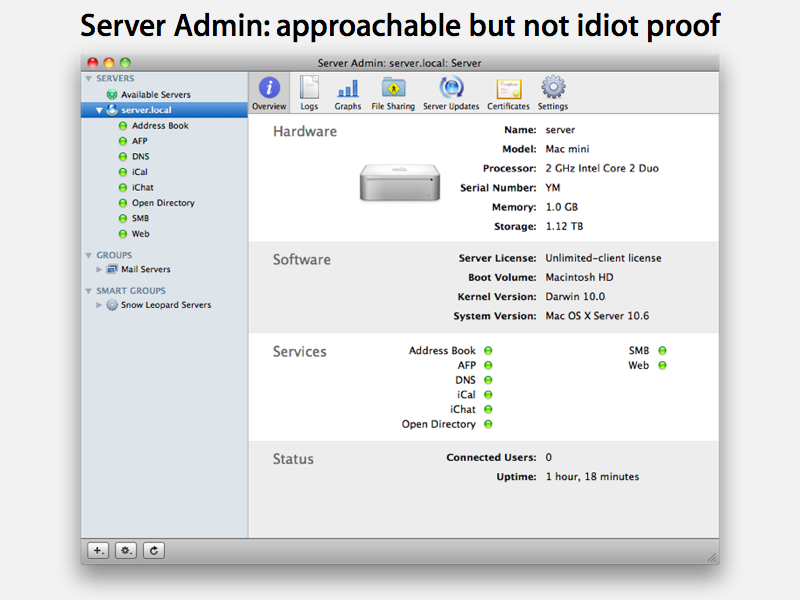
Lots of open source server software already exists, but faces difficult problems related to installation, maintenance and updating for security. By converting this software into easy to manage modules that are easy to buy and install, Apple could revolutionize server software, making it easy and affordable enough for individuals to mange their small office or home business server. It would also be easy to scale software modules for different licensing tiers, offering a low cost entry point and more powerful options targeted at companies that can afford to pay for them.
Rather than bundling all of the company's server related projects into a general purpose Mac OS X Server package, Apple could sell its Wiki Server, Podcast Producer and Xgrid as installable modules that mostly configure themselves. It could sell Final Cut Server as a module. It could sell WebObjects as a module. It could partner with open source projects like Asterisk (which turns a server into a PBX to run an office's phone services) to deliver easy to install and use services on top of Mac OS X Server.
It could allow anyone to build custom packages that offer some server-related function for Mac OS X Server users, ranging from messaging services to video encoders to digital asset management packages to web and database servers. Each could integrate with Apple's existing server management tools, allowing a single unified interface for remote administration of multiple machines. Oracle and IBM are already taking Mac OS X Server seriously enough to deliver products for it, so imagine their level of interest if they could actually address a market with ready-to-buy users.
Delegating server hardware
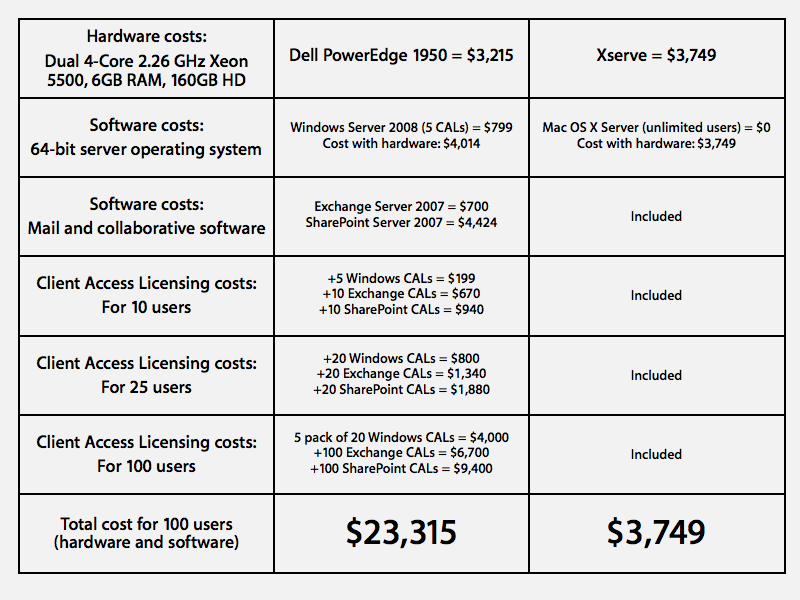
Apple could then license its platform to companies that are good at building servers, including Dell and HP or Oracle, without facing an erosion of its own server hardware sales, because Apple effectively doesn't sell server hardware. The server arena is one area where Apple could broadly license Mac OS X without running into Microsoft's monopoly, because Windows Server is typically sold separately from PC server hardware.
When companies see a $3000 server sold with either a $20,000 Windows Server license bundle, a $500 Mac OS X Server license bundle, or a free DIY Linux option, they'll have competitive options to choose from. Apple would also be able to enter a large new market without having to design and build hardware. Unlike mobile mobile devices and desktop PCs, servers don't have as much need for the deep hardware/software integration that Macs and iOS devices exemplify.
Which is of course, why Apple didn't do well in selling the Xserve. Returning to the market with a software solution would allow Apple to succeed at little incremental cost, recycling much of the investments it has already made in developing the iOS and Mac App Stores. This step isn't entirely unprecedented; when Apple discontinued its Xserve RAID, it delegated its RAID hardware sales to Promise, which filled the void with its similar VTrak E-Class. Apple then continued to sell Xsan as the software to power it.
Similarly pursuing the server market with a software-centric strategy, Apple would earn $500 in software revenues on a third party hardware sale, compared to the minimal profits it currently makes in selling the Mac mini, or in offering the Mac Pro with essentially a free copy of Mac OS X Server installed.



 Malcolm Owen
 Marko Zivkovic
 William Gallagher
 Chip Loder
 Wesley Hilliard