Apple iPhone eats up 50% share of all mobile data traffic globally
 Prince McLean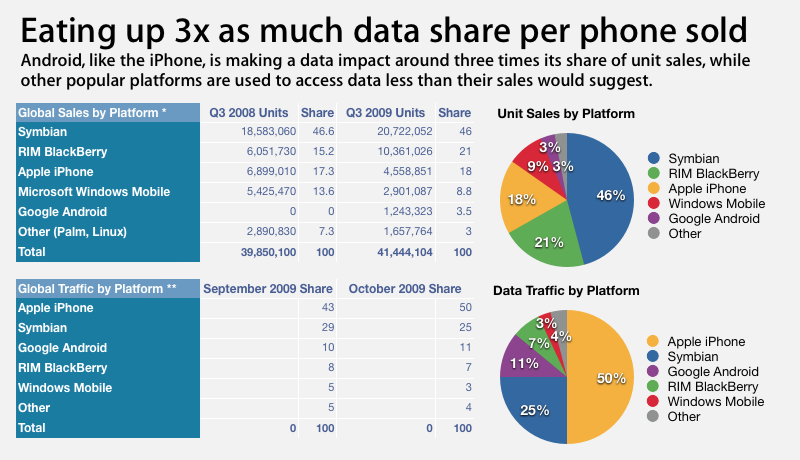
AdMob just released its first monthly mobile ad trends report following its acquisition by Google earlier this month. Despite Apple's lead in rank and growth, the new report now focuses much of its attention on Google's third place Android and RIM's fourth ranking BlackBerry.
The new report also comments on second place Symbian and the fifth place Windows Mobile, without making any detailed comments about the iPhone and iPod touch at all.
Global changes from September
In the worldwide market, AdMob notes that Apple advanced its lead in smartphone traffic share from 43% last month to an even 50%. Symbian slipped from 29% to 25%, while third place Android grew from 10% to 11%. RIM's share fell slightly from 8% to 7%, Windows Mobile dropped from 5% to 3%.
Octobers' worldwide figures for hardware manufactures closely reflected those platform numbers; Apple's hardware numbers as the only iPhone vendor are identical at 50%, while Nokia phones represented nearly all of the Symbian traffic, and HTC accounted for almost all of the Android and Windows Mobile share. RIM and Palm also act as the exclusive providers of their own platforms as well.
This indicates that actual smartphone use is closely tied to the top four hardware vendors and their respective software platforms, erasing the conventional idea that a large number of significant hardware manufacturers are behind licensed platforms such as Symbian, Android, and Windows Mobile.
US and UK markets
The same trend is visible in the US and UK markets. In the US, AdMob reports that Apple advanced by 7.2% from 48% to 55% of all mobile traffic, while Android grew from 17% to 20% (almost entirely from sales of HTC models). RIM slipped slightly from 14% to 12%, while an initial surge of traffic by Palm Pre WebOS users collapsed from 10% to just 5% in October.
The race in the US is between Apple, HTC, RIM and Palm, with incremental advancement for Apple and HTC at the expense of other smaller manufacturers and platforms, which all lost share apart from RIM, which remained stagnant. Symbian does not even register as a blip in the US market.
In the UK, Apple's share grew even larger, advancing from 71% in September to a commanding 74% share in October. Symbian and Android both slipped a percentage point, from 12% and 11% in the previous report to 11% and 10% in October, respectively.
Focus on fractionalization
To keep things interesting, AdMob virtually ignored the iPhone in its October report to examine the model distribution within the BlackBerry and Android platforms. It found that among BlackBerry users, 63% of all traffic was connected to the Curve, Bold and Tour models, which are all conventional BlackBerry devices with full keyboards.
The Pearl, a more compact Nokia-style model aimed at consumers, ate up 16% of the BlackBerry pie, while the Storm, a full screen model aimed at the iPhone, amounted to just 12% of RIM's data traffic.
This indicates that BlackBerry users are, unsurprisingly, flocking to conventional BlackBerry devices and not to RIM's effort to clone the iPhone. RIM itself does not break out its sales between models, so AdMob's statistics are an interesting peek into what devices the company is actually selling and which its users are actually using.
AdMob also similarly detailed the Android platform, which in October was still almost exclusively dominated by HTC phones. Since the Android phones on the market are currently Windows Mobile devices adapted to run the alternative OS, HTC has enjoyed a first mover advantage in being able to deliver the first couple generations of Android phones, starting with the Dream (T-Mobile G1), then the Magic (T-Mobile myTouch), and the third generation Hero (Verizon's Droid Eris).
Motorola recently threw its hat in the ring with the CLIQ and Milestone (Verizon Droid), which was launched in the first week of November. AdMob included a mid-November look at Android traffic, which shows that the Droid captured 24% of all traffic within a couple weeks of being on sale. Whether Motorola will overshadow HTC, cannibalize its sales, or grow alongside it remains to be seen. It's less likely the Android bubble will pop the way WebOS did over the last month, since Verizon is locking its Droid buyers into contracts with steep $350 termination fees.
However, Android software authors will need to consider whether to invest in creating software that targets the unique features of the Droid (including its much higher resolution screen and different operation system version) as opposed to aiming at the much wider HTC market.
AdMob's statistics indicate that the promised "18 Android phones by the end of 2009" probably won't show up as significant shares of the Android platform, but next year promises to add a variety of other flavor differentiation to the Android pie, including Sony Ericsson's XPERIA X10, which has the Droid's screen resolution but which uses the older operating system version of HTC phones.

 Mike Wuerthele
 Malcolm Owen
 Chip Loder
 William Gallagher
 Christine McKee
 Michael Stroup
 William Gallagher and Mike Wuerthele