Canalys Q3 2009: iPhone, RIM taking over smartphone market
 Prince McLean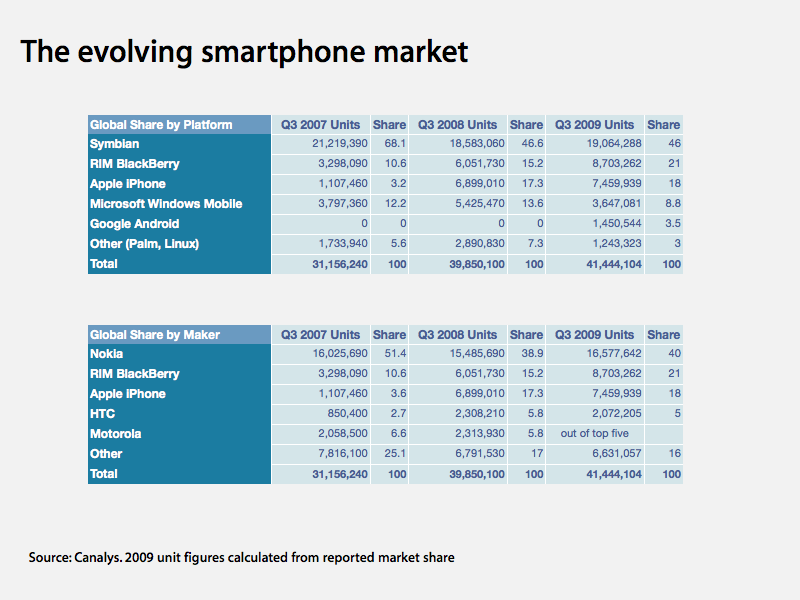
The global smartphone market grew just 4% over the previous year ago quarter, a major slowdown from last year's 27.9% expansion over Q3 2007.
"While growth has undoubtedly slowed, it is still outperforming the overall mobile phone market by some margin, as well as driving data revenue for operators," Canalys analyst Pete Cunningham said in a statement, which also noted that sales mobile phones as a whole actually shrank by 4 to 6%.
Canalys' press release only cited market share percentages for hardware vendors and software platforms, so AppleInsider did the math to chart the changes in smartphones over the last two years. The results were stunning, and contradict conventional pundit wisdom on where the industry is heading.
A reversal on expectations
Nearly all market forecasters have insisted that integrated hardware and software platforms like RIM's BlackBerry and Apple's iPhone can only possibly be temporary successes that will have to make way for licensed software platforms, where one company or open source group develops software and reference designs that a variety of hardware makers can purchase or use for free.
For example, Gartner recently predicted in a widely publicized report that three years from now it expected to see Symbian slipping only a few percentage points to maintain its lead as the most widely used smartphone operating system. This prediction comes despite the fact that Nokia, by far the largest user of Symbian, has already started seeing its share of smartphones drop rapidly, and that the company is earnestly working to invest in alternatives to Symbian, including its Maemo Linux platform.
On the the other end of the scale, Gartner predicted massive 400% growth for Android and 70-80% market share growth for Windows Mobile, while assuming that the iPhone wouldn't grow its market share at all and that RIM would lose half of its share by 2012.
Most other pundits have predicted a similar shift from integrated platforms (Apple's Mac model) to licensed platforms (the Microsoft Windows model), nearly always citing the shift from the fledgling computer market dominated by Apple and similar integrated companies in the 70s to the DOS and Windows PC monoculture that began to flourish in the 80s and 90s.
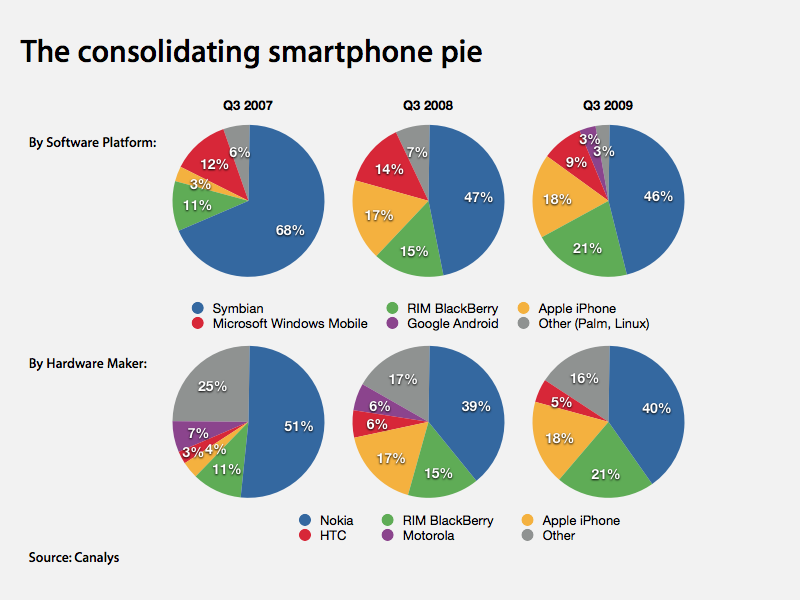
What the last three years' smartphone numbers actually show is a shrinking on the top and the bottom of licensed platforms, with growth coming from integrated platforms in the middle.
The Symbian monoculture is rapidly shrinking, shown in the blue segments. Apple and RIM, depicted in yellow and green in the pie charts, are both expanding dramatically. Meanwhile, the "other" manufacturers and licensed platforms outside of the top three are all shrinking away as well.
A short list of winners
This type of consolidation in the smartphone industry is the opposite of what everyone has been predicting, but is inline with the historical timeline of other consumer product categories. Examples include music players (a market first dominated by Sony's Walkman and then by Apple's iPod, where efforts to introduce PlaysForSure as a licensed platform simply failed) and video games (long dominated by Nintendo and usually only one or two other significant rivals at a time.)
Many attempts to introduce a new integrated platform into a mature market have fallen flat, both in PCs outside of the Macintosh (something discovered by Amiga, Atari, NeXT, BeOS, and others) and in MP3 players (like the Zune) and even smartphones (there does not seem to be much global market potential for the Palm Pre).
Similarly, attempts to duplicate the business model of Windows PCs haven't worked out well in many places, even for Microsoft. Symbian, which has long been the "Windows of smartphones" outside of the US simply because there weren't many viable global competitors, is now abdicating the throne. But of all the alternative licensed platforms hoping to take its place, from the commercial Windows Mobile to free options including Google's Android and various other platforms built on top of Linux, none are making much progress. Outside of the top three platforms (Symbian, RIM, Apple), "everything else" has shrunk from 20% of the market a year ago to just 15% now.
Rather than eating into RIM and Apple's integrated platform sales, Android appears largely to have cannibalized the use of other free Linux minority platforms and taken the lunch away from Microsoft's Windows Mobile.
The largest backers of Android are HTC (which actually lost market share as its former sales growth plateaued over the last year) and Motorola, which is in such bad shape that it has fallen from Canalys's top five and joined the "other" pool without so much as even creating a ripple.
Again, from a manufacturer perspective, outside of the top three makers (Nokia, RIM, Apple), "everything else" has fallen from 28% to 21% in just a year. This makes it essential for rival phone makers to distract from the smartphone market and talk about the vast numbers of low margin simple phones being sold. However, as that larger market continues to shrink, this will become increasingly difficult to do.
 Charles Martin
 Christine McKee
 Malcolm Owen
 Mike Wuerthele
 Chip Loder

64 Comments
Goodbye Microsoft Mobile.
In 2007, the year Apple entered the market, MS had 3 times the market share of Apple in Q3. By 2008 it had fallen behind and now has less than half of the market share of Apple.
It had an opportunity to get back in the market with Zune HD, if it had made it's platform easy to port to mobile devices and included an App Store.
It will be interesting to see how Android gets on.
Phil
Phil
Well it should do well considering the amount of hardware support it will receive. The Symbian figures should be proof of that.
"There's no chance that the iPhone is going to get any significant market share. No chance." Microsoft CEO Steve Ballmer, April 30, 2007 The latest:
http://www.macdailynews.com/index.ph...rldwide_smart/
There is something to be said about a well executed platform with multiple vendors. There is clearly a market for it. But again, it has to be well executed. Motorola badly needs Android to succeed. The bloodletting in the once premier cell phone maker is so apparent by these numbers. My first cell phone was a Moto but it's going to take a tsunami now to pry me away from my iPhone.
Symbian's huge loss of share points between 2007 and 2008 would make any company stand up and take notice. I also expect this is why Nokia is going after Apple in court right now. But there's no excuse for the shape that Windows Mobile is in. Microsoft literally sat on their butts and paid no attention to getting any modern technology out the door to remain competitive. Even worse, Apple gave them a six month head start when the iPhone was announced in Jan. 2007 and here it is, the end of 2009 and their iPhone killer OS still hasn't seen the light of day. Of all of the vendors who had the resources (people, deep pockets, technology) to put out an iPhone killer, it's Microsoft. No wonder their vendor partners (Moto, HTC, Palm) are moving on to Android and WebOS. Completely inexcusable.
Of all of the vendors who had the resources (people, deep pockets, technology) to put out an iPhone killer, it's Microsoft.
You forgot to mention...developers...developers...developers!!