From OLED to Tegra: Five Myths of the Zune HD
 Prince McLean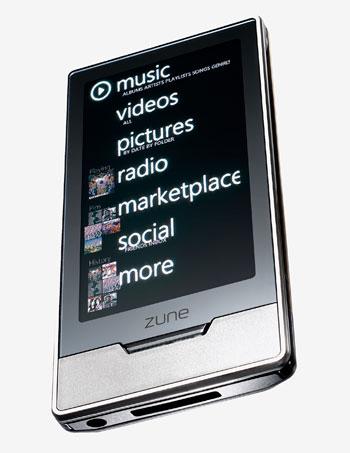
With the Zune HD, Microsoft has dusted off its failed brand and applied it to a new device aimed at the iPod touch. To distinguish it, the company has added several new features. Unfortunately, as was the case with previous models, what Microsoft has added is all sizzle and no steak. Here's why.
Myth 1: OLED is a great display technology for mobile devices
First off, Microsoft gave the Zune HD a new OLED display. OLED is an interesting new technology that uses a layer of electroluminescent organic compounds, rather than the inorganic materials used in traditional LCDs, to produce an image. OLED panels don't require a backlight, so they can render true blacks and provide a higher contrast ratio.
However, today's OLED panels are much dimmer than standard issue LCDs: a typical maximum output of 200cd/m^2 compared to around 4-500 for mid-range LCDs. OLED also performs considerably worse in bright light because OLED is 100% emissive rather than being partially transflective.
A good quality LCD actually uses ambient light to make its image brighter and more vibrant; OLED does not. This means when you take it outside, the OLED's screen is completely washed out by sunlight. Unless you only plan to use your mobile device in your dark basement, you don't want one of today's OLED screens, particularly on a mobile media player that you might expect to use on the go in various environments.
A shot in the dark
Microsoft knows this, which is why it only demonstrates the Zune HD in dark rooms. Engadget filmed a full demonstration, including the device's incapacity to pull up a web page, in a suspiciously dark room without even noting this. There are actually candles visibly flickering in the video behind the device.
Microsoft sets up its demos in the dark because the Zune HD looks terrible outside, where its contrast ratio advantage observed in ideal conditions completely falls apart. Engadget's other pictures of an OLED-using Sony Walkman show that without the candle-lit smoke and mirrors, OLED blacks are not black at all.
There are other problems with OLED. They don't last long, because the electroluminescence layer degrades far more rapidly than regular LCDs. Component colors within OLED also die at different times, with the blue pixels fading first. This results in a rapid shift of the color balance as the device ages. Additionally, the original color reproduction gamut of brand new OLED displays is already worse than standard LCD, resulting in less natural-looking colors from the start that only get worse.
More power to ya
And despite the power savings attributed to OLED's backlight-free design, OLEDs still use more power than LCD displays most of the time because the OLED technology consumes power based on how bright the image it is displaying is. Essentially, OLED is the backlight.
Sony and Microsoft try to compensate by giving their OLED devices a dark, mostly black user interface. Unless you will exclusively be using your Zune HD to watch gothic movies in the dark, the screen will be gobbling up more power than an LCD. This is particularly the case if you want to browse the web, which involves a lot of white space. Showing a white background, OLED consumes as much as 300% of the power of an LCD. Any colors that rely upon those those fragile blue pixels are particularly power inefficient.
And again, because OLED doesn't use any ambient light to brighten its picture, as LCD does, 100% of the image comes from emitted light output, which requires a bigger drain on the battery. For this reason, reviewers of other OLED products have expressed puzzlement about why the supposedly efficient OLED technology didn't translate into better battery life in actual use, as did the Register when looking at a Samsung s8000 Jet:
"Considering it's got an energy-saving OLED screen, we were disappointed with the battery life of the Jet. Perhaps the powerful processor puts some extra drain on the juice, but the promised 180 minutes of talk time and 250 hours' standby translated into a barely a day of moderate use."
If you're wondering why Apple, which sells tens of millions of mobile devices per year and has a component appetite that literally sways RAM markets, didn't beat Microsoft, a company that barely sold a couple million Zunes in two years, to the OLED trough, it's not because Microsoft is on the cutting edge, but because Microsoft is desperately looking for a marketable feature, whether or not that feature makes any sense for consumers.
On page 2 of 3: NVIDIA's Tegra processor inside the Zune HD.
Now that you're no longer in the dark on the oversold OLED, what about the Tegra processor used by the Zune HD: is it really the miracle chip that it is billed to be, both achieving spectacularly unprecedented performance and industry-leading power efficiency? Has Apple's expertise in developing ARM CPUs and in running its own CPU fab plant been outmatched by Microsoft's first foray into mobile devices with a functional web browser?
The Tegra is built by NVIDIA, leaving Zune fans to suggest that it delivers industry leading, desktop-gaming type graphics that far exceed the capabilities of industry-standard mobile graphics. However, Tegra isn't a scaled down version of NVIDIA's PC graphics GPUs. Instead, it's based on technology NVIDIA acquired in its purchase of fabless chip designer PortalPlayer in 2007.
If PortalPlayer sounds familiar, it's because Apple formerly used its system-on-a-chip parts to build MP3 players up through the 5G iPod and the original iPod nano. Apple accounted for 90% of PortalPlayer's business when it dumped the company in 2006, reportedly because the company was arrogantly jerking Apple around. PortalPlayer was devastated and never recovered.
When NVIDIA acquired PortalPlayer for $357 million the next year, Wedbush Morgan Securities analyst Craig Berger observed, "This deal comes as a surprise to us as we believe there are other semiconductor firms that offer more technology for less money," and added that NVIDIA apparently "thinks it has a better chance of penetrating Apple iPod (video) products if it owns and integrates PortalPlayer’s technology."
Apple, PA Semi, and the PowerVR deal
However, NVIDIA didn't ever get back into the iPod market. Instead, Apple began sourcing SoCs from Samsung, bought its own fabless chip developer by acquiring PA Semi for just $278 million, and secured a secret design license for Imagination Technologies' PowerVR SGX graphics cores.
So, while NVIDIA's Tegra grew from the humble origins of the chip powering the video 5G iPod, the iPhone 3GS and the latest iPod touch models feature a mobile-optimized GPU core descending from the Sega DreamCast. While Imagination's PowerVR GPU never made it into the desktop GPU market to rival the technology from ATI and NVIDIA, it has become the gold standard in mobile GPUs.
But the GPU is only half the story. Tegra uses a conventional ARM11 family CPU core (ARMv6), the same generation CPU core used by the original iPhone, the Zune, Nokia N95, and the HTC Hero. The Tegra's CPU/GPU package also uses DDR1 memory, introducing significant real world RAM bandwidth limits no matter how powerful the embedded GPU core is rated to be in theoretical terms.
In contrast, the modern Cortex-A8 used in the iPhone 3GS, Palm Pre, Nokia N900, and Pandora game console represents the latest generation of ARM CPU cores. It also employs a DDR2 memory interface, erasing a serious performance bottleneck hobbling the Zune HD's Tegra. It's difficult to make fair and direct comparisons between different generations of technology, but NVIDIA's own demonstrations of Tegra's ARM11/integrated graphics show it achieving 35 fps in Quake III. The same software running on Pandora's Coretex-A8 with SGX GPU core achieves 40-60 fps.
Tegra's Core Problem
Tegra is also being hyped as providing "8 processing cores," but this is nonsense as it simply counts logical blocks common to all embedded SoC parts as "cores." The CPU in the Tegra is a single ARM11 core. Even if the Tegra did supply multiple CPU cores, the Windows CE kernel used by the Zune HD doesn't support multi-core SMP so it couldn't make any use of them.
Other mobile devices use multiple ARM processors for efficiency or cost savings, such as the original iPods which idled along using two low power ARM processors, or the Nintendo DS, which uses an ARM9 and ARM7 to handle different functions independently. However, there is nothing in the supposed "multiple cores" of the Tegra that offers anything comparable.
NVIDIA promotes Tegra as being "Ultra Low Power," but its standard ARM11 CPU doesn't deliver anything that isn't available in other ARM designs, nor any special power savings over more powerful and modern processors like the Coretex-A8 in the iPhone 3GS and latest iPod touch.
Again, if you're wondering why Microsoft was able to score the NVIDIA Tegra "before" Apple, it wasn't due to any mobile industry clout or hardware experience on Microsoft's end, but rather simply due to the fact that Apple has its own resources for designing and building advanced, state of the art mobile processors, and didn't need to buy into the desperate hype NVIDIA is using to promote the runner up technology of Apple's former SoC vendor.
On page 3 of 3: The HD isn't for high definition
Microsoft is promoting the Zune HD as supplying HD video and HD Radio, purposely conflating the use of "HD" as a meaningless marketing term. There are two issues here, the first being HD video display and output. The Zune HD's OLED screen isn't high definition in the sense of HDTV, of course. The screen itself is only 480x272, which is significantly less than the iPhone/iPod touch at 480x320. (That's 130k vs 153k pixels; the iPod/iPhone displays 18% more pixels).
What Microsoft is promoting is the Zune HD's capacity to output 720p HD video, at least when using its HDMI dock. The iPod touch is limited to 480p (DVD quality video) but can output this without a dock using Apple's Component AV Cable. This is a software limitation, not a hardware limit somehow broken by the Tegra.
If you're buying a mobile device primarily to act as a fixed movie player docked to your HDTV, the Zune HD offers a curious advantage in that regard. On the other hand, if you expect a mobile media player to deliver a mobile experience, the iPod touch delivers both a significantly better screen resolution and a better display technology, unless of course, you're planning to always stay at home in a candle-lit basement.
However, most people looking at the Zune HD won't be thinking of it as Microsoft's smaller, second attempt at delivering the HD-DVD player. They'll be excited about its HD Radio support, perhaps imagining that HD always means "high definition" relative to HDTV.
Myth 4: Zune HD delivers high definition radio
Unfortunately, HD Radio was given an intentionally misleading name. The HD in HD Radio officially doesn't stand for anything anymore, but it was originally for "hybrid digital," because HD Radio is all about replacing or augmenting analog radio with digital transmissions. It offers both an all-digital option as well as a hybrid digital option that enables radio broadcasters to augment their existing analog radio broadcasts with a digital version, something most opt to do so as not to alienate their existing analog radio listeners.
Like the move to digital TV, digital radio offers both the potential for better quality and the capacity to deliver more content within the same bandwidth. Unlike digital TV, the US government hasn't decided to officially transition the nation to all digital radio broadcasts, as it did with TV in order to reclaim large portions of the old analog TV bandwidth for other more productive purposes (such as allowing more competition in mobile and data services).
Analog radio isn't going away, so you won't need any new converter box to tune your old radio into new digital broadcasts. New digital broadcasts will coexist with the old analog radio feeds, because radio wasn't really wasting any huge amount of bandwidth to start with, as TV broadcasts were.
One competing standard for delivering digital radio is HD Radio, which isn't an FCC open standard but rather a proprietary protocol sold by iBiquity. However, HD Radio remains the only digital radio transmission technology approved by the FCC for use in the US.
HD Radio uses a proprietary audio codec called HDC, which like Microsoft's own WMA, is based on but not compatible with MPEG-4 standards. It should be no wonder why Microsoft is jumping on board to promote this proprietary standard. Major corporate broadcasters, including ClearChannel, support HD Radio because it allows them to deliver more content using subchannels squeezed into the existing radio spectrum.
Loopholes in the existing implementation of digital radio also enable big radio broadcasters to subvert existing regulations in order to avoid the controlling-interest caps established to prevent excessive concentration of media ownership, perpetuating the shift away from local radio broadcasts and toward generic piped-in feeds from media conglomerations like ClearChannel.
International reception weak
In contrast with the relatively recent rollout of digital radio in America, the European Union began implementing all-digital radio broadcasts back in 1999. Its existing DAB (digital audio broadcasting) standard is being improved to make use of the modern MPEG-4 HE-AAC, called DAB+. More recently, another broadcast standard has emerged in Europe with an even more misleading and unfortunate name than HD Radio: DRM (Digital Radio Mondiale). Like HD Radio, it maintains backward compatibility with analog radios using a hybrid digital broadcast.
Like HD Radio, Europe's DRM and DAB+ all have their own flaws helping to hold back widespread adoption of digital radio standards, including a lack of compatibility amongst each other. This is all relevant to the Zune HD because it effectively makes its main feature usable only to Americans. That's also why Microsoft is restricting sales to the US; who outside the US would buy a media player with HD Radio features that aren't even available outside of the US, and which isn't compatible with the digital radio standards that are available locally?
Again, if you're wondering why the iPod touch hasn't jumped on the HD Radio bandwagon, it's because it the proprietary new standard isn't in use globally, isn't in high demand, and barely covers 85% of the US from fewer than 2,000 radio stations. Of course, Apple's iPod has never been oriented toward playing over the air radio feeds, but instead is designed to play your own music. Of course if you want to play Internet radio, there's an app for that.
If you're just looking for a regular radio, you don't need to spend $300 for the Zune HD to get one. Portable FM radios are dirt cheap, and even mobile HD Radios are available starting at $50. Microsoft's feature mix aimed at taking on the iPod touch is looking increasingly odd from every angle.
Myth 5: Zune HD games and software will wow you
From the hardware end, the Zune HD applies a lot of hype to drum up interest in its otherwise non-novel technology. But it's the software side where the new device really fails to shine.
Despite being first and foremost a software platform vendor, Microsoft has a schizophrenic history in delivering a mobile software platform. The Windows CE foundation that the Zune HD is built upon is regarded as a joke throughout the industry, even by Microsoft's own developers. Windows Mobile, which delivers an additional layer of software on top of the Windows CE kernel to support PDAs and smartphones, is also scoffed at. Given its dismal performance in the market over the last decade, that reputation is well earned.
The original Zune models promised to someday deliver handheld gaming potential through a beta "community technical preview" of Microsoft's XNA Game Studio 3.0 tools. Instead, Microsoft simply yanked the plug on the effort, abandoning its support for existing Zune devices so it could focus on the Zune HD. This is Microsoft's standard operating procedure in the mobile business. The same thing was also done with nearly each release of Windows Mobile. The newest release of Windows Mobile 6.5 won't even work on lots expensive hardware sold in the last year.
Curiously, Apple has been painted by some pundits as being "developer-hostile" over a handful of application approval disputes that have occurred over the past year, despite maintaing a solid, profitable mobile platform that works across all iPhone and iPod touch models ever built. Imagine if Apple just kept churning out new models of iPhone, each running firmware incompatible with its existing hardware and developer's third party apps.
Microsoft's own software for Windows Mobile and the Zune HD is similarly bad. Its mobile version of Internet Explorer still doesn't work despite having been on the market since 1996. What's "new" in the release of the Zune HD is a different version of the mobile IE browser, based not upon the creaky IE 4 engine from 1997 (still delivered in today's Windows Mobile devices), but a mobile version of IE 6, which dates back to 2001. That leaves the Zune HD's browser nearly a decade behind the modern WebKit browsers used in the iPhone, Palm Pre, Android, and modern BlackBerry phones.
If Microsoft is doing that poorly in games and web browsers, what can one expect from the Zune software store, from media integration, and from the third party developers Microsoft has abandoned along with its past Zune initiatives? Are they going to come flooding back to welcome the few enthusiasts who keep returning to buy obsolete-at-arrival Zune hardware?
Despite the hype, the Zune HD appears to have failed before even hitting the market.


 Mike Wuerthele
 Malcolm Owen
 Chip Loder
 William Gallagher
 Christine McKee
 Michael Stroup


581 Comments
Thanks for the thorough post ! great read, enlightening.
The lady doth protest too much, methinks.
so either it is a lot of baloney on the part of msft or apple fanboys are crying sour grapes!
Lets see how zune evolves.
[Disclaimer: The current iPod Touch revision (if any) has upset many, including me!]
I don't get the big deal about specs. If the platform delivers a compelling user experience then that is the selling point, not how many goo goo flops and mega wits it has. Apple's been getting away with hardware inferiority for years using the same technique. Yet today. for some reason, that does not apply to Zune?
To that end, the OLED news is disappointing - I had an OLED screen on a Moto flip phone a long time ago and it seemed bright enough. I wonder what gives today?
Microsoft sets up its demos in the dark because the Zune HD looks terrible outside, where its contrast ratio advantage observed in ideal conditions completely falls apart. Engadget's other pictures of an OLED-using Sony Walkman show that without the candle-lit smoke and mirrors, OLED blacks are not black at all.
The link off this paragraph points at a gallery of pictures. It also assumes that all OLEDs are the same. We know that Apple for instance can put inferior LCDs on their screens. They hardly point to the quality of LCD overall. How are we supposed to make a judgment on the blackness of blacks using a photo of the display? One: your looking at the image on your Computer Monitor, which probably doesn't do true black. Two: You have no idea how the photo has been enhanced or calibrated for publishing. Three: You have no idea under what circumstances the photo has been taken.
Additionally, the fact that OLEDs degrade faster than LCDs is a moot point given the half life of one particular OLED panel is about 17,0000 hours.. The device would have been replaced some time before then. Don't also forget that the interpretation of brightness is a not a linear one.
I think the assertion made about OLED is making a bit of a stretch. Perhaps it should be four myths.
I think its pretty clear that this missive has not been based on any real world use or observation on the part of the reviewer.
Simple proof. anybody who buys a zuneHD, take it out in daylight (not direct sunlight) and see how the screen looks, and post the results. If it stinks, game over, regardless of the processor speed and rez.