Apple approves Commodore 64 emulator for iPhone
 Prince McLean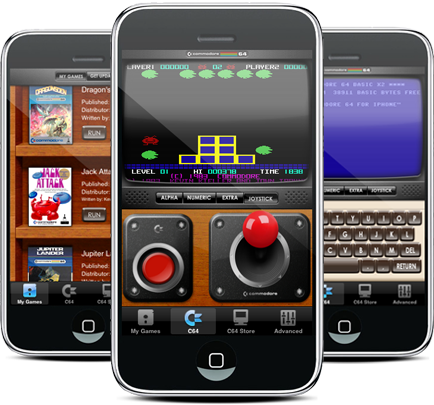
According to a report by TouchArcade, Manomio's $4.99
The sticking point for Apple appeared to have be the inclusion of the Commodore BASIC 2.0 interpreter, which would enable the app to execute arbitrary code. The iPhone 2.0 SDK specifically limited apps from containing their own executable runtimes in a clause that stated:
"An Application may not itself install or launch other executable code by any means, including without limitation through the use of a plug-in architecture, calling other frameworks, other APIs or otherwise. No interpreted code may be downloaded and used in an Application except for code that is interpreted and run by Apple’s Published APIs and built-in interpreter(s)."
That element of the SDK baring the launch of other executable code brought the approval of any type of emulator into question, as the sole purpose of an emulator is to act as another platform in order to run programs designed for it.
Emulators vs. the SDK
The main point of Apple's SDK restriction appears to be the company's desire to prevent its own Cocoa Touch platform from being sidelined by a third party developer's sub-platform, such as Java, Adobe Flash, or Microsoft Silverlight. If developers want to ship apps for Apple's iPhone, they have to use Apple's APIs.
There are also security implications involved. Most of the highly publicized vulnerabilities that are counted against Mac OS X's security are actually flaws in the third-party runtimes it bundles, particularly Java and Flash. At WWDC, Apple cited 'web plugins' as the primary reason for crashes under Leopard, clearly fingering Flash. Any capacity to run code is a potential vector for malware or a vulnerability exploit.
Additionally, the ability to run external titles would not only allow developers to subvert the App Store approvals process, but could also open up the iPhone to widespread piracy, a problem that would not only undermine the success of the App Store itself but also expose Apple to copyright infringement claims from intellectual property holders in the same way Napster was sued for making the distribution of pirated media available.
In App Purchase
Apple addressed the friction between emulator titles and sub-platform limitations in iPhone 3.0 via in app purchasing, a new feature in iPhone 3.0. This enables developers to package additional elements to enhance their apps and sell them separately.
In Manomio's case, its C64 package includes the emulator and five game titles: Dragon's Den, Le Mans, Jupiter Lander, Arctic Shipwreck, and Jack Attack. Additional games are expected to be released as in app purchases as they become available. The app will not load arbitrary game code downloads nor expose a BASIC interpreter.
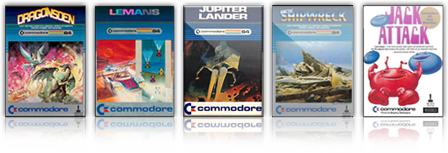
The booting emulator screen displays a screen that says "BASIC is disabled in this version. Don't despear[sic]! It should be resolved in a future update." Whether the company meant "despair" or "disappear," other developers will be closely watching to see how Apple interprets its SDK in allowing its state of the art smartphone platform to act as an emulator for previous generations of titles.
Return of the Commodore 64
Somewhat ironically the Commodore 64, which debuted in 1982, wildly outsold Apple's own offering at the time: the Apple IIe, which at $1200 cost twice as much. Commodore brought its computer to the public using toy and department stores at a time when Apple and IBM were wedded to networks of authorized dealers. A significant part of Apple's recent success comes from its direct retail initiatives.
Commodore also helped pioneer the concept of bundling in ports for a ready-to use system as opposed to the existing Apple II line, which presented the user with eight expansion slots but only a few built-in ports. While Apple's expansion potential was touted as a feature, few owners really needed it.
This may have influenced Steve Jobs' view of the personal computer, as all subsequent computers from Apple, including the Macintosh, moved away from the open-ended PC design toward a ready-to-use system aimed at the mass market. Jobs' return to Apple in the mid 90s refocused the company on the new iMac and moved away from the PC-like "Power Express" boxes with lots of slots that were then on the ailing company's drawing board.
Today, Apple's notebook line has virtually no expansion options, particularly with the replacement of the seldom used ExpressCard slot with an SD card reader on mainstream models. The consumer-oriented iMac and Mac mini also continue to offer no general purpose expansion slots, although most modern peripherals have standardized on specifications such as USB or FireWire, greatly reducing the need for general purpose expansion slots.
As for the iPhone and iPod touch, Apple doesn't include either a user-replaceable battery or a RAM slot, leaving the mobile devices tied, much like the Commodore 64, to a single interface for games and apps. For the C64, that was its difficult-to-pirate cartridge slot; for the iPhone, it's the digital rights management of iTunes. Which now offers the ability to act as a C64.





 William Gallagher
 Andrew Orr
 Sponsored Content
 Malcolm Owen

 Mike Wuerthele