More importantly, Apple is providing its users with additional options that benefit both Mac users and the open source community. Here's how, the fourth in this series looking closer at some of Snow Leopard's well-known, but often misrepresented or misunderstood features.
(This article was updated to clarify details in how Apple implements support for Microsoft's changing roadmap of Exchange Server client APIs.)
Introducing Snow Leopard's Exchange clients
Integrated support for Exchange beginning with last year's iPhone 2.0 means Apple's mobile platform simply doesn't need an Outlook client. Now Snow Leopard can also get by without Entourage/Outlook, thanks to new and improved baked-in support for Exchange in Mail, Address Book and iCal.
Microsoft has responded with the announcement that it will now be delivering a real (but still scaled back) version of Outlook for the Mac again, after a decade of giving enterprise Mac users a third rate alternative in Entourage, but Microsoft's efforts to win back Mac clients may come too late to prevent the significant erosion of one of the primary reasons companies have to pay for Office on the Mac.
With iWork and the built in Exchange client support in Snow Leopard, many users will have no need to even consider Microsoft's Mac client offerings. It will be very difficult for Microsoft to convince Mac users that they need Office after those users discover suitable alternatives that cost significantly less.
Why the client is so important
With Snow Leopard and the iPhone each now providing their own client layer for accessing Exchange Server, Apple can now offer its users alternative access to other server products as well, from its own MobileMe and Snow Leopard Server offerings to web services from Google and Yahoo. This effectively turns Microsoft from a direct seller into a wholesaler that has to deal with Apple as a middleman retailer.
Ten years ago, Apple was in that position with its hardware sales. It tried hard to get Sears, CompUSA and other retailers to sell Macs for it, but those retailers also sold generic PCs. Because they made more money selling generic PCs, they had little incentive to aggressively market Macs. Apple's retail stores eventually solved this issue by allowing the company to reach users directly.
In the software business, Microsoft has long known the importance of owning the client end. It worked hard to displace Netscape's web browser in the late 90s, not because there was any money to be made in giving away browser clients, but because it knew that whoever controlled the client could set up proprietary demands for a specific web server. That's what Netscape had worked to do as it gave away its web browser in hopes that it could make money selling Netscape web servers; Microsoft first took control of the client with Internet Explorer and then began tying its IE client to its own IIS on the server side with features that gave companies reasons to buy all of their server software from Microsoft.
As Apple takes over the client end of Exchange, it similarly gains market leverage. First and foremost, the move allows Apple to improve the Exchange experience of Mac users so that business users have no reason not to buy Macs. Secondly, it gives Apple a client audience to market its own server solutions, including MobileMe to individual users and Snow Leopard Server to organizations. In concert with providing Exchange Server support, Apple is also delivering integrated support for its own Exchange alternatives in both MobileMe and with Snow Leopard Server's improved Dovecot email services, Address Book Server, iCal Server, the new Mobile Access secure gateway, and its included Push Notification Server.
Two Birds, One Stone
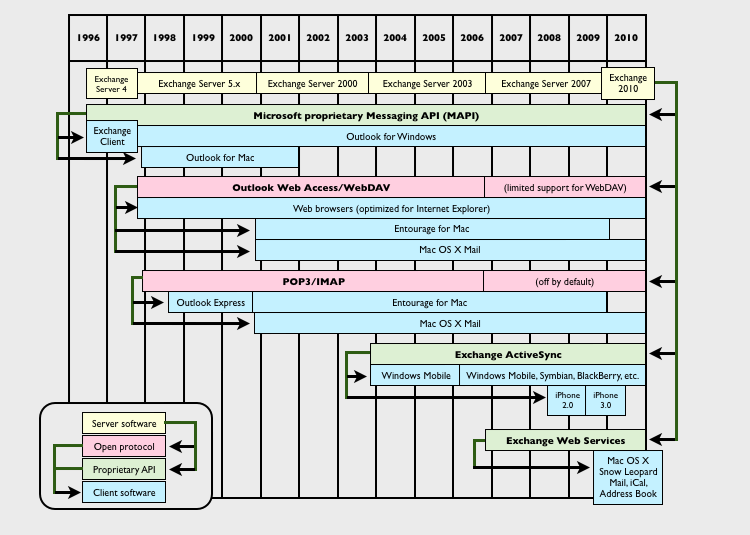
Apple's support for Exchange and its promotion of its own Exchange alternatives are two sides of the same coin, in the sense that they use the same technologies. Apple built its original support for Exchange using WebDAV, the open specification that Microsoft supports on Exchange Server as a way to deliver messages to mobile clients.
However, Microsoft has since moved away from supporting the open WebDAV specification, and now advocates the use of its own proprietary Exchange Web Services protocol using SOAP and XML to accomplish things that aren't possible using WebDAV alone.
In contrast, Apple's strategy for providing messaging services in Mac OS X Server has been to work with the open community in extending WebDAV. This began with CalDAV, a calendaring extension to WebDAV implemented in Leopard Server's iCal Server, and continues with CardDAV, a similarly open contact sharing extension for WebDAV.
In order to keep up with Microsoft's changing client strategy, Apple has pursued multiple efforts to deliver Exchange support for its clients. For the iPhone, Apple licensed the rights to implement a compatible Exchange Active Sync conduit with Exchange; it did not license any Exchange Active Sync software from Microsoft. Apple owns both the iPhone and Snow Leopard software that talks to Exchange.
The client applications Apple has upgraded in Snow Leopard to connect to Exchange, including Mail, Address Book, and iCal, use WebDAV to talk to Apple's own Snow Leopard Server applications. Because Microsoft only supports its new Exchange Web Services API under Exchange 2007, Snow Leopard's new Exchange support requires a modern version of Exchange. The iPhone's EAS works with older versions, including Exchange 2003.
Because Apple makes its money almost exclusively from selling hardware, it has opened up its own Snow Leopard Server applications, Address Book Server and iCal Server, as open source Darwin servers that can be compiled to run on Linux. That means Apple is essentially giving away both the client (to Mac users) and the servers (to the community) in order to encourage the use of open standards in messaging and collaboration. That giveaway is being done to help Apple sell Macs.
This effort to support everything from integrated client software owned by Apple makes Snow Leopard's support for Exchange of use to everyone, even if they don't use Exchange. The client work Apple has invested in making Macs Exchange-friendly also improves the features available via MobileMe, Snow Leopard Server, and even some other third party services such as those from Google and Yahoo.
Apple's App Store software model
If this seems like a familiar strategy, it's because Apple is doing something similar on the iPhone: creating a managed market for third party developers, as long as they support Apple's business as well. Apple's iPhone App Store goal is to support and assist small developers in producing high quality, good looking apps that are sold at low prices in high volume. This "managed market" strategy has worked much better than the "laissez faire" conventional third party Mac platform that developed on its own starting in the 80s, where developers set prices relatively high, piracy abounded, quality was unchecked, and the only force keeping software consistent and looking good was the taste of Mac software buyers.
Microsoft did a better job of supporting developers on its DOS and Windows platforms, but also required less of its developers, resulting in a mixed bag of third party PC software that is usually expensive, often buggy and hobbled with old legacy issues, and almost always inconsistent and inelegant. The Linux community, along with Google's new Android mobile platform, offer even less in terms of minimum standards and quality control, resulting in software that is often free but usually unfinished and typically inaccessible to anyone outside of dedicated tinkerers and hobbyists. While examples of fine open source client software exists, there is no available market driving this kind of development financially.
The success of the iPhone App Store has benefited both developers and users by establishing a competitive market based on meritocracy. Snow Leopard's support for Exchange, because it opens up equal access to alternative competition, similarly creates an iPhone-like market for desktop messaging services ranked by merit, not the vendor's current market position. This will provide Snow Leopard users with not just the ability to talk to corporate Exchange Servers, but also the ability to access Apple's own offerings and other third party services.
The next segment in this series looks at fifth feature of Snow Leopard that has often been misrepresented: its new malware protection and related security features.
Inside Mac OS X Snow Leopard: QuickTime X
Inside Mac OS X Snow Leopard: 64-bits
Inside Mac OS X Snow Leopard: GPU Optimization
Inside Mac OS X Snow Leopard: Malware Protection

Daniel Eran Dilger is the author of "Snow Leopard Server (Developer Reference)," a new book from Wiley available now for pre-order at a special price from Amazon.