A closer look at iPhone 3G S Cortex-A8 ARM and PowerVR chips
 Prince McLean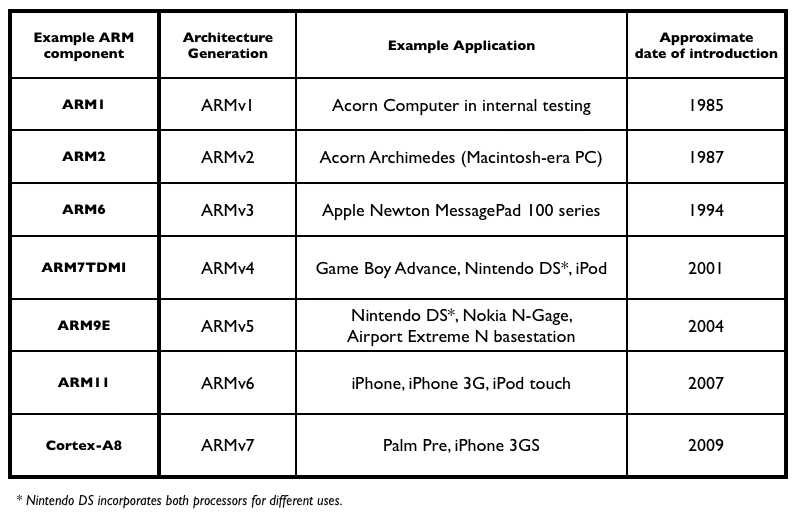
The use of the Cortex-A8 core has been cited by multiple sources, including an analysis by AnandTech. This makes the new iPhone 3G S very similar in terms of processor design to the Palm Pre, although Palm's phone uses a device built by Texas Instruments.
ARM Processors
The Cortex-A8 is a seventh generation CPU core design licensed by ARM to a variety of manufacturers. The vast majority of all smartphones, handheld games and other mobile devices use ARM processors.
The Cortex-A8 class is referred to in general terms as ARMv7, not to be confused with ARM7, which was actually a third generation ARMv3 used in the Apple eMate300 a decade ago. Previous generations of iPhone and iPod touch used an ARM11 processor, part of the ARMv6 generation.
Apple partnered with its British equivalent Acorn in the late 80s to adapt Acorn's RISC processor for use in mobile devices, forming the ARM partnership. Apple subsequently used a third generation ARM6 in its first Newton MessagePad in the early 90s.
By the time the company discontinued its Newton and eMate devices in 1998, ARM processors had become the most popular mobile processors available, in part due to ARM's licensing of its highly efficient technology to a variety of chip manufacturers. Steve Jobs sold batches of Apple's shares in the ARM partnership at a huge profit to help keep the company afloat.
When the company introduced the iPod in 2001, it used a fourth generation ARM7TDMI processor. The latest generations of the AirPort Extreme also use an embedded ARM processor.
S is for speed
The Cortex-A8 in the iPhone 3G S sports "a two-issue in-order core, capable of fetching, decoding and executing two RISC instructions in parallel," according to AnandTech's report, which also notes, "the ARM11 processor in the iPhone/iPhone 3G has a basic vector floating point unit, but the A8 adds a much more advanced SIMD engine called NEON. The A8 also has twice as many double precision FP registers as the ARM11."
"The combination of higher clock speeds, more cache and a dual-issue front end results in a much faster processor," the report states. "Apple claims the real world performance of the iPhone 3GS can be up to 2x faster than the iPhone 3G, and I believe that’s quite feasible."
The report states that if the processor is running at 600MHz, it would draw three times the power of existing iPhone processors, but notes that in typical use, the device spends a lot of time in standby. Separately, Apple has detailed technologies for maximizing the performance of a processor by running it at less than its top rated clock speed while scheduling tasks more efficiently. This was done with the original iPhone.
As a result of new efficiency measures, Apple claims significantly longer battery life over the current iPhone 3G when using the iPhone 3G S for general processing tasks despite the big leap in performance and the extra power consumed.
Apple has increased the maximum rated battery life of the iPhone 3G S in WiFi internet browsing from 6 hours to 9 hours, video playback from 7 to 8 hours, and audio playback from 24 to 30 hours. Ratings for 3G browsing and talk time are unchanged, as the baseband processor that handles the intensive work of communicating with 3G data networks is independent from the general purpose ARM processor. Apple has bumped up rated 2G GSM talk time from 10 hours to 12.
SGX is for graphics
Just as ARM processor cores are the most widely used in mobile devices, Imagination Technology's PowerVR graphics cores are also extremely popular in embedded appliations, commonly appearing as integrated together with an ARM processor on System on a Chip (SoC) devices.
PowerVR started out in the late 90s as a rival to 3dfx in the desktop PC graphics processor market, with both makers also vying for inclusion into the Sega Dreamcast video console in 1998. However, by 2001 the company's third generation PowerVR began falling behind rival products from ATI and NVIDIA.
Imagination subsequently withdrew from the desktop market to focus on embedded graphics components with its highly efficient PowerVR MBX technology, which, like ARM, the company has widely licensed to a variety of device makers, including Apple.
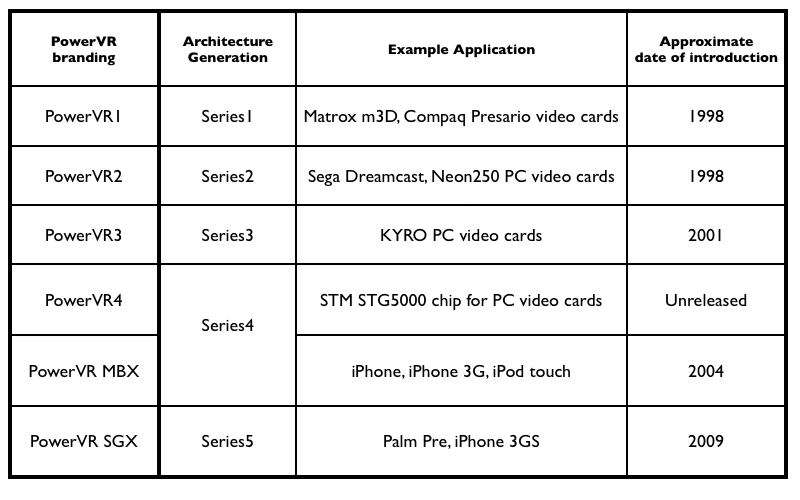
The latest technology generation is branded PowerVR SGX. Anandtech reports that the new graphics architecture improves over MBX in part in that "pixel, vertex and geometry instructions are executed by a programmable shader engine, which Imagination calls its Universal Scalable Shader Engine (USSE)."
The report also states that Imagination's new SGX graphics cores range "from the PowerVR SGX 520 which only has one USSE pipe to the high end SGX 543MP16 which has 64 USSE2 pipes (4 USSE2 pipes per core x 16 cores). The iPhone 3GS, I believe, uses the 520 - the lowest end of the new product offering." It has not yet been confirmed what version of the SGX design the new iPhone 3G S uses.
However, the report noted that "in its lowest end configuration with only one USSE pipe running at 200MHz, the SGX can push through 7M triangles per second and render 250M pixels per second. That’s 7x the geometry throughput of the iPhone 3G and 2.5x the fill rate. Even if the SGX ran at half that speed, we’d still be at 3.5x the geometry performance of the iPhone 3G and a 25% increase in fill rate. Given the 65nm manufacturing process, I’d expect higher clock speeds than what was possible on the MBX-Lite. Also note that these fill rates take into account the efficiency of the SGX’s tile based rendering engine."
Apple's video introduction of the new phone indicates significantly faster launching of and switching between applications and speedier browser rendering and other operations. Overall the company indicates up to a 2x performance improvement.




 William Gallagher
 Malcolm Owen
 Amber Neely

 Marko Zivkovic
 Andrew Orr