Apple filing details safe touch-screen navigation system
 Sam Oliver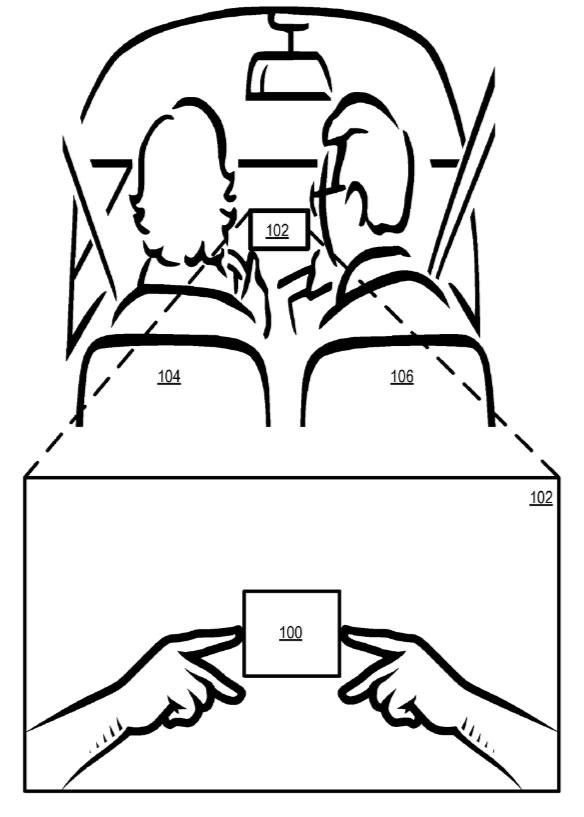
The 11-page filing starts off by noting that the use of a conventional navigation system in a moving vehicle often raises safety concerns, particularly if the driver of the vehicle is attempting to operate the navigation system while simultaneously operating the vehicle.
"Many navigation systems use knobs and pushbuttons for entering destination and other information for use in determining driving directions," Apple says. "The accurate use of such input devices may force the driver to take her eyes off the road, resulting in a potentially hazardous condition."
The company goes on to explain that conventional solutions to this safety problem detect when the navigation system is being operated while the vehicle is moving and display a warning message notifying the user that operating the navigation system while the vehicle is moving is dangerous.
"Some conventional solutions may request that the user acknowledge the warning by pressing a pushbutton, for example. Once acknowledged, the navigation system typically becomes operable to the driver," the filing says. "Also, there are few safety concerns with a passenger in the vehicle operating the navigation system while the vehicle is moving. For passengers, the warnings may be unnecessary or irritating, and locking down the operation of the navigation system would prevent the passenger from operating the navigation system regardless of whether it was safe to do so."
Apple's solution to the problem calls for a smarter touchscreen-based navigation system that may be either a self-mounted handheld device like an iPhone or one that's hardwired into the car. Either could tie into various forms of sensors and I/O devices such as a speaker and a microphone to facilitate voice-enabled functionalities, such as navigation, stereo, and phone functions. A loud speaker could also be included to facilitate hands-free voice command functionalities, such as voice activated entry for requesting driving directions.
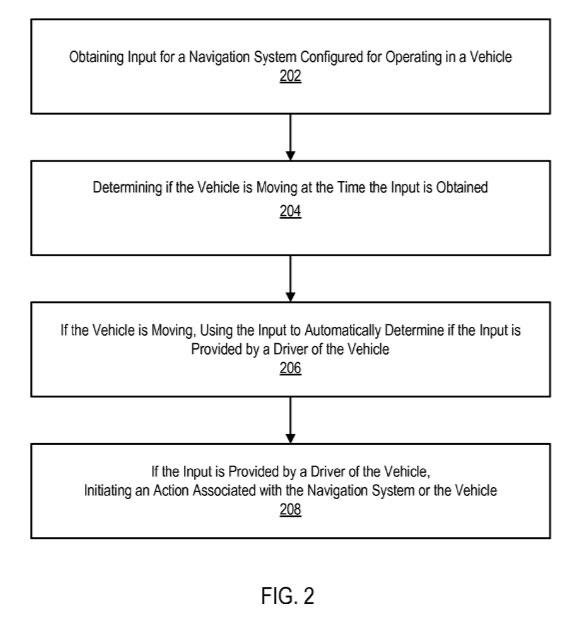
However, the heart of the filing is focused on assuring that drivers don't distract themselves while driving by fidgeting with the touch-screen. It details numerous methods of locking down the system while a vehicle is in motion, or, alternatively, authorizing only the front seat passenger to control the system.
For instance, the navigation system could determine if the vehicle is moving at the time of input or whether the vehicle is in gear or in park. The system could also be communicatively coupled (wired or wirelessly) to particular sensors in the vehicle, such as tire sensors, engine sensors, steering sensors, or GPS sensors. If the vehicle is determined to be in motion, the navigation system would enter into a lockdown mode where touch-based input would be disallowed, assuming a passenger is not present.
Simultaneously, however, other sensors could be at work to determine whether a passenger is also present in the moving vehicle, such as seat belt sensors, infrared sensor (to detect body head), proximity sensors or seat sensors (to detect the presence of a payload). If any of these sensors indicate a passenger may be present, the system could further scrutinized the situation by attempting to determine the angle of any ensuing touch input provided on the touch-sensitive display (e.g., angle of the user's finger at the touch point relative to a predefined reference frame). In these cases, a passenger may be able to operate the navigation system while the driver maintains focus on the road.
"The angle detection can provide the navigation device with the functionality to determine whether a driver or passenger is operating the navigation system," Apple says. "As such, the combination of any or all of a seat sensor, seat belt sensor, angle detection, or other sensors can determine which user provided input to system."
The Cupertino-based company goes on to explain that in some implementations, a biometric sensor can be included in navigation system to determine intrinsic physical traits of a user:
For example, the biometric sensor may be a fingerprint sensor, voice recognition sensor, iris recognition, or other sensor used to recognize a user identity. The recognizing factors can be stored in navigation device where the factors can be used to configure usability information for users of system. For example, a fingerprint can be stored for a vehicle owner which can be configured to enable use of navigation system at all times without limitation. At some point, the vehicle owner may store biometric information about other drivers in the family and place restrictions on the users. The restrictions can include operating navigation system functions related to entering new destinations, for example, when the restricted user is a passenger, but not a driver. As such, the restricted user may input data into the navigation system in the passenger seat, but may not input extensive data into the system 102 when in the driver's seat. Thus, the restrictions may protect the safety of the driver and the passenger by restricting any operation that may avert the driver's attention away from the road.
Control of the navigation system by drivers could also be determined by preference settings that could in some cases override the safety measures:
In some implementations, an override can be pre-configured for one or more drivers. For example, a more experienced driver may configure the system 102 to allow one or more drivers to interact with the navigation system 102 while the vehicle is in motion. Similarly, the configuration can preclude inexperienced drivers from providing input to the navigation system while the vehicle is in motion. The configuration can include identification of the driver using biometric sensors (e.g., fingerprint, digital camera recognition, hand geometry, voice recognition, etc.), mobile phone identifier (e.g., Bluetooth.TM., service provider, etc.). In some implementations, the navigation system 102 can use biometric input to determine whether a driver can legally operate the navigation system 102 and/or vehicle. For example, upon receiving a fingerprint input, the system 102 can search the department of motor vehicles for validation on the user's driving record or license and adjust the available navigation system functionality accordingly.
Oddly, the patent filing at times veers off course with abrupt mentions of locking out "functions such as text messaging, mobile device, browsing, and such, based on biometrics, vehicle movement, proximity, and the like." It also randomly notes that "a digital camera can be included on navigation device to capture snapshots of maps, points of interest, directions, and the like. In one example, if the navigation device is removable, the digital camera can perform standard camera functions, such as recording photographs and video clips."
More relevant side notes mention the inclusion of one or more wireless communication subsystems, such as an 802.11b/g, Bluetooth, CDMA, GSM and EDGE. Apple says these subsystems could allow the navigation system to pair with an iPhone and receive driving itinerary that may have been prepared on the handset before entering the vehicle.

 Mike Wuerthele
 Malcolm Owen
 Chip Loder
 William Gallagher
 Christine McKee
 Michael Stroup
 William Gallagher and Mike Wuerthele