Store wars
Global Intelligence Alliance Group (GIA) ranked Apple's software sales through iTunes in comparison with Google's existing Android Marketplace, as well as several other competing stores for other platforms now being set up for deployment later this year, including Nokia's Ovi Apps Store for Symbian, RIM's BlackBerry Apps Storefront, Microsoft SkyMarket for Windows Mobile, and Palm's webOS Software Store for its upcoming Pre smartphone.
A variety of software stores operated by third parties were not included in the rankings. Microsoft formerly recommended Handango to its Windows Mobile developers; that site also offers mobile software for PalmOS, Symbian, and BlackBerry devices and announced plans last fall to sell software for Android. Another example is PocketGear. As platform vendors seek to implement their own stores, they will also compete with their former partners, much like Microsoft's Zune ate up the business of the company's PlaysForSure MP3 player and music store partners.
The study also excluded mobile providers that also operate their own software stores, including Verizon Wireless' Media Center (formerly called "Get It Now"), which sells and rents BREW applets for many phones the company sells. Verizon limits many of its phones from being able to load apps apart from those sold by the company itself, another potential conflict for platform vendors hoping to duplicate Apple's App Store success. Apple negotiated with AT&T to run its own software store itself, exclusively. Few other platform vendors have similar clout to demand the same thing.
Rankings by time to market
GIA's report ranked Apple and Google as both "strong" in terms of time to market, as both companies are already operating their software stores. Apple has been selling software since July 2008, and now has a catalog of over 15,000 new apps and user downloads that have surpassed a half billion. Apple has sold 17 million iPhones through the end of last year; most iPhone apps also run on the company's iPod touch.
Google began selling Android software in the middle of last month, after several months of free software distribution. There are currently nine paid apps and 132 free apps listed in Android Market. There is also currently only one Android phone model, the T-Mobile G1, which Morgan Stanley estimated to have sold 300,000 units through the end of last year. Additional phones are due for release from a variety of vendors this year, and Google also hopes to introduce other devices based on the Android platform.
RIM and Nokia's software store efforts were rated as "medium" in time to market, with RIM planning to open its BlackBerry software store later this month and Nokia aiming at a launch date of in May. Microsoft and Palm's efforts were rated "weak." Their stores are expected to open towards the end of the year.
Ability to attract development
Apple, Android, RIM, and Nokia were all rated by GIA as "strong" in their ability to attract developers to their platform, while Microsoft and Palm's webOS plans were ranked as "medium." The report cited "clarity and transparency of software developer kits, approval processes, ease of programming language, reimbursement share and overall control/censorship" as factors that would influence what platforms developers decide to support.
Another factor influencing developer interest is device platform adoption, which GIA ranked independently. In that category, Nokia and Microsoft were ranked as "strong," Apple and RIM as "medium," and Android and Palm's webOS were ranked as "weak." The report noted "The more devices (brands/models) that are available, the larger the addressable market for applications becomes, assuming no individual carrier, brand or model specific adaptations need to be done."
Nokia sells the most phones by far, but its sales are fragmented. Its simpler S40 phones run Java applets or Flash Lite content on the company's embedded Nokia OS, while its higher end smartphones run S60, a platform built on the Symbian OS. Additionally, the different versions of Nokia's S60 phones each have different screen resolutions and other differences that further limit which phones can run specific applications. Nokia will also carry forward its N-Gage gaming platform, which specifically targets a small subset of a dozen (mostly N-series) S60 smartphone models using a unique, closed development SDK.
Nokia sold between 11.6 and 18.8 million smartphones worldwide per quarter over the last two years, giving it a market roughly 7 times larger than the iPhone (about 120 million Nokia smartphones vs 17 million iPhones) in the active installed base of smartphones that are two years old. That doesn't include iPhone touch sales, and doesn't account for Nokia's platform fragmentation among different models.
Microsoft reported shipping 29 million Windows Mobile licenses over its last two fiscal years (ending mid year), and 20 million sales in calendar 2008. That works out to about 35 million Windows Mobile smartphones sold over the past two calendar years, about twice the iPhone's current market as of the end of 2008 (again, excluding sales of the iPod touch).
At the end of 2008, RIM reported a total subscriber base of 21 million BlackBerry users, about 20% larger than the iPhone user base, although RIM's devices are splintering into different, incompatible sub-platforms, including the new touchscreen Storm. Both Android and the webOS will have a negligible installed base through most of this year, during which everyone's share of the smartphone pie will be up for grabs.
User appeal and application availability
In terms of interface and user experience of each platform's software stores, GIA ranked the iPhone, Android, Nokia, and the planned webOS as "strong," while giving Windows Mobile and the BlackBerry a "medium" rank. That metric relates to "making the downloading and installation process fast, efficient and intuitive."
The report noted that "Apple emerges strong here, while also dominant in integrating user popularity ratings and top downloads lists. Nokia’s smart approach of tailoring the offering/suggesting applications based on user history, preferences, peers and location will put Ovi in a strong starting position. Palm has received good reviews on its new webOS interface and now needs to show actual proof once device shipments start."
In number, variety, and appeal of apps, the iPhone was ranked "strong" along with Windows Mobile, while Android was ranked "medium" and Nokia, BlackBerry, and the Palm webOS were ranked as "weak." The report stated "Size-wise, Windows Mobile will have the lead here, although growth is currently strongest for Apple titles, which are also said to include many applications very well liked by its users. RIM and Palm need to get going fast once their storefronts are up and running."
Regarding Windows Mobile, the report stated "It is estimated that there are currently more than 20,000 different types of software that can be downloaded from a large number of 3rd party application stores." That contrasts with the 15,000 apps that have appeared for the iPhone in the last six months.
Those numbers don't capture the fact that Apple's iPhone has developed a large following of consumer-oriented apps; Windows Mobile has very few serious gaming titles, for example. Gaming is a market promoted by Apple on the iPhone, in conjunction with iPod touch sales, both to take full advantage of the iPhone's hardware and to show off the power of its Cocoa Touch development tools.
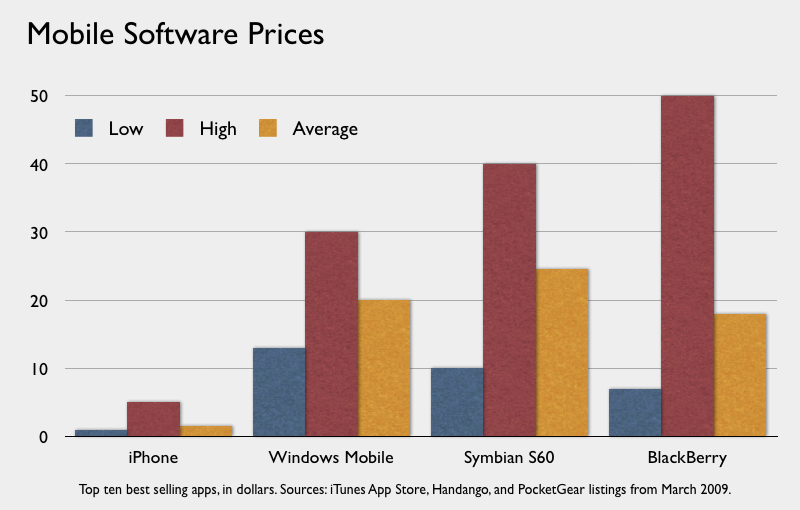
Apple's iPhone software library is also primarily priced below $10; the top ten paid titles in iTunes ranged from $1 to $5, and on average cost $1.60. The top selling Windows Mobile titles listed by PocketGear range from $13 to $30, with the average price slightly above $20. PocketGear also listed an average cost of $18 for BlackBerry among top titles, ranging from $7 to $50. PocketGear doesn't sell software for Nokia phones, but Handango listed an average price of $24.50 for its best selling Symbian S60 titles, ranging from $10 to $40.
Barriers to other mobile software stores
Apple's high volume, low cost mobile software sales employ iTunes' FairPlay DRM to promote frequent and regular sales from users and spurring regular new apps from developers. Apple executives have noted that the company runs its iPhone App Store to promote software availability to lubricate the company's hardware sales. That's why the company charges third parties a relatively small 30% cut of the software revenues it collects to handle billing transactions, software distribution, and merchandizing.
Nokia, Palm, and RIM all share similar motivations to promote the availability of software for their platforms in order to sell hardware. However, those companies also lack a high volume, micropayment marketplace like Apple's iTunes. Handango charges developers 40% to 70% of their revenues to list mobile software. Palm is planning to partner with PayPal to handle transactions, incurring transaction fees on developers separate from the 20% listing cut Palm intends to charge them. Nokia and RIM similarly lack any expertise in micropayment software sales, and Nokia's high profile failure of its initial N-Gage gaming efforts indicates that promoting a mobile software platform is not easy.
Microsoft promoted its SkyMarket as a strategy to "monetize" Windows Mobile software distribution. That will likely result in Windows Mobile titles continuing to retain a significant price premium. Sales of Windows Mobile software will not benefit Microsoft to the same degree as iTunes App Store sales benefit Apple, as Microsoft only earns minimal revenues of $8 to $15 on each hardware phone sale via Windows Mobile licensing. Apple earns hundreds of dollars per iPhone sold, which is why Apple recorded $4.6 billion in iPhone 3G revenues in its launch quarter, more money than Microsoft has made in years of its Windows Mobile business. Microsoft desperately needs to earn revenue from app sales to pay for the development of Windows Mobile, and so will likely pursue an arrangement with developers that works like the Xbox, where the company takes a much larger share of developer's revenues.
Similar to Microsoft's Windows Mobile, Android software sales won't make Google any significant money directly or indirectly through increased hardware sales. However, Google is advancing Android primarily to support its mobile advertising business as a free alternative to Windows Mobile. That will enable Android to shrug off a profit motive in its software store. Google delegates much of Android's custom development work to its hardware partners.
However, Android also lacks a security model that contains software sales to a single source, restricts the distribution of malware, and inhibits widespread piracy as Apple does for iPhone users. Microsoft has similarly not demonstrated any efforts to secure Windows Mobile software distribution as Apple has, and Palm has suggested that it will not secure software distribution on the Pre either. Both Nokia and RIM require certificate signing security for certain apps similar to Apple, but impose fewer security restrictions on how and where users can load mobile software.
Highlighting the importance of mobile software to phone sales, GIA executive Erwin Baumgartner stated, "Applications can make all the difference, and manufacturers like Apple who see the smartphone more as a software platform than as a set of hardware features have the ability to position themselves miles ahead of the competition."