How Intel's battle with NVIDIA over Core i7 impacts Apple
 Prince McLean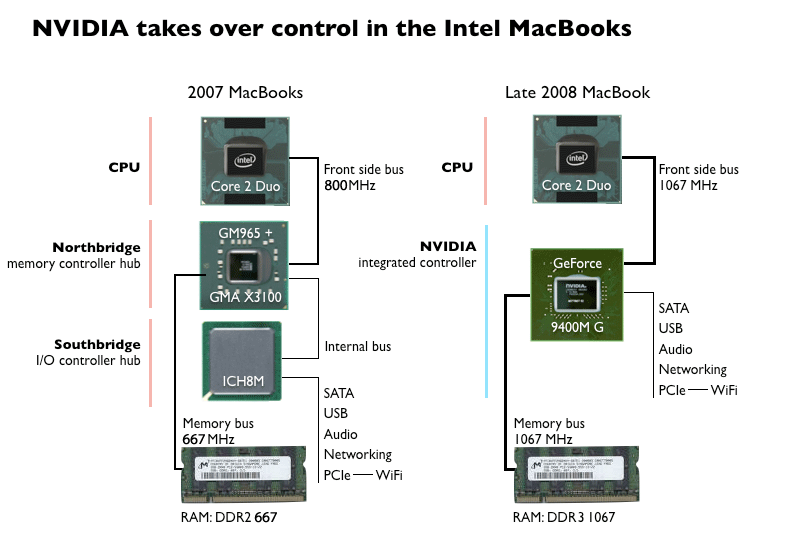
Apple in the middle
The suit relates to a disagreement between Intel, the maker of the Core 2 Duo CPUs used in Apple's MacBook line and its desktop Macs (apart from the high end Mac Pro, which uses Intel's Xeon "Harpertown" CPU), and NVIDIA, which last year expanded its role with Apple as a GPU provider into one where the graphics company now supplies the chipset-on-a-chip controller that serves as the glue between Intel's CPU and everything else in the computer.
Intel and NVIDIA teamed up in 2004 in a patent licensing agreement that resulted in NVIDIA making a competitive move into Intel's chipset business with its MCP79 chipset platform. Last year, Apple became the first PC vendor to adopt NVIDIA's one-chip controller in its MacBook line. The move not only simplified and improved the architecture of Apple's notebook machines, but also provided significantly better graphics compared to the Intel controller chips it had been using.
The dispute between Intel and NVIDIA involves Intel's next generation Nehalem CPUs (marketed as "Core i7") with QuickPath integrated memory controllers; Intel says NVIDIA's license does not allow it to make competing, compatible chipsets for the new CPUs, while NVIDIA says it believes the 2004 agreement does. Apple has a lot riding on the dispute, as its next iMac and Mac Pro are both expected to use Nehalem CPUs. Further, a mobile version of Nehalem is expected next year, resulting in Apple's entire Mac lineup being Nehalem-based within the near future.
Upsetting the Apple cart
Apple's migration to NVIDIA controllers last fall in the new unibody MacBooks was part of a long term strategy to standardize on GPUs across its Mac product line. In addition to being able to deliver optimized graphics drivers that take fuller advantage of NVIDIA hardware features than previous Macs, the move will also make it easier for the company and third party developers to accelerate tasks in Mac OS X Snow Leopard using OpenCL.
If Apple is forced to go back to Intel platform chipsets in order to use Intel's latest CPUs, it will end up with two separate GPU architectures to support, just as it had prior to last fall: NVIDIA standalone GPUs in its higher-end Pro models, and Intel integrated graphics on the lower end consumer models. Intel's integrated graphics (where the GPU is integrated into the controller chipset) are significantly behind NVIDIA's in performance and do not support OpenCL.
The uncertainty involved in the dispute is likely itself a significant problem for Apple. The company was widely expected to introduce a revised iMac last fall at the one year anniversary of the current design, and again at Macworld Expo. If Apple delayed the refresh primarily to take advantage of the upcoming Nehalem CPUs, this eleventh hour wrinkle could again delay an already overdue update.
The company's desktop Mac sales have already tapered off in expectation of the next refresh; Apple's cyclical sales surges are directly tied to new product introductions. Any additional delay will only compound this year's sales slump related to the economic crisis. On the other hand, this is one of the better years to suffer through an architecture war; had the battle between Intel and NVIDIA played out during a surge in economic growth, Apple's dilemma of having no new desktop products to sell would be a much bigger problem. The issue does not affect Apple's notebook sales, which now make up the majority of its Mac sales.
Intel's history with competition
As the long term leader in PC CPUs, Intel has played the hardware equivalent to Microsoft in the decades since IBM released its original PC in 1982. Like Microsoft, Intel has defended its dominant position by seeking to kill opportunities for competitors to muscle into its business. Intel's battle with NVIDIA today has already played out in the past like the dramatic foreshadowing of a soap opera.
After struggling to sell memory components against Japanese competitors, Intel's sudden success in microprocessors tied to IBM's selection of its 8088 processor in its first PC led to a cutthroat battle to defend that business in the 1980s. When IBM selected Intel's 8088 CPU, it insisted Intel license the design to other manufacturers to ensure a chip supply from at least two sources. Intel licensed its chip to AMD.
Intel then happily supported Compaq's efforts to take away IBM's business after the new PC maker cloned IBM's ROM, allowing Compaq to sell IBM-compatible PCs with Intel's new 386 processors. At the same time, Intel naturally defended its own intellectual property, refusing to license the new 386 processor that Compaq was using to other chip manufacturers, including AMD, starting in 1986. AMD filed suit and won in arbitration, but Intel kept the case in the courts until 1991, when the Supreme Court of California ended the matter by ruling in favor of AMD. In the meantime, that legal uncertainty forced AMD to develop additional clean room compatibility with Intel's CPUs.
After AMD muscled its way into the 386 business, Intel developed Socket 1 in 1997, a proprietary new physical connector for its new 486 CPUs to prevent users from being able to replace Intel's 486 with compatible versions from other vendors such as AMD. Earlier CPU socket designs had been essentially open standards. Fierce competition from competitors also resulted in Intel marketing its 586 as Pentium, a brand it could trademark. With the Pentium II, Intel released Slot 1, a cartridge-style, proprietary CPU packaging that again threw competing CPU makers off the track.
In markets where Intel faced less competition, such as with its late 90s Pentium Pro, chip prices didn't fall nearly as dramatically each year compared to markets where Intel faced AMD and others. That led Intel into its partnership with HP to build Itanium, an entirely new 64-bit CPU intended to eventually replace the x86 entirely, starting in the server market. The subsequent, monumental failure of Itanium was particularly embarrassing for Intel because the company was then forced to start over in copying AMD's 64-bit extensions to x86, in order to produce CPUs compatible with the standard AMD had popularized.
Along with Itanium, Intel also floundered in the development of its x86 Pentium 4, ending up trounced by AMD's competing Athlon XP CPUs. However, intense competition with AMD eventually resulted in Intel producing its Core CPU architecture and again grabbing the lead in desktop performance at high efficiency and competitive prices, attracting Apple's attention just as PowerPC began to run out of steam.
Partnership and rivalry with NVIDIA
With AMD's merger with NVIDIA's arch-rival ATI, one might think Intel and NVIDIA would find more reasons to agree than to argue. NVIDIA has sought to release a series of "two-chip PC" systems, where one chip is made by NVIDIA and the other is made by Intel: the first being the MCP79 used by Apple in the MacBooks, and a second being Ion, a platform that pairs NVIDIA's graphics and controller chip with a low cost Intel Atom CPU. Apple is rumored to be considering Ion for use in its future products, such as an update to Apple TV.
Intel naturally wants Apple's entire business to itself, as well as the chipset business of other PC makers that it is rapidly losing to NVIDIA. Along those lines, the company has worked hard to brand its combination of CPU, controller chips, and WiFi components into a platform brand it could co-market with PC makers, including the Centrino laptop brand, of which Santa Rosa was a member. While many PC makers buy up Intel's parts across the board, Apple has never co-marketed the Centrino brand with Intel, instead preferring to use Intel's components together with those of other makers.
Apple's move last fall to adopt NVIDIA's chipset was a particularly large jump away from Intel's integrated platform, however, likely serving as further motivation for Intel to investigate ways to keep its customers, including Apple, tied to its products using artificial means rather than by simply providing the best products available on the market. That includes leveraging strong products (such as Intel's CPUs) to force adoption of its weaker products (such as its integrated GPUs), by refusing to license interoperability with key products to its competitors (such as seeking to block NVIDIA's attempt to support its upcoming Nehalem CPUs).
Such competitive games are played by everyone in the industry, from Apple (refusing to license FairPlay and iPod connectivity to Microsoft's Xbox) Microsoft (resisting efforts to make Windows and Office interoperable with competitors) to NVIDIA (which similarly seeks protect its proprietary technologies, including CUDA).
Fortunately for all involved, Intel and NVIDIA have expressed an interest in working together, and both can gain more from partnerships than from blockades that would open up the market to AMD and other rivals. Until the matter is resolved however, Apple is caught in the middle of squabble that may deeply impact the company's desktop hardware plans this year, complicating an already difficult time for PC sales in general.









 William Gallagher
 Andrew Orr
 Malcolm Owen
 Mike Wuerthele


 Andrew O'Hara




78 Comments
Dan,
Your writing is thorough and thoughtful, as usual.
,dave
I think you should write a piece on Intel's upcoming Arrandale, which will be introduced at the end of this year and come with Intel's horrible integrated graphics packages within the chips. In particular, Arrandale is the only Nehalem mobile chip announced so far that offers a low enough TDP for Apple to fit into its notebooks and the competitive climate will force Apple to adopt this chip and derail its deployment of OpenCL.
I know someone is thinking it..."Can We All get Along?"
Good article, but bad title.
There is a lot of nice history here, but absolutely nothing on how this will impact Apple until the very last sentence, which just say's it will "complicate" things.
I think I knew that already.
Intel f$cks Apple, again. With partners like them, who needs enemies?
Time for a switch to AMD?