Windows 7 vs. Mac OS X Snow Leopard: Apple ups the ante
 Prince McLean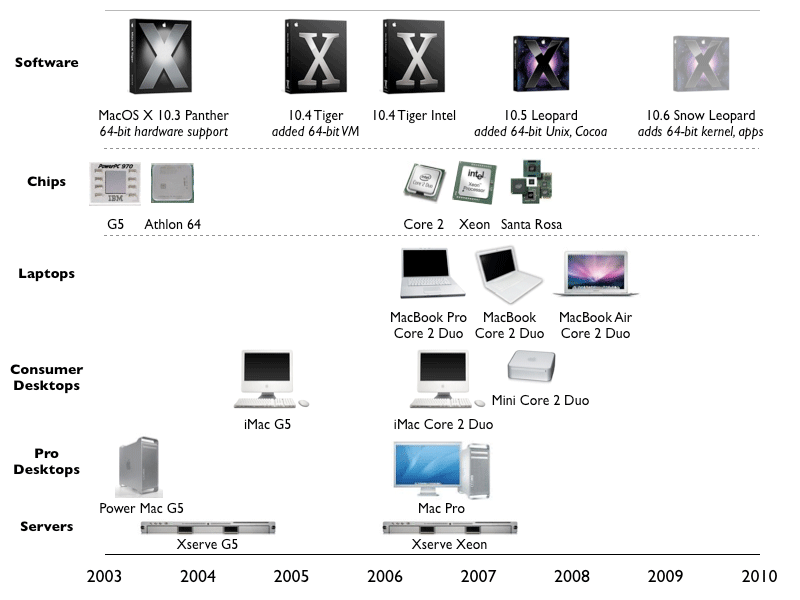
Previous Windows 7 vs. Mac OS X Snow Leopard segments
Apple initially seemed to suggest that Mac OS X 10.6 Snow Leopard would be a minor release following 2007's 10.5 Leopard, citing support for Exchange Server push messaging as the only customer-facing feature. However, Apple historically directs attention upon its currently shipping products rather than its future plans. As the Snow Leopard release grows closer (remarks at WWDC last summer indicated it would ship "in about a year," or Summer 2009), more details have been released.
New kernel features in Snow Leopard
Snow Leopard will deliver a full 64-bit kernel, requiring the same significant "all at once" upgrade in device drivers that Vista's significant kernel changes did. Apple will likely have an easier time pulling this off, as Snow Leopard is only designed to run on a relatively small number of higher end PCs, all made by Apple. Rather than trying to get lots of vendors on board as Microsoft must, Apple will be supplying the majority of kernel-level drivers for Snow Leopard.
While Microsoft has sold a 64-bit version of Windows for Intel x86 PCs since mid-2005, actual 64-bit adoption has been slow. Apple has incrementally supported 64-bit background servers and applications in Mac OS X since the release of the PowerMac G5 in 2003; all 64-bit capable Macs can already run 64-bit Mac OS X software because Apple doesn't offer two versions of its operating system; the same version of today's Leopard runs both 32-bit and 64-bit code.
In Snow Leopard, this will improve as the entire operating system, including all bundled apps, will be compiled for both 32-bit and 64-bits. This results in a roughly 15% increase in performance across the board for 64-bit Macs, such as those with Core 2 Duo processors (most models released since 2006, as the chart below depicts). It also has implication related to security hardening. Windows users also benefit from running the 64-bit version of Microsoft's operating system, but compatibility problems have made the move less attractive, leaving mainstream Windows users stuck on a 32-bit platform. Windows 7 perpetuates this problem by delaying the move to 64-bits to a future release.
In addition to bringing 64-bit processors into the mainstream of Mac computing by making 64-bit the default rather than an option, Snow Leopard also debuts the fruits of Apple's efforts in making full use of multiple cores and multiple processors. Snow Leopard's new Grand Central Dispatch is used to aggressively and efficiently schedule processes across all available processor cores in parallel, and OpenCL is being made available to allow developers to take advantage of the raw processing power that often lays idle in the system's GPU.
Strategic improvements
Apple is also advertising QuickTime X as a streamlined, highly efficient media playback library (originally developed for the iPhone), as well as new advancements to Safari 4.0 and its SquirelFish Extreme JavaScript engine. The latter two will help to accelerate a new wave of sophisticated web applications, including Apple's own SproutCore-based MobileMe and iWork.com, as well as other HTML5 applications from partners such as Google, which are similarly working to develop open, interoperable, and high performance web apps with desktop-style features based upon industry standards.
Microsoft, in contrast, is betting upon its own Silverlight, a Flash-like, proprietary platform for web development that ties web applications to the company's own development tools and runtime rather than leveraging open web standards for interoperability.
Like Microsoft, Apple hopes to bridge its desktop operating system with online cloud computing services offered as subscription software. The difference is that Apple is again working within open standards and in partnership with companies like Google, rather than offering entirely proprietary services. That strategy appears to be paying off, as Apple now has millions of paid MobileMe subscribers which represent more than ten percent of the Mac installed base, while Microsoft has yet to move its Live Mesh out of beta, and has struggled to put together a consistent strategy for its web services.
Next month, Microsoft is expected to announce SkyBox as a new mobile cloud sync service to take on MobileMe (and later its SkyMarket to rival Apple's iPhone App Store), despite having its Windows Mobile platform eclipsed by the iPhone and splintered among various hardware makers and service providers, each of whom might not want to cede the potential for software sales and cloud sync revenues exclusively to Microsoft.
Touch and Office features
While Microsoft made a lot of announcements about integrating touch screen features into Windows 7 back in 2007 around the rollout of the iPhone and its own Surface project, Apple will be delivering a more practical version of new touch functionality in Snow Leopard, one which enables developers to make use of the multitouch trackpads now built into all of Apple's notebooks (which make up more than half of the company's sales).
Apple has already delivered multitouch gestures that can be used system wide, as well as pinch and zoom features that work in its own specific apps. Snow Leopard will extend touch frameworks to developers to allow them to take full advantage of multitouch trackpads in innovative ways, all without users having go out and purchase their own touch screen monitors.
Other silent but practical additions to Snow Leopard include new text processing features that will give all Mac applications the kind of auto-complete and auto-correction features Microsoft provides inside Word. Mac OS X has already extended Word-style spelling and grammar checking to be a system wide service. Windows offers those services in Microsoft-authored apps but they don't yet extend to third party apps.
Open software updates
For Windows NT, Microsoft developed its own new sophisticated file system called NTFS, but it never shared or licensed the technology so that other vendors could build interoperable systems that used it. The result was a selection of patent-threatened, mostly-compatible software libraries that enable Linux, Solaris, and Mac OS X to use NTFS volumes in a limited way. That vacuum prompted Sun to develop its own sophisticated file system to go well beyond the capabilities of NTFS.
Sun has released its 128-bit ZFS as part of OpenSolaris, enabling Apple to build a compatible, read-only implementation in Mac OS X Leopard. In Snow Leopard, Sun's ZFS will be fully supported as a read/write file system, enabling mainstream Mac users to start taking advantage of its storage pooling, data redundancy, automatic error correction, dynamic volume expansion, and snapshot features.
Other open software improvements to make their way into Snow Leopard include the CUPS printing libraries used by both Mac OS X and Linux, which Apple acquired and maintains with the support of the community. Apple has also funded development of the open source LLVM compiler, which is intended to build upon and eventually replace GCC (the GNU C Compiler). LLVM is already resulting in major new code optimizations, but the explicit optimizations for parallel execution it supports will also help Snow Leopard apps take full advantage of Grand Central dispatching across multiple cores.
Microsoft develops its own kernel, file systems, printing technology, compilers, and other operating system components, resulting in less opportunity to take advantage of advancements by the open source community.
On page 2 of 2: Where's the open beta?; and Rumored enhancements.
Some have wondered why Apple hasn't shipped a public beta for Snow Leopard, which appears set for release well ahead of Windows 7. The answer is that Apple unique position demands it take an alternative approach. Microsoft's new software will eventually be bundled on every new PC sold, outside of Apple's, so there's no need to worry about leaking features or showing off the flaws of an unfinished product. Microsoft doesn't have to sell Windows 7, it only has to worry about market rejection. Due to the volumes of PCs it will eventually be installed on, it's bound to be successful even if it is a marginal product.
By contrast, Apple has to vigorously sell Macs against all odds. It has to deliver products as they are completed in order to awe the market both with its differentiated features and its finished quality. If Apple were to open up Snow Leopard to public review, the Windows-aligned tech media would have a field day complaining about its minor errors, as they worked so hard to do at Leopard's actual release. There would also be an immediate call to port Snow Leopard's look and features into Windows, erasing Apple's competitive advantages before the company could even begin selling its work.
Windows Vista worked hard to incorporate versions of Mac OS X features, but Apple was still able to show off unique features in Leopard at its release.
Rumored enhancements
The lack of a public beta means that users will be kept guessing about the finishing touches to Snow Leopard up until its release. One rumor calls for a new unified appearance called Marble, a like assumption given Apple's consistent efforts to brand and identify each reference release of Mac OS X with user interface improvements. Apple's own apps, notably Logic Pro 8, iTunes, iLife, and iWork, provide clues to the company's direction.
Apple will also be incrementally improving upon technologies that already exist in Leopard, from accessibility features like Voice Over, to new font Auto Activation in Font Book, to resolution independence, which is required to support the increasing screen density of modern displays.
MobileMe suggests new features related to managing notes, tasks, and events in Snow Leopard's apps (as well as on the iPhone). Document sync with iWork.com makes sense too, as does expanded functionality within Back to My Mac, Leopard's mashup of Bonjour and IPv6 VPNs that allows users to share their home files and devices with their mobile notebook while traveling. New geotagging services in iPhoto and location lookups in iMovie indicate the potential for moving expanded location-related services to the operating system level for all apps to use.
Apple's tight integration between its operating system and its hardware allows the company to deliver new innovation at a remarkable pace. Apple can build in hardware support and deliver immediate operating system integration for it, as it did when upgrading its notebook audio to optical digital interfaces, or in moving decisively to MiniDisplayPort graphics and multitouch trackpads.
Until completed versions of Snow Leopard and Windows 7 ship, the closest we can get is a look at the betas. The next segment will look at installing and using the Windows 7 public beta.






 Marko Zivkovic
 David Schloss

 Malcolm Owen

 William Gallagher
 Mike Wuerthele
 Christine McKee