Windows 7 vs. Mac OS X Snow Leopard: competitive origins
 Prince McLean
The operating system most users end up with will depend upon what hardware they choose to buy, not the specific feature details of the software that system happens to run. History reveals that the hardware decision isn't going to be based primarily upon features.
The following presents a historical overview of the competition between Apple and Microsoft in the operating system market leading up to this year's face off between Windows 7 and Snow Leopard. While modern Macs can now also run Windows, Apple is the only PC maker to refrain from actually licensing it from Microsoft as an OEM; in contrast, Apple's Mac OS X only legally runs on the company's own premium PCs. That has enabled Mac OS X to differentiate Apple's hardware from other PC vendors using easy to demonstrate software features and tighter hardware integration, winning back some of the ground Apple lost during the decade of the 90s.
How Microsoft inherited Apple's crown in the 90s
In the 90s, Microsoft and its entourage of Windows PC makers came to largely view Apple as nearly irrelevant, but once Mac OS X arrived and began to catch the attention of users with its slick and sophisticated graphics compositing, its malware-free computing experience, and its unique and consistent interface features, Microsoft was pressured by its licensees to catch up so they could offer a competitive product.
Mac OS X essentially reset the clock for Apple, turning back time to 1990, when the company commanded a greater than 10% share of the entire PC market and dominated nearly all graphical desktop computing. Back then, the remainder of the PC market was running DOS, making it fairly easy for Apple to distinguish its graphical, easy to use product. Windows 3.0, the first version to ever ship installed on a new PC, hadn't yet arrived.
Perhaps things were too easy for Apple; rather than aggressively competing against DOS PCs, Apple used its technical superiority to extract higher prices for its machines. The problem was that Apple's boutique market lacked a boutique outlet for sales. The company was forced to sell its Macintosh models next to cheaper DOS PCs in computer stores and general retailer such as Sears, where they sat at the mercy of retailers who had no incentive to sell Apple's product, as they were making higher margins on the DOS PCs.
Microsoft's command-line DOS operating system.
As Mac sales remained flat, PC sales began to climb rapidly. Microsoft's continuous, incremental updates to Windows also began to blur the line between the Mac experience and that of DOS PCs with its Windows shell installed. Additionally, while Microsoft was building Windows from a relatively clean slate, Apple's Mac OS was tied up with early 80s legacy issues, including a simple cooperative multitasking model and a complete lack of modern operating system features such as protected memory, secure user accounts, and file permissions.
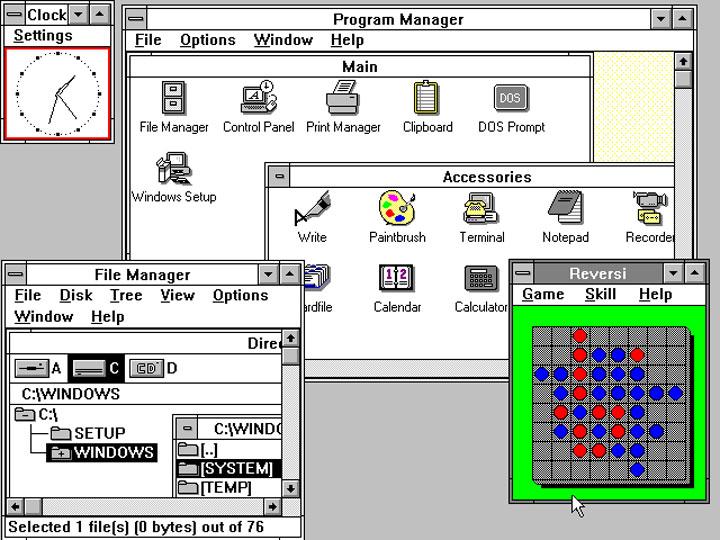
Windows 3.0 was the third major release of Microsoft Windows, released on May 22nd 1990.
Rather than delivering a technology overhaul, Apple released a series of code names for software that never materialized as promised, including Taligent, Copland, and Gershwin. By the end of the 90s, Apple had lost its position as the leader in graphical desktop computing to the point where many observers had forgotten it ever had defined innovation in the industry. Fortunately, the company had a comeback plan thanks to its merger with NeXT and the homecoming of its CEO, Steve Jobs.
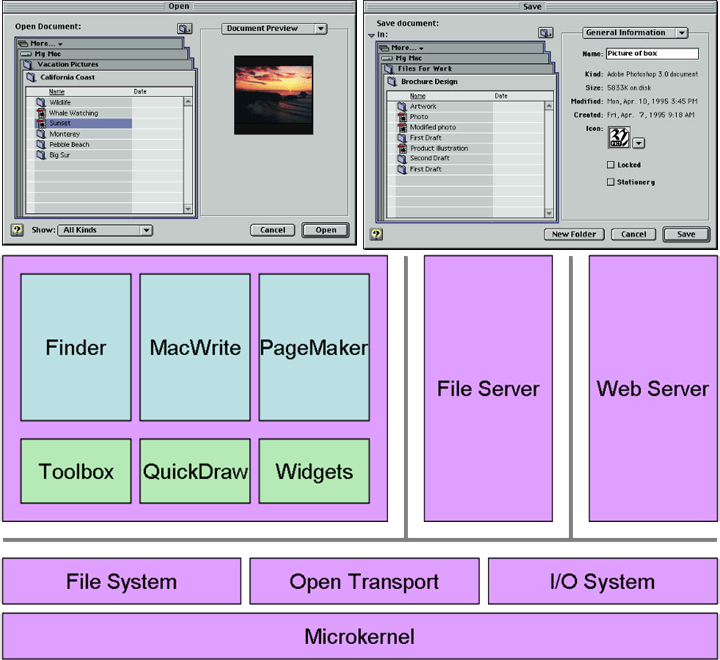
A diagram of Copland's runtime architecture based off of one from Apple.
The tables turn in the 2000s
At the beginning of the 2000s, Microsoft had just released Windows 2000 (aka Windows 5.0), a mature and stable revision of its new Windows NT operating system that was developed to replace the DOS Shell version of Windows it had sold as Windows 95/98/Me. Microsoft's competition was all but gone, with Apple down to a roughly 2% share of the worldwide market for all PCs and servers, and IBM's OS/2, NeXT, BeOS, and other desktop operating system competitors out of the picture entirely.
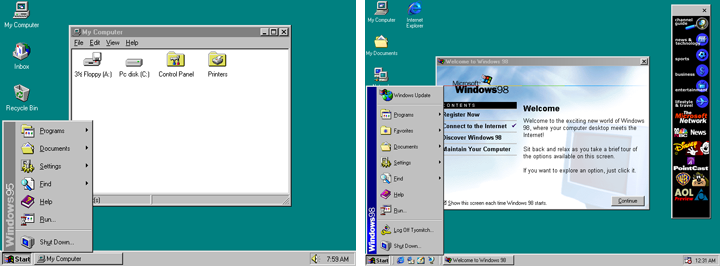
Windows 95, released Aug 24, 1995 (left) and Windows 98, released Jun 25, 1998 (right).
The company's worrisome monopoly trial was about to be set aside by the new Bush Administration, and Microsoft was close to releasing a fusion of Windows 2000 and its consumer hardware-friendly Windows 98 as Whistler. Beyond that release, the company laid out a roadmap including Longhorn and Blackcomb to guarantee that the company could remain at the forefront of desktop PC software innovation as long as it could continue to repress any legal actions challenging its rise to the top through exclusive contracts with OEMs that prevented competitors from entering the operating system market.
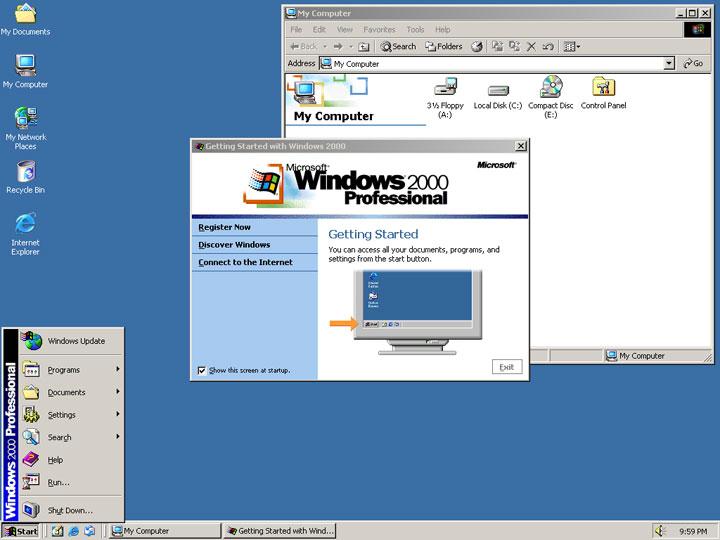
Windows 2000 was released February 17, 2000 and targeted business desktops, notebook computers, and servers.
Microsoft was ultimately able to successfully pay off or scuttle any significant legal problems, but it was hit by a new challenge: a festering rash of high profile security flaws tied to its early 90s, pre-Internet legacy. Suddenly, the company was finding itself in the position of Apple a decade prior, with a complicated software roadmap riddled with potholes, a product that was facing increasing price competition (thanks to Linux and other free software), and new competition from Mac OS X that rivaled its position as the leader in desktop innovation.
Windows XP vs. Mac OS X
Microsoft's Whistler, delivered as Windows XP, was internally Windows 5.1, a minor update to Windows 2000. However, with the security work Microsoft had to assume, XP would end up being the company's primary OS throughout the decade. Even two years after the release of Windows Vista (6.0) in 2006, which sprang from Longhorn but took far longer to complete than planned, nearly 80% of Microsoft's installed base remains on XP, and the company's hardware partners continue to advertise their systems' ability to revert back to XP as a feature.
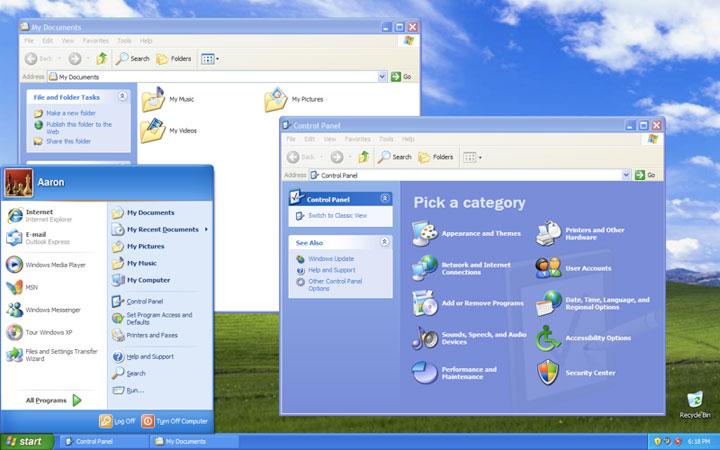
Released on Oct 25, 2001, XP was Microsoft's first consumer OS built on the Windows NT kernel and architecture.
In contrast, Mac OS X 10.0 debuted along side XP but was then updated in a series of major reference releases, including the free 10.1 update in 2001, the mainstream 10.2 Jaguar in 2002, 10.3 Panther in late 2003, 10.4 Tiger in early 2005, 10.4 Tiger for Intel in 2006, and 10.5 Leopard in 2007. While Microsoft released some "service pack" updates for XP during that time, only XP SP2 contained any significant feature updates, mostly related to patching up its security issues. Each of reference releases to Mac OS X delivered major new features, applications, and services for Mac users, in addition to performance enhancements that made the new software run faster even on older machines. Apple has also released dozens of free "service pack" minor updates to its reference releases of Mac OS X.
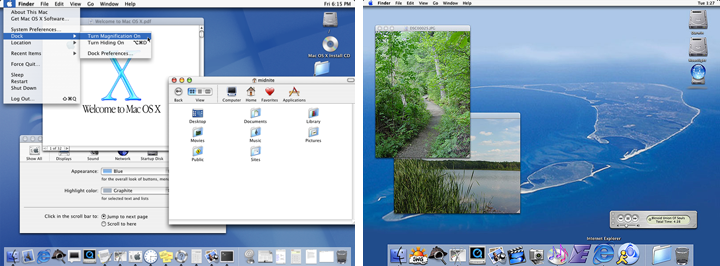
Mac OS X 10.0 "Cheetah," released Mar 24, 2001 (left) and Mac OS X 10.1 "Puma," released Sep 25, 2001 (right).
Another factor that changed the relationship between Windows PCs and Macs was Apple's development of new retail stores, both free standing outlets owned by the company and "store within a store" locations run inside retail partners' locations. These allowed Apple to showcase its differentiated machines isolated from Windows PCs that competed primarily on price, not on features and usability. The result was that Apple could now sell its machines' features on their own merits, rather than just struggling to match prices with lowball PC makers.
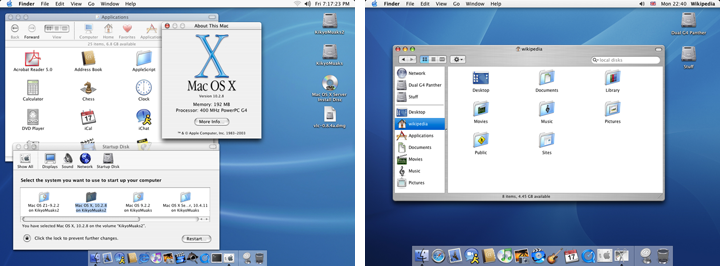
Mac OS X 10.2 "Jaguar," released Aug 23, 2002 (left) and Mac OS X 10.3 "Panther," released Oct 23, 2003 (right).
That retail strategy also shifted the pricing pressure of store brand and no-name PC makers against name brand manufacturers such as Dell and HP, forcing them to race to the bottom the the barrel in pricing, which subsequently resulted in poor product quality that further differentiated Apple's products from those of the other PC makers. Apple's retail stores are now allowing the company to experiment with new manufacturing techniques such as those used in the new unibody MacBooks, as well as higher end, environmentally friendly materials and customized silicon designs.
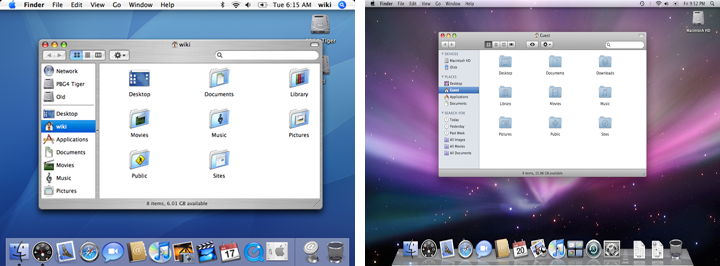
Mac OS X 10.4 "Tiger," released Apr 29, 2005 (left) and Mac OS X 10.5 "Leopard," released Oct 26, 2007 (right).
All of these integration enhancements fuse Mac OS X into the Mac hardware, making it increasingly less comparable to Windows as a retail product. Apple doesn't advertise Mac OS X as an alternative to Windows, it pits the Mac against generic PCs in more general terms.
On page 2 of 2: Vista vs. Mac OS X; and Windows 7 vs Snow Leopard.
In contrast, Microsoft has had to keep Windows a general purpose, one-size-fits-all product that it can license to every PC maker on earth apart from Apple. Microsoft's business interests often fail to align with those of its licensees, resulting in skirmishes with its OEMs. These broke out particularly with the release of Windows Vista in 2006. For example, Acer was irritated by Microsoft's price hike on Vista and its strategy to sell the OEMs a crippled Home Basic version that users would have to upgrade directly with Microsoft in order to get the same features they had with XP. Dell and HP pushed back when Microsoft tried to cancel XP and make Vista the only option.
Vista ended up a colossal failure due to the way it was sold by Microsoft, its problems with existing hardware, incompatibilities with software titles, and its poor performance relative to XP, despite offering new features and, in particular, strong new efforts to bolster Microsoft's security reputation. Not even Microsoft's most loyal pundits could defend the release of Vista after months of sales data proved beyond any doubt that consumers didn't care about the new operating system's features or its security advancements; they were only upset that their existing software and hardware ran worse under Vista than it did under XP, and that Vista cost more.

Windows Vista was released Jan 30, 2007 to horrid reviews.
Those events set up circumstances that favored Apple's strategies: all Apple has to do is deliver incremental improvements to Mac OS X and its already happy and expanding pool of Mac users will remain loyal customers, while Microsoft is tasked with rethinking Vista to make it palatable to OEM licensees, suitable for existing users, and yet also feature competitive enough to compare with Apple's offerings. Additionally, Microsoft is running out of potential new customers as the PC market matures into a slow growth phase. Apple has lots of potential for growth, as it is now very profitable with less than 10% of the market, leaving it plenty of Windows users to woo over to its own platform.
Windows 7 vs Snow Leopard
With that background, the game is set for a rematch between Apple and Microsoft, with the Mac maker's latest Snow Leopard due in the first half of the year and Windows 7 aggressively scheduled to arrive shortly afterward. The next segment will look at how Apple plans to reward loyal Mac users while tempting Windows users to switch with Snow Leopard, and how Microsoft plans to correct its mistakes with Vista to regain the upper hand with Windows 7.
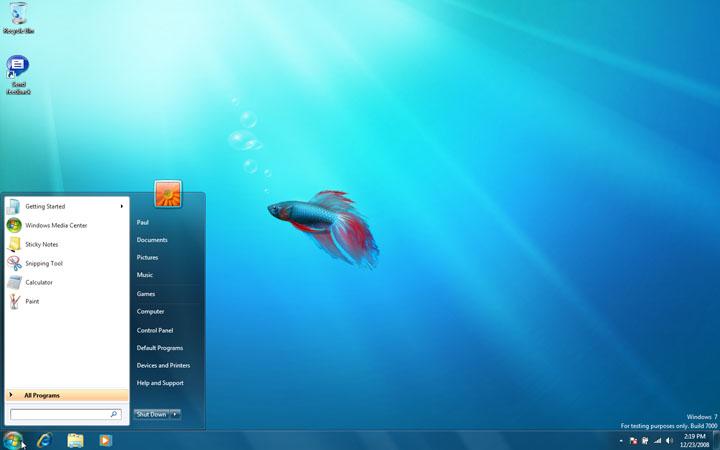
Windows 7 build 7000 was released publicly on January 7th, 2009.


 Mike Wuerthele

 Malcolm Owen
 Chip Loder

 William Gallagher
 Christine McKee
 Michael Stroup