Reconstructing Apple’s 2008 earnings to reflect iPhone sales
 Andy M. Zaky, Bullish Cross, Special to AppleInsider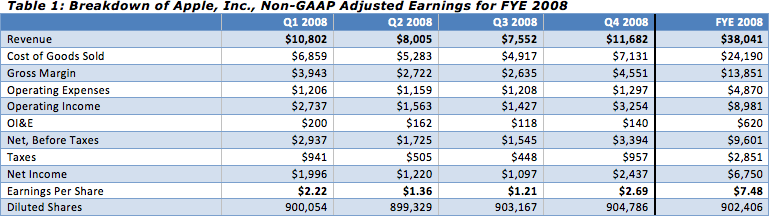
The Apple earnings confusion has largely been the result of Apple’s relatively (un)complicated subscription method of accounting for sales of the iPhone. Most analysts seem to be either thoroughly lazy, or genuinely perplexed by this fairly simple concept; and so I thought I might make their jobs a little easier by reconstructing Apple’s 2008 earnings results to reflect what Apple actually earned in 2008
While the broader market is down well over 40% this year, Apple’s stock has been significantly more deflated than others in the tech sector due in large part to Apple’s decision to give iPhone customers free “once in a blue moon†software updates rather than having them pay a $10.00 nominal fee. Who would have thought that a simple decision to waive a small $10 fee would cause so much destruction to shareholder value and billions in losses in market capitalization?
The table below lays out what almost no analyst has dared to show their clients regarding the reality of Apple’s earnings results in 2008. The method used for determining adjusted earnings is relatively simple and straightforward, and could be found here for those who are interested in the inane details. The table below lays out the adjusted earnings results for each of Apple’s fiscal quarters in 2008, which includes full revenue and earning recognition for sales of the iPhone and Apple TV.
Table 2 (below) lays out just how much of a difference the subscription method of accounting had on Apple’s financial results by comparing Non-GAAP earnings (which includes full recognition of revenue from sales of the iPhone) with GAAP-based earnings results which employs the deferred revenue mechanism of subscription accounting). There are a couple of key points that investors should take away from analyzing this comparison. First, that Apple didn’t record nearly 14.6% of the revenue it actually received from sales of the iPhone throughout 2008. In fact, for each quarter in 2008, Apple reported an average of $1.391 billion less in revenue than it should have reported but for the obtuse and unrealistic requirements of the Generally Accepted (Asinine) Accounting Principles (GAAP).
Secondly, one should also notice how Apple reported $2.12 or 28.4% less in EPS than what it actually earned in the “real world.†This is particularly troubling because Apple’s trialing P/E reflects a much higher multiple than what reality dictates. On a GAAP “fantasy†basis, Apple is trading at 17.19 times 2008 GAAP-based earnings. Yet, under adjusted-earnings, which contemplates actual “reality,†Apple is currently trading 12.31 times last year’s earnings. GAAP accounting principles actually makes Apple’s stock price appear significantly less attractive from a valuation perspective than it actually is.
Thirdly, one should notice how Apple reported 30.1% less in Operating Income than what it actually earned. This means that Apple is reporting only two-thirds (2/3) of the actual results from its primary operating activities.
Operating Income is supposed to be a reflection of the health of Apple’s core business. OI&E, the tax rate, and diluted shares are malleable from one quarter to the next. But operating income tells the investor how Apple’s business is really doing. EPS is for show, while operating income is for the serious analyst. I have to question an accounting measure that requires a company to simply “leave out†30% of its primary business from earnings reports because that company decides to give its customers a “once in a blue moon†free $10.00 software update. I thought Sarbanes-Oxley and the accounting measures imposed after Enron were supposed to makes companies more transparent, not less!
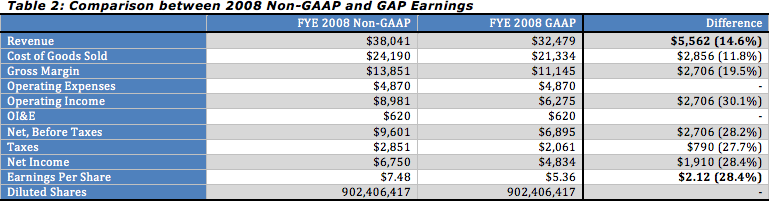
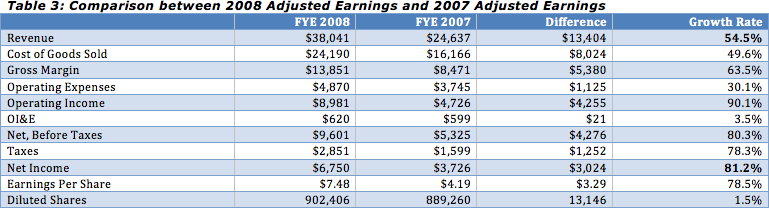
Table 3 below compares 2008 adjusted earnings with 2007 adjusted earnings, which is useful in analyzing the various trends in Apple’s growth rate. Since Apple started selling the iPhone in the final days of fiscal Q3 2007, adjustments to Q3 and Q4 of 2007 were necessary to make the data comparable from one period to the next. It would be silly to compare 2008 Adjusted Earnings with 2007 GAAP based earnings. The methods used in making the adjustments from GAAP to Non-GAAP earnings can be found here.
Right away, one ought to notice the staggering growth rate in both revenue and earnings that Apple displayed in 2008. Apple’s real revenue grew 54.5% from $24.637 billion in FYE 2007 to $38.041 billion in FYE 2008 – a full $13.4 billion growth in revenues. Even more impressive is Apple’s 81.2% growth rate in adjusted net income. For a company that is trading at 12 times 2008 earnings, it doesn’t take a genius to conclude that Apple is severely undervalued. Especially since Apple currently trades at about 3.37 times its cash position – which is objectively and significantly lower than every other large cap tech company.
GOOG trades at 7.18 times its cash position, RIMM at 15.51 times cash, AMZN at 9.15 times cash, MSFT at 9.13 times cash, CSCO at 3.62 times cash, IBM at 10.96 times cash, INTC at 6.54 times cash, and HPQ at 5.15 times cash. What is more, only GOOG, AAPL and MSFT have no debt of the companies mentioned above. Apple has the largest net cash position than any of those companies and Apple has more net cash than RIMM, GOOG, AMZN and IBM combined.
I will take up the issue of valuation later on this week where I’ll give a comprehensive analysis of several large cap tech companies. Preliminary research indicates that Apple is extensively more undervalued than every other large cap tech company at current levels and this is due almost exclusively to the subscription method of accounting.
In order for Apple to be trading at the same current valuation as GOOG, RIMM, AMZN, MSFT, CSCO and IBM, Apple would have to be trading at $206.25 – and that’s after this current correction in the market place. The fact of the matter is, Wall Street never valued Apple properly prior to the beginning of this bear market. Apple could have been trading at $300 before this recent downturn and even after this excessive sell-off, Apple should be trading at $158.92 at current S&P levels. I leave it to my readers to make their inferences about where Apple might be headed in 2009 and 2010. Much more to follow.
Disclosure: Long Apple. The information contained in this blog is not to be taken as either an investment or trading recommendation, and serious traders or investors should consult with their own professional financial advisors before acting on any thoughts expressed in this publication.







 Malcolm Owen
 Chip Loder

 William Gallagher
 Christine McKee
 Michael Stroup
 William Gallagher and Mike Wuerthele