Even before Google first outlined its Android strategy a year ago, it was clear that the rumored "gPhone" wouldn't be competing against the iPhone, but rather with Microsoft's Windows Mobile, which threatens Google's ability to push its search and information services to smartphone users. Apple's iPhone has served as an outlet for Google's services ever since it was released.
At the same time with the iPhone being the most talked about phone on the planet right now, T-Mobile is going to have a hard time not making comparisons particularly given the fact that T-Mobile can't sell the iPhone. Google is also contrasting its restriction-free Android Market against the iPhone's App Store. The most obvious comparison between the G1 and iPhone is in their hardware, but the features available on both are related to their software support and service limitations. Here, we'll take a look at all three areas to underline that the G1 is aiming at a very different audience than the iPhone crowd.
An intersection of partners' features
Apple designs its own hardware in conjunction with its in-house software development. The iPhone also shares a tight software platform with the iPod touch and integrates into Apple's iTunes. The iPhone's biggest limiting factor is its connection with AT&T, which Apple has worked to smooth over by making itself the retailer and supporter of iPhone sales and service. Still, certain limits posed by AT&T impact Apple, including its 3G coverage and inability to offer tethering.
On the G1, Google's Android software is paired with a hardware design by HTC, a Windows Mobile manufacturer. Media options come from Amazon's music store (the phone isn't designed to sync with a PC, but rather only over the air with Google), and T-Mobile is providing the telephone service. This spreads around the responsibility for managing the G1 experience in usability, sales, support, features, and coverage.
That puts the G1 at the intersection of features supported by all of its vendor partners. For example, Android currently lacks software support for multitouch and advanced Bluetooth capabilities. Other HTC phones support advanced Bluetooth features, but often sport curious omissions, such as the G1's lack of a headphone jack and its paltry 1GB of storage memory.
That adds up to a product with no multitouch, limited Bluetooth features, limited memory that must be augmented at extra cost, and needing a clumsy workaround to use it as a music player. Add in the limitations posed by T-Mobile, the weakest 3G provider in the US with tethering limits of its own, and the G1 begins to look like the worst bits of all its partners.
The other side of the same coin is partner commitment. While Apple is only selling the iPhone, AT&T has other partners' phones to market, although nobody visiting an Apple Store would know that. With the G1 however, Google plans to offer competing Android hardware from other manufacturers; HTC builds Windows Mobile phones; T-Mobile has other devices to sell; and Amazon is working to sell MP3s to every platform. Nobody is backing the G1 exclusively in the way that Apple is putting all its muscle behind the iPhone and its advancement.
Hardware: G1 vs. the iPhone 3G
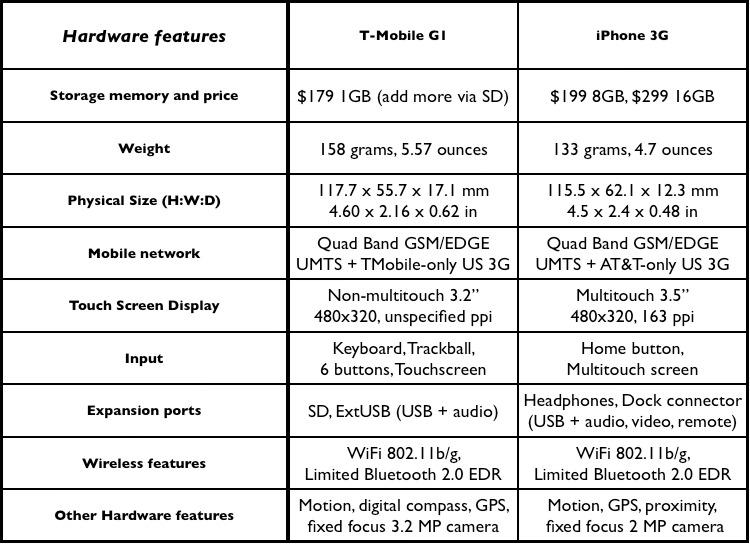
In raw hardware features, the G1 is $20 cheaper than the 8GB iPhone but only supplies 1GB of internal storage. Apple has pioneered offering a sizable amount of Flash RAM as standard on the iPhone and does not offer any expansion route. The G1, like most Windows Mobile and other smartphones, supplies very little memory to hit a lower price point, but offers a microSD slot so users can add more. HTC hasn't published the maximum size of the SD card [apparently it is limited to 8GB] the G1 can accommodate, but adding a basic 8GB card makes it $40 more, erasing any price advantage and making it slightly more expensive than the iPhone.
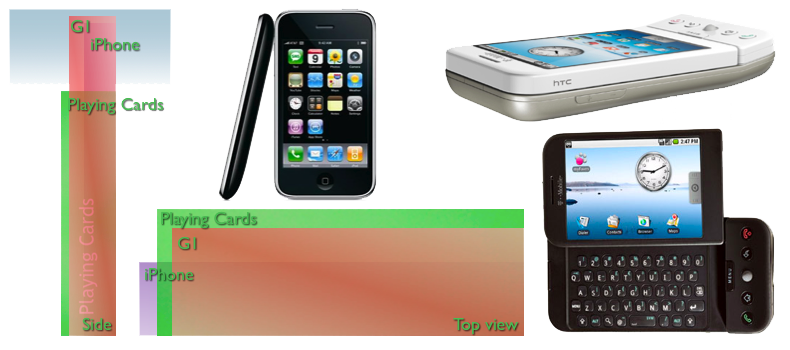
The G1 is significantly larger and heavier than the iPhone, in large part to its reliance on a sliding physical keyboard that makes it a half centimeter thicker. It lacks the iPhone 3G's curves and beveled edges, which will result in a bulkier feel. The keyboard should appeal to T-Mobile's SideKick users and people who like HTC's other Windows Mobile phones with sliding keyboards and an interface that relies upon six hardware buttons [the six buttons are a black menu button, a green phone button, a black home button, the trackball button, a black back button, and a red end call button] and a mouse pointer trackball rather than centering exclusively on consistent touch gestures. In fact, the G1 presently has no virtual keyboard option at all, so all text entry will require sliding the screen up and taping directly on its mini keypad.
Anyone interested in the iPhone 3G's interface will be disappointed to find that the G1 doesn't offer 'pinch to zoom,' two finger twirl, and other multitouch direct manipulations because Android is aiming to target the cheaper non-multitouch touch screen market. This is both a hardware limitation of the G1 and a current software limitation of the Android platform, so no software update will add this to the G1 later. Additionally, because software support for multitouch is missing, developers will have to roll their own for any subsequent Android phones that might support this in hardware, making that software incompatible with the G1.
As a mobile device, both phones support worldwide GSM/EDGE operation. However, due to the fact that the US didn't have the same radio bands available for UMTS 3G service as the rest of the world, US providers have had to build their own networks using what radio spectrum they could acquire. The iPhone exclusively supports AT&T's version of UMTS/HSPA 3G service in the US, while the G1 only supports T-Mobile's version of UMTS/HSPA in the US. Again, both support worldwide standards for GSM/EDGE and standard UMTS/HSPA 3G service outside of the US.
While complaints abound about AT&T's 3G service because it is only available in around 200 mostly urban markets in the US, T-Moble plans to have 3G service up in just 21 markets by the release of the G1, and 27 by the end of the year. Other 3G providers in the US, principally Verizon Wireless and Sprint, use Qualcomm EVDO 3G technology that is entirely incompatible with both American and international UMTS/HSPA service, although EVDO offers wider coverage within the US. The bottom line is that the G1 will have far less 3G service coverage than the iPhone 3G, even completely excluding significant markets such as Washington, D.C. and Houston, Texas.
Both the iPhone and the G1 say they offer 5 hours of talk time, but the G1 is only rated for 130 hours of standby, compared to 300 on the iPhone. Apple also outlines battery lifespan times for WiFi and audio and video use. Part of the reason the iPhone can claim longer life is its 1400mAh battery is larger than the 1150mAh in the G1, but Apple also has a better reputation in power management than HTC.
For external connectivity, both the G1 and iPhone 3G support WiFi and Bluetooth 2.0 EDR, although neither currently takes much advantage of the Bluetooth capabilities. The G1 also lacks a headphone jack, providing a single 11-pin port designed by HTC that instead breaks out into USB and audio (both stereo headphones and a mic). The iPhone 3G, like all iPods, has a 30-pin Dock connector which provides USB, audio in and out, remote features, as well as composite and component video output. In addition to this connector, the iPhone also has a standard audio headphone jack with mic support so you don't have to carry around a dongle just to use it as an iPod.
Both devices provide accelerometer support for sensing motion, GPS, and a simple fixed focus camera, although the G1 provides a 3.2 MP sensor (2048x1536 pixels) compared to the iPhone's 2 MP camera (1600x1200). The G1 also provides a digital compass, which enables it to present your direction as you move it, making the accelerometer controls smarter. The primary application for this is being able to hold up the phone in orbit around yourself to navigate Street Views. It could also be applied for intelligent maps that present North automatically so you don't get turned around.
In hardware, the G1 is clearly aiming at people who might be interested in a Windows Mobile phone, not a slick integrated product like the iPhone. It caters to people who buy hardware based on specification numbers and feature checklists rather than overall suitability for a task, elegant usability, and strong industrial design.
On page 2 of 2: Software: G1 vs. the iPhone 3G; Service: G1 vs. the iPhone 3G; and Not the Android many were looking for?
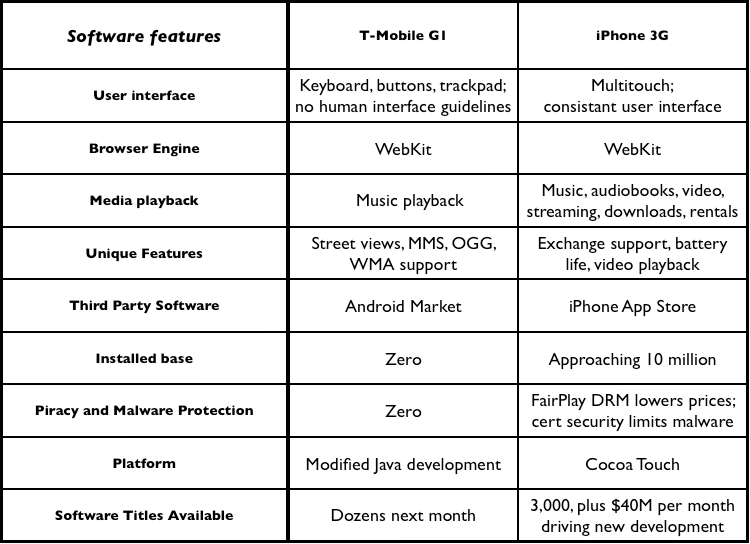
There are two aspects of software: the first party tools and foundation built by Google or Apple, and the third party software created by other developers. In terms of first party software, Apple is now at release 2.1 after having put out regular updates nearly once a month over the last year and a few months. Google will be delivering 1.0 next month, and has a spottier record of deploying software updates, with only two public releases of its SDK since announcing Android a year ago. Apple released its SDK after the Android announcement and put out a dozen updates since.
Android has demonstrated some unique features yet missing on the iPhone, including support for displaying Street Views within the Maps application and MMS picture messaging. The most obvious departure between the two in terms of software is that Android presents the same desktop PC interface found on Windows Mobile and Linux devices, while the iPhone was custom designed around a new mobile multitouch set of simplified human interface guidelines. Google's interface doesn't follow a standard set of guidelines, and Android Market doesn't yet police any restrictions on third parties the way Apple does, making the Market place more of a free-for-all from the onset.
The G1 and iPhone share a few components, such as similar open source foundations, including SQLite and WebKit. This means the two will benefit each other as shared technology contributions simmered together. The G1's browser, called Chrome Lite, really has more in common with the iPhone's mobile Safari and the WebKit browser pioneered by Nokia. Google's G1 browser therefore has the same rendering accuracy of the iPhone's Safari, although it lacks features like pinch to zoom, because neither the G1 nor Android support multitouch.
A major software difference between the G1 and iPhone relates to third party security. Apple has set up a secure software distribution system for third party developers that protects their interests through FairPlay DRM in exchange for cheap software titles for users with the implicit understanding that software from the iPhone App Store won't deliver spyware, adware, or other malicious payloads, and will follow Apple's guidelines for usability, quality, consistency, and performance. The same cannot yet be said for Google, which plans to deliver software without any certificate checks, quality assurance, nor any way to stop a virus outbreak once malicious coders discover that Android users are wide open targets for exploitation.
The other side of the same coin is that the iPhone's several million installed base is creating its own weather in software demand, resulting in tens of millions of revenue pouring upon third party iPhone developers each month. That's a huge incentive to develop new titles that stand out and to port over existing titles from other mobile platforms, where piracy prevents developers from making much in exchange for their work. While Google has future plans to deliver paid software, there is currently no installed base of Android users and no iPod surrogate to fuel confidence in the market for Google software. This risks leaving Android Market full of placeholder software that nags for paid upgrades; promising titles that lack getting the refinement and updates they need due to a lack of profit incentive; both malicious and just incompetent malware; and other problems Apple has worked diligently to address.
One last comparison between the G1's Android platform and the iPhone is that Apple's SDK is based up on Mac OS X's Cocoa and familiar to the installed base of Mac developers. Interest in the iPhone is now great enough to have shifted things to the point where iPhone development is spilling over into increased interest in the Mac platform. Android is often linked with Linux as a platform, but its use of the Linux kernel is as irrelevant as the iPhone and Mac's use of BSD. The real platform of Android software developers is Java, although Android phones can't directly run existing Java ME apps. Google's Android platform does allow mobile Java developers to port much of their code into the unique non-Java bytecode used by Android.
Again, Google isn't targeting Android toward the iPhone, but rather at mobile software markets represented by BlackBerry, Palm, Linux, Windows Mobile, and Symbian.
Service: G1 vs. the iPhone 3G
Apart from hardware and software differences, the G1 and iPhone also have significantly different services; while the iPhone integrates with iTunes for mobile apps, music, video, podcasts, cloud sync, and desktop integration, the G1 connects to Android Market for software, Amazon for music sales, and syncs data directly with Google. The G1 currently provides no desktop PC sync nor any Exchange Server sync support, but does offer Google's own cloud as an alternative service to push email, contacts, and calendar updates to the phone.
The Amazon MP3 store, like Apple's WiFi iTunes Store, is only download friendly over WiFi, not 3G, and does not support any video downloads or movie rentals. In terms of media support, the G1 handles the same codecs as the iPhone (MP3 and AAC audio; H.264 and MPEG4/H.263 video) although the G1 also supports playback of OGG, WMA, and Real audio (but not FairPlay-protected iTunes audio or video content, which Apple will not license to third parties).
The G1 provides no bundled general video player application nor video recording features; the only way to watch video is from YouTube. Third-party video players will be available from the Android Market.
A final difference related to service is that T-Mobile limits users to 1GB of data over 3G per month, at which point they may be choked off to 50Kps dialup or GPRS-level access speeds, according to the fine print on the carrier's web [this policy appears to have been taken back]. AT&T offers all the 3G you can find. With T-Mobile's limited 3G coverage, that might not affect most G1 users, who will be forced stick to WiFi as much as possible.
This is not the Android you were looking for
Overall, the G1 offers a debut that delivers more serious limitations than the iPhone did. It's SIM locked to T-Mobile, proving that pure ideology is no match for mobile provider demands. The company says it will unlock phones after three months of service, but the phone will only ever be usable on T-Mobile's network for 3G in the US; GSM and EDGE will work on other carriers worldwide.
Android Market promises a "more free" development environment, but the yawning debut of the G1 means that there won't be an Android installed base anywhere approaching the iPhone for well off into the future when better Android phones appear. By then, the iPhone market will have grown by additional leaps and bounds. Google is counting on a lack of restrictions to motivate developers to join its platform, but the real motivator in a Capitalist society is revenue, something that Google hasn't lined up yet in its store, and something the small number of G1 adopters won't be stoking on their own. Additionally, the security problems Google is simply hoping won't exist will undoubtedly come to haunt the platform.