Road to Mac OS X Snow Leopard: the future of 64-bit apps
 Prince McLean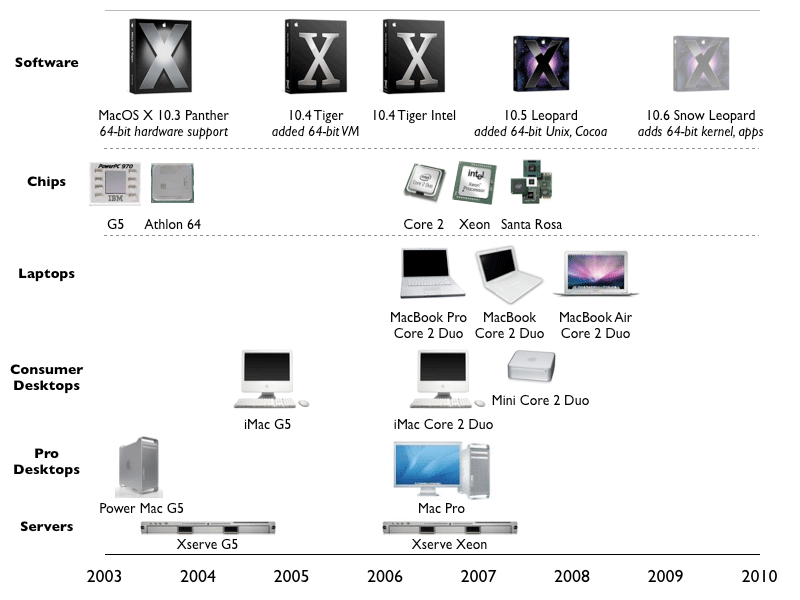
Snow Leopard's across-the-board leap to 64-bits, from the kernel to all of its bundled apps, will make more memory available and boost performance. However, Apple will also need to manage its 64-bit lead and organize its developers. Here's why.
Road to Mac OS X Snow Leopard: The Future of 64-bit Apps
The rise of 64-bit desktop CPUs
Apple took an early lead in providing 64-bit support for desktop computers with Mac OS X Panther and the PowerMac G5 in 2003, which enabled users to tap into the G5's 64-bit instruction set. At that time, Intel's 64-bit strategy was Itanium IA64, but every year the outlook for the IA64 architecture got worse. Microsoft released an IA64 version of Windows XP, but nobody was buying any Itanium workstations so it didn't really matter. In 2002, HP bragged a distant lead in selling Itanium workstations (without stating exactly how many), but by 2004 it had dumped the entire line.
Alongside the new G5, AMD introduced the first processors using its new AMD64 architecture: the server-oriented Opteron in April 2003 and the desktop Athlon 64 in September. AMD64 enhanced the existing x86 family of CPUs with 64-bit instructions and other improvements rather than trying to replace it outright, as Intel had with the Itanium IA64. The industry had already aligned behind Itanium at great expense, so AMD's technology looked unlikely to make any headway in the PC world. In late 2000 a pundit in Windows IT Pro wrote, "Seeing Microsoft adopt the AMD chip is about as likely as seeing pigs fly." (Clash of the 64-Bit Architectures)
Itanium's EPIC failure (late, expensive, and underpowered) was crushed by AMD's Sledgehammer when Microsoft announced it would port Windows XP to AMD64 in 2003, and Intel was forced to sheepishly follow behind AMD and implement the same architecture in its chips. Intel began calling its version of AMD's technology "EMT64T," but AMD, Intel, and Microsoft eventually agreed to rename the new 64-bit PC architecture as x64.
The developing market for 64-bit systems
Microsoft wasn't able to ship its first x64 version of Windows XP until the second quarter of 2005. By then, Apple had shipped two years of PowerMac G5s, introduced its Xserve G5, greatly enhanced its 64-bit support in Mac OS X Tiger (adding the ability to address vast new 64-bit virtual memory spaces), and had even been shipping the iMac G5 to consumers for nine months. Many G5 Mac users were benefitting from a 64-bit OS without even knowing it before the 64-bit version of Windows XP appeared for early adopters of x64 PCs.
However, the pace of IBM's G5 development had begun to slip, and so shortly after the initial shipment of Windows XP x64, Apple announced its plans with Intel to migrate to x86, initially to dodge the larger bullet of stagnant G4 development that had hampered Apple's laptop line, but eventually to migrate from the G5 to the very promising 64-bit CPUs Intel had in the pipeline for the next fall.
In 2006, Apple transitioned its entire product line to Intel, and over the following year it moved even its desktop and laptop systems entirely to Intel's 64-bit Core 2 processors. It also released Mac OS X Leopard, with additional support for graphical 64-bit apps in addition to the existing 64-bit servers and 64-bit virtual memory found in earlier systems.
Despite two and a half years of Windows XP x64, and nearly two more years of Windows Vista x64, Microsoft has still seen only minor adoption of its 64-bit computing platform. Apple is now five years deep into delivering a 64-bit OS for consumer hardware, and has moved to selling 64-bit hardware across the board for over a year. Will Apple be able to take any advantage of that lead?
The 64-bit APIs
While 64-bit hardware, virtual memory, and related improvements benefit even 32-bit software running on Mac OS X, the greatest advantage comes when running 64-bit software, particularly on Intel Macs, where a combination of factors combine to result in a significant overall improvement when using both 64-bit hardware and software. That makes the release of 64-bit Mac apps an important topic.
Apple's cancelation of portions of 64-bit Carbon hamstrung legacy code developers such as Adobe, meaning that Photoshop CS4 will only be available as a 32-bit app on the Mac. Currently, the only 64-bit apps Apple ships with Leopard are Xcode, Chess, Java, and Quartz Composer.
Snow Leopard, which will run on both 32- and 64-bit Intel Macs, will deliver 64-bit apps across the board (that is, universal "32/64-bit apps" that run on either architecture appropriately). That will give a nice boost to users of 64-bit Intel Macs (most of the Macs sold over the last two years), who have so far been hampered by the TLB flush issue currently affecting 32-bit apps, as described in the previous segment.
New 64-bit apps on Snow Leopard will get an even bigger boost from being able to take advantage of the additional registers on x64 that are so desperately missing from the 32-bit x86 architecture (but not PowerPC).
The significant boost that comes from recompiling Intel Mac apps as 64-bit, added to the relative ease in delivering them and the increasingly large share of the Mac installed base running a 64-bit OS, should result in lots of new support for 64-bit apps over the next year. Additionally, a lot of the code that would benefit most from 64-bits is from the open source world, making Mac OS X's compatibility with the LP64 model used by 64-bit Linux useful as well.
On page 2 of 2: What About Proprietary Apps?; More 64-bit Macs?; and Can Apple maintain its 64-bit lead?
Apple still hasn't said anything about when its own Pro Apps will move to 64-bit. Aperture, Final Cut Studio, and Logic Studio are all prime candidates for the move, as they handle huge data sets that demand fast and wide access to RAM.
Final Cut Pro and Logic both use the same Carbon API that Photoshop does, so it will be interesting to see how quickly Apple can eat its own Cocoa dog food, or whether Adobe's complaints about Carbon are also a serious problem for Apple, too. If not releasing 64-bit Carbon really was a show stopper for developers, Apple not only knows their pain but would also be experiencing it firsthand itself.
Interestingly, Adobe has already delivered a 64-bit version of Lightroom, an app which was written from scratch using Cocoa and therefore easier to release as 64-bit. Apple still hasn't delivered a 64-bit version of Aperture, which is Lightroom's main competitor. Aperture along with the Logic Studio and Final Cut Studio apps will likely be updated this winter or in the spring, and should make the move to 64-bits at that time, although Apple hasn't committed to that. Along with the late summer release of Snow Leopard, 2009 looks like it will be the year of 64-bit apps. Two weeks ago, Maxon released its CINEMA 4D R11 as a 64-bit Cocoa app.
Windows is seeing new interest in 64-bits as well, in part because the limitations of 32-bit memory are more onerous on Windows, where there's no relief for the MMIO or 2GB app limit problems, and no PAE relief either. However, Microsoft's 64-bit strategy suffers a lot of compatibility problems from third party hardware vendors that Apple doesn't have to deal with in many cases. Mac OS X only has to run on a limited number of premium hardware machines from one vendor.
Adobe hasn't released a 64-bit Flash Player plugin for the Mac either, which will force users back into running the 32-bit version of Safari in order to see animated ads and YouTube videos. Of course, Apple might prefer to see Flash go away on the desktop entirely, just as it killed off Flash on the iPhone.
More 64-bit Macs?
Window's 64-bit problems explain why Microsoft reported only seeing 5.18% of the traffic to its Windows Update servers as coming from users of Windows Vista x64 this June, a year and a half after Vista went on sale, and three years after the company introduced its x64 platform. Microsoft reported this as a huge "percentage of increase" in 64-bit users over its previous figures which were even worse, but it really indicates something far more interesting: the installed base and market for 64-bit Vista is smaller than 64-bit Mac OS X.
Apple said this summer that 89% of its installed base is running Tiger or Leopard. And while an increasing number of PCs are shipping with 64-bit hardware, all of Apple's Mac models are now 64-bit and have been for nearly two years. Apple is also growing at around 40% while the PC industry as a whole is plodding along at a much slower pace. Gartner tells us that 70% of new PCs are being sold to the enterprise, a market segment that takes Vista off and installs its own image (keeping Vista's enterprise adoption rate at an abysmal 8.8% in June). Rejection of Vista, combined with Microsoft's less than stellar 32-bit compatibility, is resulting in the Windows PC market only slowly moving to 64-bit hardware, and even then often still running a 32-bit OS.
Apple has 3.5% of the worldwide market for PCs and servers, and 8% of the US market. What percentage of the world wide market for PCs is hitting Microsoft's Windows Update servers? Apparently not much of the enterprise market (70%), where companies provide their own Windows Update proxy servers for their own PCs. And scratch out the botnet PCs and anyone who doesn't update regularly or automatically. That leaves it pretty clear that only a minor fraction of a minority subset of PCs are running 64-bit Vista.
Valve's Steam, which runs surveys of its serious PC gamers, reports only 3.3% of its users are running any version of 64-bit Windows. Gamers tend to buy premium machines and would be among those mostly likely to benefit from 64-bit Windows; a full 15% were running Vista. Still, that affluent, early adopter, power user crowd had less 64-bit representation than Macs have in the entire worldwide market of PCs and servers.
Can Apple maintain its 64-bit lead?
Apple's early lead in 64-bit desktops with the G5 appeared to have an uncertain future for a few months during in the transition to Intel Macs, but the company has built upon its pioneering 64-bit technical progression to aggressively move its users to 64-bit hardware running a 64-bit OS.
After introducing 64-bit Intel Macs and servers in 2006, Apple made 2007 its year of ubiquitous 64-bit Mac hardware and 2008 a year of 64-bit development. Snow Leopard looks likely to help make 2009 the year of 64-bits apps. With all of its PC competitors tied to Microsoft, Apple has the potential to deliver 64-bit performance and compatibility that set the company apart, if it can deliver the apps necessary to take full advantage of its lead.





 Mike Wuerthele
 Malcolm Owen
 Chip Loder

 William Gallagher
 Christine McKee
 Michael Stroup
 William Gallagher and Mike Wuerthele