MacBook Air (HDD model): an in-depth review
 Prince McLean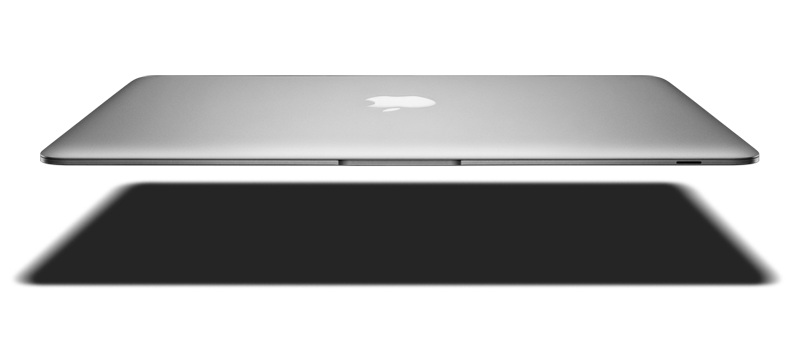
MacBook Air (early 2008)
4.0 / 5Every product involves a series of engineering decisions. The Air trades off some high end features of the MacBook Pro to slim down in size and weight, and trades off the economy of the MacBook in order to deliver a desirable punch that matches its razor thin outline. In our review, we'll look at three major categories of Apple's engineering decisions that resulted in the Air: mobility, performance, and overall design.
- Mobility looks at how the Air competes in terms of small physical size versus practical usability.
- Performance examines its top speed capacity versus heat generation, fan noise, and battery life.
- Design compares its offerings in rich features versus a delivery of pared down, elegant simplicity.
Each area considers a balance between two extremes in desirable aspects. Every competing ultra mobile laptop alternative to the MacBook Air makes different design decisions that renders it more or less suitable for specific types of tasks.
Air Mobility: the Physics
Apple's first foray into the modern market for ultra mobile laptops takes a unique turn compared to other models in its class, as detailed in How the MacBook Air stacks up against other ultra-light notebooks. Most existing ultra mobile units are built around smaller displays and reduced size keyboards. For example, the Asus EEE PC and the OQO e2 can fit in a large pocket, but have 7" and 5" screens respectively. More conventional light laptops such as the Sony TZ line achieve their mobility using an 11.1" screen. Smaller screen sizes allow a reduced overall footprint but also demand a smaller keyboard.
Alternatively, mobile laptops that provide a standard sized keyboard and full sized display commonly come in a package similar to the existing MacBooks. The highly rated Lenovo ThinkPad X61 has a full sized keyboard, but makes room for it by omitting a trackpad. It's also well over an inch thick and 20% heavier. Other laptops that provide a full sized keyboard similarly do so using a full sized case. After all, why be light and thin without a small outline, and why be full featured in the keyboard and screen without being full sized? Apple provides a unique answer in the Air.
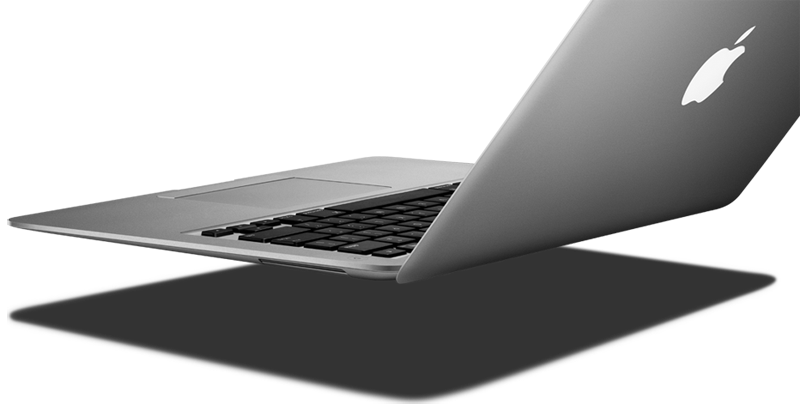
For the MacBook Air, it appears Apple started with a full sized keyboard and selected a matching display. The inch of margin around the keyboard makes the Air the same width as the MacBook, and similarly gives it room for the same sized display. However, the Air uses that margin to quickly taper down into a whisper thin edge, giving the Air a much slimmer profile.

Physics simply limits the degree to which the Air could be reduced in size using the same design proportions. Were it to attempt to cram the same full sized keyboard into a smaller outline, it would have to use a smaller 11" display but would also quickly lose internal volume unless it reduced the thin taper on the edges. Less internal room would mean it would either need to have a much smaller battery and compromise its logic board and disk allocation further, or revert to the boxier shape of conventional laptops. That's exactly what the 12" PowerBook did; it used a slightly smaller keyboard and display, but ended up considerably thicker than the 15" and 17" models it was sold next to.
In terms of mobility, Apple balanced a full sized keyboard and display and an exceptionally thin case to deliver the Air as a light, slim alternative to other MacBooks rather than simply a scaled down mini version. The Air isn't supposed to be a curiosity of miniaturization, but a full sized, practical laptop that is easier to carry around and sexier to show off.
Roadworthy Mobility Factors
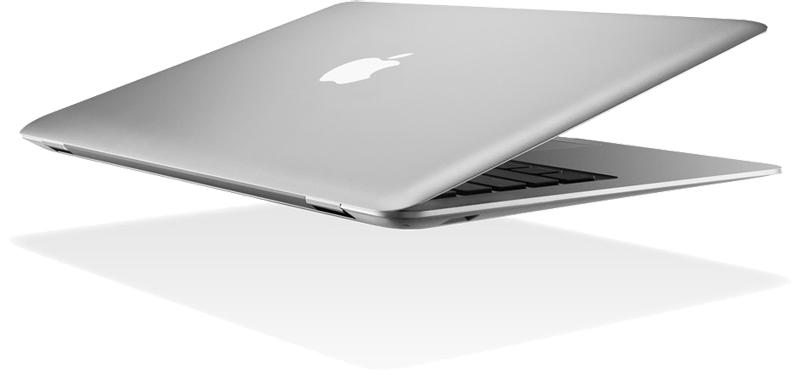
The latest MacBook weighs five pounds, and the new 15" MacBook Pro is 5.4 pounds. The Air is just 3 pounds. It's not only much lighter than its siblings, but its tapering frame makes it feel even lighter and more compact than it is. Closed, the unit looks and feels tiny, but once opened it feels luxuriously large.
Its tapering aluminum edges also give the unit a rugged, solid feel. Gripping the unit on both sides of the keyboard, there is simply no flex at all. It feels like a solid cast chunk of aluminum, without the expected weight. The lid is so thin that it can be flexed, but feels far more durable and substantial than the thicker display of the MacBook Pro. The Air's new hinge design also feels solid and smooth, with no play or bounce.
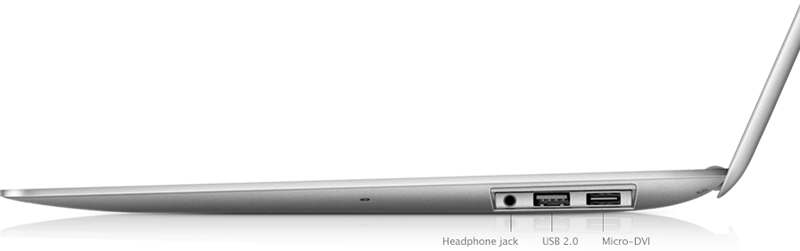
When shut, the unit feels like an armored tank, with no fragile exposed ports, switches, or latches. The flip down port cover that hides the USB, video, and headphone jacks also feels durable and solid. The tapered edges that make it feel so thin also contribute toward this rigidly substantial feel. Of course, you're not going to want to use the Air as a frisbee or stand on it, but as a mobile laptop it appears to have the durability to well withstand the common hazards of traveling.
The slimmer power adapter with an angled MagSafe connector is also a mobility feature, particularly when compared to the huge, heavy and clumsy brick required by the MacBook Pro. The right angled MagSafe cable should also relieve the cable stress that wears at the junction of the wire and the power connector of Apple's existing MagSafe plugs.
How Small Can It Get?
The Air's mobility certainly has some drawbacks too, highlighted in the design section below. Overall however, it looks like Apple delivered serious usability in a very compact and well built shell. Is there room to get smaller with the Air? Right now, Apple appears content to ignore the tiny gadget computer market.
Shortly after delivering the Titanium PowerBook, a group of Apple engineers put together an ultra compact version that the company refused to bring to market. That conflict resulted in some of those employees leaving to form OQO. While that company has gone on to produce some extremely small computers, their practical applications are limited. Until that segment ever takes off, the MacBook Air will likely remain Apple's target for delivering a light and thin notebook.
Underneath the Air in size and price, Apple is developing its iPhone and iPod Touch as a "WiFi mobile platform" to absorb the needs of active mobile users who want to access their information and to browse the web in a format dramatically smaller than a laptop product can deliver, as noted in the article The Unrealized Potential of Apple’s Hybrid Platform: Mac, iPod, iPhone, and Apple TV. This further makes it unlikely that the company will work to scale the Air down into the sizes pioneered by OQO.
Of course, if the Air is a hit Apple might consider introducing a scaled down version that makes even more compromises. For now, the Air has already stirred up a whirlwind of controversy regarding the tradeoffs required to deliver its debut size, shape, and weight.
On page 2 of 5: Air Performance: CPU and Graphics; Memory and Disk; The Performance Numbers; and Performance Efficiency.
Next to mobility, the Air's second set of engineering tradeoffs involve its processing speed and graphics capabilities compared to its usable battery life, heat generation, and fan noise. The faster things get, the hotter parts become, and the more energy they require. Conversely, a silent, cool, and highly efficient laptop can't deliver barnstorming performance. The Air takes a balanced approach but also makes some risky and aggressive moves.
The Air matches the top performance available at the high end of light, thin laptops, using a 1.6 or 1.8 GHz Core Duo CPU. In terms of performance, small devices such as the EEE PC and OQO are not in the Air's class at all. Even other popular, highly mobile laptops such as Sony's Vaio G and Panasonic's Toughbook R6 achieve their battery life and form factor by using a considerably slower single core processor and limited graphics chips.
Compared to other MacBooks, the Air comes very close to the entry level MacBook in both processor and graphics. It uses the same Intel X3100 embedded graphics chipset as the MacBook, meaning it's not a gamer machine or equipped to drive the native resolution of a 30" display. It does have the capacity to drive an HD video projector, any VGA or DVI monitor up to a resolution of 1920×1200, and provide composite and S-Video output. In comparison, most laptops in the Air's size and weight class only provide basic VGA output.
Memory and Disk
The Air supplies 2GB of RAM standard, which is twice what most other popular ultra mobile laptops include, and in many cases is also more than what those units can be expanded to hold (there's often a 1.5GB ceiling in highly mobile laptops). Models that can accommodate more RAM, such as the ThinkPad X61, are also limited by Windows Vista's inability to directly use more than 3.3GB. Given Apple's previous practice of skimping on RAM and delivering machines that desperately needed an upgrade right out of the box, the Air's liberal provision of RAM neatly works around its lack of future RAM expansion. Users with needs for more than 2GB of RAM will likely not be well suited by an ultra mobile form factor laptop.
The Air provides two hard drive options: the default 80GB 1.8" mechanical hard drive and an expensive option to upgrade to a 64GB Flash RAM solid state drive. Apple has been pushing its iPod line away from hard drives and toward Flash RAM because Flash is faster to read, less fragile and sensitive to impact, and more energy efficient. The downside to Flash is that it is far more expensive. Number-obsessed pundits have actually voiced confusion about why the SSD option is $1000 more for fewer GB.
The obvious answer, of course, is that SSD is still a costly, infant technology. Prices will likely drop rapidly, but the current expense of ultra-high density Flash RAM chips simply makes the SSD a pricy option. For business road warriors, the $1000 cost difference may not be much of a barrier. Standard 2.5" laptop drives used in MacBooks are already significantly more fragile than the full sized 3.5" drives used in desktop computers. However, the even smaller 1.8" hard drive used in the base model Air will have the same increased margin of failure evident in the iPods.
While desktop hard drives are generally expected to live reliably for three years, iPod sized hard drives have a roughly two year expected lifespan, as their AppleCare warranty options suggest. Take a hard drive apart and you'll understand why. Their ultra fragile mechanisms spin platters at thousands of RPM and are read by featherweight arms with a magnetic head that floats over the disk surface on a cushion of air. After just a few minutes of activity, these drives quickly become too hot to comfortably handle. It's amazing they can last as long as they do.
When exposed to regular shock and vibration, the chances of the head touching the surface or otherwise failing quickly rises into the danger zone. Once a disk fails, it is usually impossible to repair and often very expensive to attempt to recover data from. SSD solves all those fragility problems by using electronic chips instead of moving parts. Apple's business in iPods and with the iPhone give it high volume component pricing on the latest SSD devices, but its still an early adopter technology. Apple's SSD offering on the Air should both bring attention to the technology and help push SSD into the mainstream.
The Performance Numbers
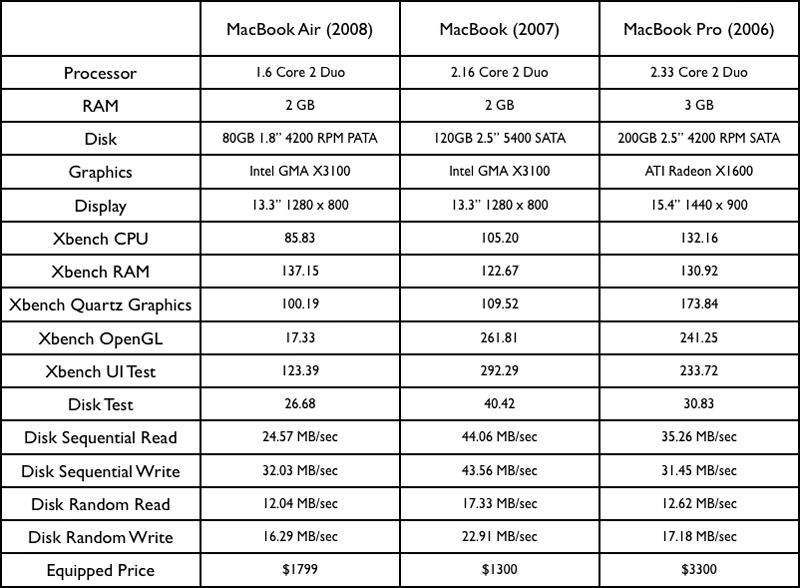
The Air's slightly slower CPU, matching graphics chips, slower-spinning HDD option, and fixed 2GB of RAM all make it difficult to compare in absolute ways against the base MacBook. How much difference does the mini hard drive make compared to the CPU? The Air's inability to enter FireWire Target Mode also makes performance testing of its hard drive a little more complicated to neatly isolate.
According to our Xbench testing, the Air compared well against a higher end MacBook and offered very similar Quartz graphics performance. However, Xbench rated the Air's OpenGL so poorly that there must be an error in the existing 1.3 version of the benchmark. That also appears to have skewed the overall user interface score and the score overall. The disk scores reflected the Air's use of a smaller, slower spinning mechanism. The Air's modern chipsets also appear to allow it to outscore our top of the line MacBook Pro from 2006 in RAM testing despite both using a 667 MHz bus, but that may also be an error related to Xbench and the new Air.
Combined, these numbers don't really provide a very useful picture of overall performance. For the uses it was intended, the Air's speed differences in CPU, disk, and RAM combine to deliver a very fast mobile system. Users who browse the web, work with office documents, and use iLife apps should be very happy with its performance. Like the standard MacBook, the Air is not equipped to play leading games such as the new titles released by EA or to run other heavy duty intensive graphics rendering applications.
Despite its focus on mobility, the Air delivers leading performance for its class and respectable performance even when compared against full sized, fully equipped MacBooks. PC World benchmarked the Air running Windows and found that it placed well ahead of light laptops from Sony and Fujitsu, but behind the leading ThinkPad X61, which is considerably thicker but uses the same CPU and graphics chip. PC World didn't outline how much RAM was installed in the ThinkPad, but it would certainly benefit from having a faster 2.5" hard drive compared to the Air's 1.8" drive.
It does seem odd than many observers are blown away that the MacBook Air is not as fast as the latest generation of full sized laptops. When have ultra mobile laptops, even those considerably thicker than the Air, ever matched the performance of full sized laptops?
We haven't yet obtained an SSD model for comparative testing with the base model Air model, but we have witnessed the dramatically faster application launching and rebooting it offers.
Performance Efficiency
The Air is no slouch, but it isn't a hot, loud, battery hog either. I couldn't get it to make any significant heat or noise until I baked the unit until it was unpleasantly hot to the touch. Even then, the fan was rather quiet despite evacuating hot air pretty rapidly from the openings along the back edge.
Apple says the Air's battery lasts for 5 hours with WiFi running. A number of reviewers have reported real world numbers of a little less than four hours. In all fairness, any laptop battery needs to be fully charged and calibrated through a couple charging cycles before reaching its top performance.
To really stress test things, I started playing a ripped DVD via a remote file share using wireless networking. DVD Player played the movie at full screen brightness all the way through once and started back through again for a total of exactly three hours. Playing the DVD over the network was enough work to cause the Air to become slightly warm and run the fan.
A number of factors will make a significant impact on battery life: screen brightness, disk activity, processor use, and WiFi radio activity. Casually browsing the web with the screen brightness dimmed slightly would provide far longer battery life than my pulling an entire DVD through the air. The SSD option, for anyone who can afford it, should also contribute to longer battery life. Three to four hours of use is better than other MacBooks, but given that there's no way to swap around battery packs, the Air demands to be used within a few hours proximity to power. With the increase in laptop use, finding an outlet in class, at work, in public spaces, and on airplanes is becoming easier, but some users will cling to models that allow them to carry spare batteries.
On page 3 of 5: Design Factors: the Missing Features; Built-in Optical Drive versus network Remote Disc or optional SuperDrive; and WWAN radio or expansion bay versus option to use a USB Dongle.
The real controversies surrounding the Air are related to what it leaves out in terms of features outside of its strengths in mobility and performance. The primary worries relate to its design decisions concerning its optical drive, WWAN support for 3G mobile networks, FireWire, and Ethernet.
Built-in Optical Drive versus network Remote Disc or optional SuperDrive
It was widely assumed before the Air's announcement that Apple would deliver a thin new laptop in part by removing the optical drive. Most makers of ultra mobile laptops already do this apart from Sony, which specializes in getting a tiny optical mechanism inside its extremely small laptops. Optical drives not only take up a lot of space, but also help to consume battery power. Apart from installing software and serving as a floppy replacement, the main use for an optical drive is to play DVDs or CDs.
It's in Apple's interest to migrate users to iTunes media, so it has positioned the Air's custom designed SuperDrive as an optional accessory users might be able to live without. In order to make an optical-free system even more viable, Apple includes Remote Disk DVD and CD sharing software that allows Air users to set up a Mac or Windows PC on the same network as an optical disc server. Remote Disc was detailed in the article MacBook Air spawns new software solutions for missing hardware.
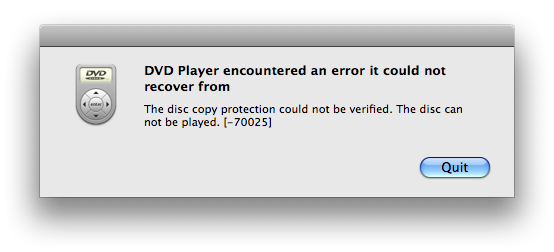
The software is easy to install and simple to use, but we ran into several problems with it. As Apple warned, it does not work with CSS encrypted DVDs. When I tried to play a DVD remotely, it mounted and launched DVD Player, began playing the initial FBI warnings, then stopped with an error that "disc copy protection could not be verified. The disc can not be played." (below) This seems to be related to the licensing restrictions on DVDs, and is not a technical problem Apple can solve. In order to play DVDs on the Air, you'll have to rip the CSS off them yourself using Handbrake, and then copy them over the network. DVD Player on the Air happily played my ripped DVD directly from a personal file share on another computer.
Audio CDs also have issues, for reasons that are less obvious. When sharing a CD over standard file sharing, a client Mac can read the raw file and play it because there is no CSS encryption on standard audio CDs. By default, a Mac reading an audio CD over the network will open iTunes and copy the song over directly, essentially ripping the CD over the network. Both existing Macs and the Air can do this, although it requires logging into the remote Mac with a user account.
However, Remote Disc seems to have a problem with reading audio CDs. Apple warns that "Some CDs or DVDs may be unable to install over a network using DVD or CD Sharing if they contain some forms of copy protection" but also states "MacBook Air does not support playing DVD movies or burned or ripped CD media." That simply does not make sense. Burned CD media is not different than pressed commercial CDs, and "ripped CD media" is a puzzle of its own. What is that even supposed to mean, a CD that has been ripped, or that can be ripped? Perhaps Apple was trying to say "does not support ripping or burning using Remote Disc."
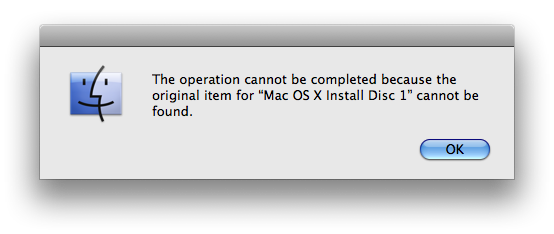
If you want to rip a CD on the Air without buying a SuperDrive, you can do it by simply connecting to the CD via the computer name under Shared in the Leopard Finder. You're currently out of luck trying to do that with Remote Disc. Whether this is an artificial, non-sensical limitation Apple purposely erected or just a bug in Remote Disc isn't yet clear. We also experienced intermittent problems with sharing standard DVD-ROM and CD-ROM media, too. All of them presented the same error: "the original item could not be found."

The DVD and CD Sharing server software that gets installed on the remote machine has some issues as well. On one Leopard Mac, the software appeared to work but wouldn't ever pop up the permission dialog when the Air asked to use the drive. On another Leopard machine and a Mac running Tiger, there was no problem with asking permission. Remote Disk is a great idea and has a clever and simple interface, but it does not yet work flawlessly, or even satisfactorily. Expect an update to improve things in the next few weeks.
The optional SuperDrive leaves less to chance, and has no issues with audio CDs or DVD movies. Because it requires more power than the USB specification supplies, the Air was specially designed to deliver additional power over its USB port. Using a hub allows you to power the SuperDrive while still using other USB devices. Using the SuperDrive will also tax the Air's battery however, so rather than using it to watch inflight movies, it makes more sense to rip them to local files or to use media downloads instead of DVDs.
WWAN radio or expansion bay versus option to use a USB Dongle
Many expected Apple to include a 3G radio for use with mobile data networks. Other laptops in the Air's class often feature built in support for EVDO or HSDPA networks, which require a data plan with a mobile service provider. However, a look inside the Air's case reveals there's no room for a WWAN radio and antenna and no space for an Express Card slot. There also appear to be no ExpressCard slot WWAN modules that support the Mac.
Users who want to access a WWAN service will need to use a USB adapter like every other MacBook user. The remaining complication is that some WWAN USB units won't fit into the tight space of the Air's port bay, requiring a USB extension cord. It might be tricky to find such a short USB extension. A more ideal solution would be to tether the Air to a mobile phone that supports data uplink, either using a USB cable or wirelessly. The iPhone, as all other phones from AT&T, doesn't support tethered data sharing from mobile phones to computers, unfortunately.
Another option for mobile users who want ubiquitous network access is one of the new portable WiFi wireless LAN routers that accept CardBus EVDO cards. This allows multiple WiFi devices, including the Air and iPhone, to access EVDO broadband mobile service.
On page 4 of 5: FireWire versus USB; Ethernet jack versus optional USB Ethernet Dongle; Design Factors: Premium Features; Full sized backlit keyboard versus toy buttons; and Full sized display and resolution versus mini screen.
In its space shaving and cost cutting, the Air also removes FireWire. While most PCs only use FireWire for DV camcorder input, Macs commonly use it for Target Mode, hard drives, file migration between computers, professional audio interfaces, and ad hoc networking as well. USB provides an acceptable alternative for hard drive use on the Air, but the missing Target Mode is a significant issue for Mac users. Apple partially addresses the missing FireWire link by including a new version of Migration Assistant that uses the network in place of a FireWire connection for importing user accounts and files. This works well enough but is slower, particularly over WiFi.
Without being able to boot up as a FireWire drive, or from another Mac in Target Mode, Air users might want to invest in an emergency USB flash drive or hard drive that can boot to perform disk repairs. At the same time, PC users have all been living without Target Mode features all these years, proving that it can be done. The Air also has an internal bootable volume containing the Apple Hardware Test diagnostics, which can be launched by starting the Air with the D key held down. AHT tests RAM and other components for obvious errors, but is really only useful in determining if major logic board problems are occurring. It does nothing to diagnose or solve file system errors.
USB and FireWire overlap in use, but are very different in their architecture. USB is a general purpose way to connect a computer to a simple peripheral. FireWire is designed to connect smart devices together, and therefore requires more intelligence built into each device. USB simply isn't sophisticated enough to emulate FireWire or act as a gateway for FireWire devices, so there isn't any way to connect FireWire camcorders, instruments, or other devices into the Air's USB port. Further, the Air's USB port can't reverse to act as a USB disk in Target Mode nor act as a networking adapter as FireWire can.
If you have actual needs for FireWire, the Air isn't going to work for you unless you can delegate your FireWire needs to another machine.
Ethernet jack versus optional USB Ethernet Dongle
Another feature aggressively pruned from the Air is an Ethernet port. Apple provides an optional USB 10/100 Fast Ethernet dongle for use with the Air, but most users should find its 802.11n WiFi adequate for most tasks. Apple recommends using Ethernet for migrating files from an existing Mac because it offers a significant advantage over WiFi in speed, but most users will only migrate once.
As a light thin mobile system designed around WiFi wireless networking, the lack of Gigabit Ethernet is less critical but is still a significant omission, particularly when combined with the missing FireWire. There's simply no ultra fast way to get data off the Air. The optional Ethernet dongle might solve this issue for users who need to move a lot of big files around faster than 802.11n can deliver.
Wireless N is still pretty fast for moving around reasonably sized files. The Air seems to have very similar WiFi reception compared to the recent generation of MacBook Pros, which is very good. In addition to being faster, Wireless N also has better reception thanks to its MIMO antenna technology. Apple seems to have Wireless N dialed in now, so reception isn't the flakey situation it sometimes was with earlier PowerBooks running Wireless B/G with less than stellar antenna designs.
Thanks to the simplified file sharing and share discovery in the new Leopard Finder, the Air can attach to servers or other personal file shares on the same network quite effortlessly. In a wireless home or office, the Air's featherweight portability makes it an excellent presentation system and mobile computer for writing, working with office files, web, and email. For the most demanding work, you might want to opt for a more powerful system, but the Air is by no means anemic, and its wireless networking is only a problem if you're moving around gigabytes of files on a regular basis.
Design Factors: Premium Features
In addition to the design aspects of the Air that might give shoppers a reason to upgrade to the full featured MacBook Pro or a competing ultra mobile system from another vendor, there are also design features of the Air that go beyond what other systems in its class offer. The gallery MacBook Air unboxing: notes and high-quality photos depicts some of these design details.
Full sized backlit keyboard versus toy buttons
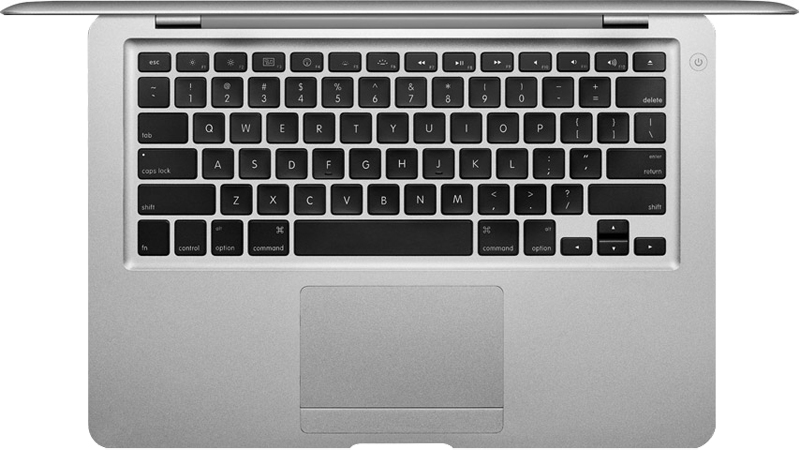
As previously noted, the Air's keyboard seems to have been a defining factor in determining its overall proportions. Rather than making a laptop that was just small, the Air delivers a full size keyboard and shrink wraps it in an aluminum frame. Beyond the full sized keys, it also sports illuminated key labels that respond to ambient light levels or can be manually adjusted in brightness. Apart from the Air, Apple only offers this feature on the MacBook Pro.
The ambient light sensor, located just to the left of the center mounted iSight camera in the top of the display bezel, is used to both dim the screen's backlight and illuminate the keyboard as the room's light level decreases. While the LCD backlight brightness seems to have a major impact on battery use, the illuminated keyboard doesn't have as obvious of a drain. In terms of both practical use and wow factor, the Air's use of an illuminated keyboard really sets it apart from competing models.
Full sized display and resolution versus mini screen
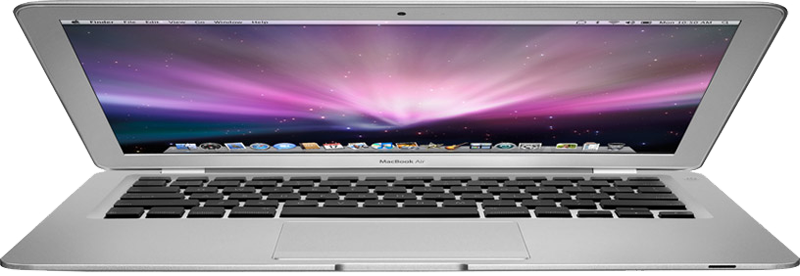
Building the Air around a full size keyboard also means there is room for a full sized display. The 13.3" wide LED backlit screen is the same size and 1280x800 resolution as the MacBook. It appears to be more evenly lit when viewed at different angles than the MacBook and previous generations of the MacBook Pro, both of which use a conventional cold cathode fluorescent lamp backlight. Incidentally, the new LED backlight is also mercury free, which helps make the Air more environmentally friendly and easier to recycle.
While the Air has a wider margin around the screen than other MacBook models, the bright display really grabs attention and is well proportioned. The Air's solidly minimal aluminum frame acts as a neutral canvas to the display; the flat metal body is ornamented only by the beveled depression around the keyboard and a thin rubber bumper around the edge of the screen lid that allows it to close tightly without scratching the lid against the case.
On page 5 of 5: Video conferencing camera; Multi Fingered Touchpad; Audio and Video input and output; Will the Air Breathe Life into Ultra Mobile Laptops?; and Rating.
We originally thought the Air supplied a high quality 1.3 megapixel camera for video conferencing with iChat and recording video and taking pictures with Photo Booth, just like the MacBooks and MacBook Pro. Of the other light and thin laptops we looked at, most supplied no integrated camera and the ones that did typically used a poor quality 0.3 megapixel unit that can't give as good of results.
It appears the Air uses a similarly lower end video camera. There is no resolution specification supplied, but it provides a visibly softer picture in iChat, and oddly enough, it does not work in Photo Booth at all. When launched, Photo Booth indicates no supported camera is installed. Hopefully this will be fixed shortly, as its a bit odd to ship a new model with an "iSight camera" that doesn't do what customers would expect from an iSight camera.
Multi Fingered Touchpad
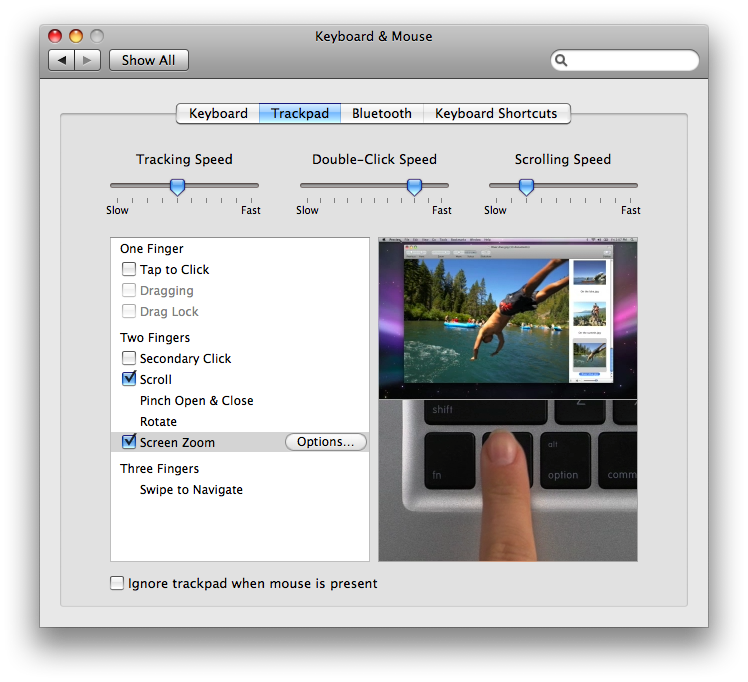
While existing MacBook models already respond to multiple touch points, the Air goes further to provide pinch, rotation, and "three finger flick" gestures. These appear to be software features that Apple may port back to existing models. However, it's also possible they depend upon support in the new trackpad controller the Air uses, which has been identified as the same touch controller used by the iPhone. That further suggests that additional gestures developed for the iPhone and iPod Touch could be developed in concert with the Air and new MacBook trackpads that use the same sensor and controller.
The new gestures on by default are two finger scrolling (already supported on existing MacBooks); Screen Zoom, which uses control + two finger scrolling to zoom in and out (also supported on existing models, but not previously on by default); pinch to zoom and two finger rotate are entirely new features, and can't be turned off. Also new is the three finger flick, used to navigate back and forth through photos or web pages. It too is not possible to turn off from System Preferences. That doesn't seem like a problem, but it is interesting that there is no option.
Tap to click, double tap to drag, and "drag lock until you tap again" are all optional features left off by default, as they are on existing MacBooks. Two finger secondary click (right click) is also left off by default. That leaves pinch, rotate, and swipe the only new trackpad gestures that are as yet only available on the Air.
Audio and Video input and output
The Air only provides a stereo headphone jack which lacks the optical audio support that the other MacBooks have. It lacks any audio input jack. It supplies a simple mono speaker and mono mic for video conferencing. Musicians and podcasters will need to get a USB audio interface to use the Air for those purposes.
The speaker sounds great for speech but only fair for music and movie playback. Even the MacBook Pros don't provide exceptional music playback from their small speakers. If you listen to music from your laptop, you probably already use headphones to do so. The Air has a standard headphone jack, but its location in the flip down port bay means that fancy headphones with a short, fat, or otherwise special connector might not fit well. Normal headphones work fine and sound great.
The Air's micro-DVI port supplies VGA and DVI output as well as composite and S-Video for use with a TV. VGA and DVI connectors ship in the box, but if you want to hook the Air up to a TV or lower quality video projector, you'll need the optional TV adapter. Most business-quality projectors have a VGA input that the Air can use without any optional dongles.
There's no video input options apart from capture devices you can attach via USB, and again, no workaround to directly importing DV due to the missing FireWire.
Will the Air Breathe Life into Ultra Mobile Laptops?
Most vendors of highly mobile laptop lines sell them to a niche market as high end luxury items. In many cases, these ultra mobile systems are less than practical, using ultra low voltage, single core processors that deliver slow performance, limited graphics support using small displays and only very basic video output features, scaled down keyboards that are unpleasant to type on, cheap and flimsy plastic bodies, and an assortment of ports covered up with rubber protectors fated to be mangled within the first couple months of use. Despite the weaknesses, they still cost $2000 and up once they're upgraded to a reasonable amount of RAM.
With the Air, Apple is targeting mobility users with a super slim, rigid metal case and offering liberal performance features that match the high end of the mobile class. However, it's also competing aggressively on price, with a $1799 model that undercuts less practical models by hundreds of dollars and doesn't need immediate upgrades. On top of that, Apple is leveraging its Mac OS X Leopard operating system, backwards compatibility with Windows, and the bundled iLife suite, which adds hundreds of dollars in value compared to typical PC offerings.
While critics complain about Apple's risk taking with a built in battery, an expansion strategy that relies almost entirely upon USB, or ask Is the MacBook Air Another Cube?, it seems they're missing the real value offered by the Air. It isn't designed to wow the crowd obsessed with specification numbers; it's designed to impress in design and execution. It's sexy, practical, powerful, and reasonably priced. It takes the MacBook into an entirely new weight class, and delivers itself as a razor thin, super light computer that can easily serve as a primary system for lots of mainstream users.
There are plenty of things to list as missing in the Air, but in many cases, adding them in would involve both raising the price and watering down the slick physical sophistication Apple delivered in its attractive, simple, and well designed ultra mobile laptop. The MacBook Air isn't a gamer PC, it isn't a workstation replacement, it isn't designed around optical media, and it won't plug into your DV camcorder, gigabit switch, or FibreChannel SAN. It doesn't have to. It's the delicious looking iPod laptop from the maker of the iPhone, and Apple isn't going to have any problem selling it.
Rating 4 out of 5

Pros:
- Highly mobile light and thin design.
- Sexy, attention arresting appearance.
- Impressively solid hardware engineering.
- Leading CPU and graphics performance for its class.
- Very practical full size, illuminated keyboard.
- Bright LED backlit screen looks great and its environmentally progressive.
- Innovative multitouch trackpad features work well.
- Full featured video output options for a light mobile.
- Runs quiet and cool even when cranking.
- Very good WiFi 802.11n reception.
Cons:
- No built in WWAN options.
- No FireWire or Gigabit Ethernet.
- Peripherals and connectivity limited to single USB port.
- Battery life closer to 3-4 hours; no add-on battery option.
- Remote Disc needs more work.
Places to Buy
More on MacBook Air



 Malcolm Owen
 William Gallagher
 Mike Wuerthele
 Christine McKee

 Andrew Orr
 Sponsored Content