Will Apple Rescue Intel's Silverthorne?
 Prince McLean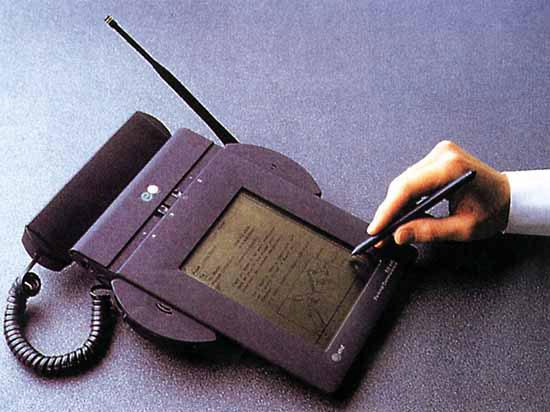
The market for tablet sized computing devices has repeatedly disappointed in the past. Enthusiasm for "pen computing" erupted in the early 90s led by Go's PenPoint OS (below, running on the short lived, early 90s AT&T EO) and followed by Microsoft's Windows for Pen, but the market didn't respond appreciatively to products as delivered. Handheld processors of the day were often designed for more conventional laptops and couldn't really support the performance required for tablet features and the power efficiency demanded by more compact devices with smaller batteries.
in 1993, Apple released the Newton MessagePad using a new processor architecture the company designed in collaboration with Acorn Computer, called ARM. While the Newton had the computing power and efficiency to handle advanced features such as handwritten recognition, it also had other problems, as described in Newton Lessons for Apple's New Platform. Among the most significant was that by the mid 90s, Apple itself was in serious trouble. In 1998, Steve Jobs canceled the Newton as part of efforts to get the company back on track.
The Troubled Tablet PC
In the second half of the 90s, Microsoft began delivering portable computing initiatives based on Windows CE, a new mobile operating system that shared little in common with the desktop Windows apart from its name. The WinCE-based Handheld PC in 1996 experimented with tiny clamshell form factor PCs but couldn't garner much interest. After the explosion of the Palm Pilot PDA, Microsoft rebranded its efforts as Palm-Sized PC in 1998 and after being sued by Palm, Pocket PC in 2000.
After a decade of disappointing failure in the mobile devices arena, detailed in The Spectacular Failure of WinCE and Windows Mobile, Microsoft shifted its attention away from WinCE to offer handheld tablet PCs based around the desktop version of Windows. In early 2006, Microsoft unveiled Origami, rumored to be a portable Xbox or possibly a media player to rival the iPod. Instead, it turned out to be a new version of the Tablet PC specification, later designated UMPC for ultra mobile.
The rebrandings did nothing to boost sales however. One reason for the UMPC failing to take flight was the same price to performance problems that plagued earlier devices. Typically using lower powered versions of Celeron M or Pentium M chips, UMPC devices such as the Samsung Q1 debuted at around $1000, but delivered worse battery life than a laptop, less computing power, and a lower resolution 800x480 screen in exchange for a thicker tablet form factor and a stylus-sensitive display. The market didn't respond appreciatively.
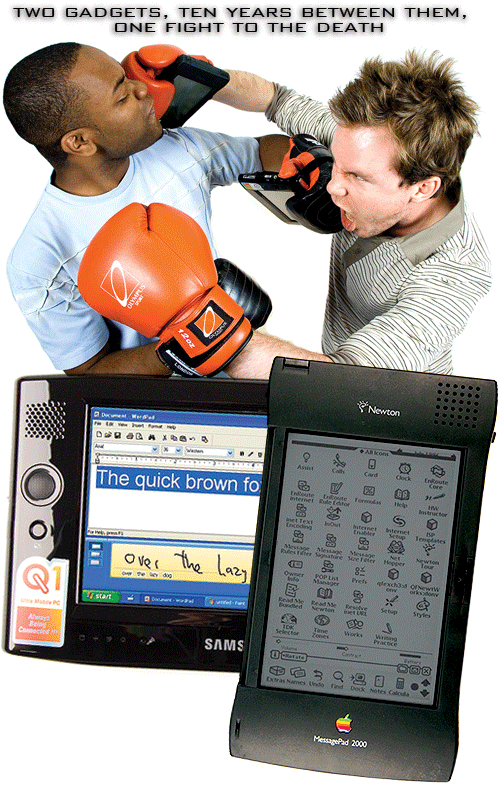
When CNET.co.uk pitted the 2006 Origami Samsung Q1 UMPC against the 1997 Apple Newton MessagePad 2000, it declared the decade old Newton as the overall winner. The failure of UMPC to functionally outperform an ancient technology relic has led many to believe that there is hope for the ultra mobile form factor outside of Microsoft.
The Linux Ultra Mobiles
While Intel's collaborations with Microsoft haven't grabbed much interest, Linux-powered ultra mobiles have recently been stealing the limelight. The ASUS Eee PC is a $300 to $500 low end laptop without a stylus or touchscreen (below). It coasts along using Intel's Dothan processor, similar to the CPU inside the Apple TV. Rather than trying to be a tablet, the device acts as a low priced laptop alternative. While it isn't directly comparable with Microsoft's Tablet PC vision, it has the same screen resolution as the UMPCs: 800x480.
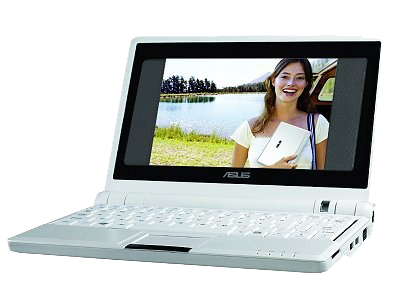
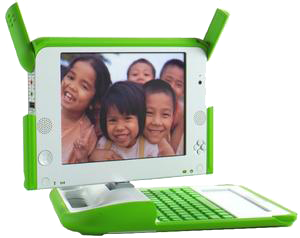
Last year, Intel promoted a prototype of the Eee PC alongside the "Classmate PC," a demonstration designed to compete against the "One Laptop Per Child" OLPC project's $100 XO-1 (below). That ultra mobile device is also based on Linux, but uses the Geode processor from AMD. Its increasing popularity in developing nations has raised some concern for both Intel and Microsoft that market volumes could derail the economies of scale that have long favored the WinTel PC.
A Silverthorne Lining for the Dark Cloud of Microsoft's UMPC?
While the low end of ultra mobiles is generating some excitement, the future of Microsoft's UMPC itself is anything but certain. Earlier this year in April, Intel unveiled the Silverthorne processor and its Menlow platform as the basis for the second generation of UMPC devices and what Intel calls Mobile Internet Devices. However, the only "MID" units most consumers would recognize are Apple's iPhone or iPod Touch which use Samsung ARM processors, and Nokia's Linux-based N800 Internet Tablet, which features a processor from Texas Instruments.
Convincing Apple to to use the Silverthorne processor architecture in upcoming products related to the iPhone and iPod Touch architecture, or alternatively in an ultra mobile version of the MacBook line, could serve to throw Intel back into the ring in the mobile processor business. Mac sales are outpacing the growth of PC competitors by a wide margin, and new Mac-derivative devices such as the Apple TV hold promise in markets that aren't yet established, as described in Apple TV Digital Disruption at Work: iTunes Takes 91% of Video Download Market.
Additionally, Apple's iPod sales are continuing to grow despite the general malaise of the entertainment gadget industry. The iPhone launched into second place in North America with 27% of US Smartphone Market. Canalys figures indicate that the iPhone Already Leads Windows Mobile in US Market Share. Leveraging its relationship with Apple to push its latest processors would be a major coup for Intel, which has hit repeated setbacks in the development of processors for both mobile phones and in ultra mobile computing.
What Would the Jesus Phone Use?
Apple's close partnership with Intel, which went public in 2005 and resulted in the rapid migration of Mac models from PowerPC to Intel's Core processors throughout 2006, did not directly impact the architecture of the iPhone. Instead, Apple continued using the same ARM processors for its new smartphone as it had been using in the iPods since 2001, as described in Origins: Why the iPhone is ARM, and isn't Symbian.
Apple has long term contracts with Samsung for purchasing Flash RAM, a relationship that likely made Samsung's ARM-based 'system on a chip' components an easy choice for the iPhone and the closely related iPod Touch. However, sources indicate that Apple may be moving away from ARM and toward Intel's x86 compatible Silverthorne processor family in new models of the iPhone, iPod, or related devices that could include a tablet or micro-laptop form factor.
That planned move could explain why Apple kept third party development efforts closed on the iPhone. However, Apple's Universal Binary architecture on the Mac allows developers to simultaneously target PowerPC and Intel processors, as well as 32-bit and 64-bit architectures and single and multiple core chip designs. Since it would also be unworkable for Apple to deliver a development platform that only targeted new iPhone models, even if Apple moved from ARM to Intel's new ultra mobile offerings in new iPhone models, it would still need to support the ARM architecture for developers.
Trading Places in the CPU Market
Apple's processor agnostic operating system technology allows it to deploy Mac OS X on whatever processor architecture offers the best in price and performance. In contrast, Symbian, Palm OS, and Windows Mobile/WinCE are all primarily tied to ARM, while Microsoft's desktop Windows XP/Vista is tied to x86 compatible processors.
Mac OS X already runs across three very different processor families. Apple has the flexibility to migrate the iPhone to a new CPU or alternatively to straddle the fence, with its mobile devices continuing to use ARM while more complex portable devices take advantage of processors like Silverthorne. Either way, Apple will continue to use Intel's most appropriate processors for low power, mobile, portable, desktop, workstation, and server processors across its Mac product line, and the Mac market is now large enough to decisively factor into Intel's roadmap.
That's a dramatic reversal of the situation Apple found itself in just a couple years ago as the last computer maker using PowerPC. Now, rather than begging its PowerPC partners to deliver customized parts suitable for the products it wants to build, Apple has access to a smorgasbord of CPUs from Intel and enthusiastic support for the kind of hardware applications both companies share a vision for delivering. Before partnering with Apple, Intel expressed frustration with the lack of creativity among the more conservative PC makers.
It's also a reversal of Apple's longstanding situation as the minority alternative platform among PCs. Being the only significant vendor of a non-Windows PC long meant Apple couldn't benefit from the economies of scale enjoyed by larger PC makers such as Dell and HP. Now, Apple has access to take direct advantage of Intel's latest and greatest processors and chipsets in its Mac lines, a leveraged flexibility that resulted in PCWorld awarding the MacBook Pro this year as the fastest laptop for running Windows Vista.
In addition to having broad access to the bleeding edge of desktop and laptop processors, Apple also now acts as the world's largest manufacturer of music players and mobile internet devices. Dominating consumer sales with the iPod has given Apple favorable volume pricing in Flash RAM, ARM processors, and related mobile components.
That in turn helped the company to deliver the iPhone with far more usable storage at a price very competitive with high end phones with less RAM; the iPhone typically delivers 64 times as much Flash as other smartphones. When the cost of mobile service is included, the iPhone is even several hundred dollars less than simpler $99 smartphones such as the Motorola Q running Windows Mobile, as outlined in iPhone Price and Profits vs Nokia, LG, HTC, RIM, Palm.
On page 2 of 2: Apple Goes Ultra Mobile; The Writing is Not On the Tablet; Every Rose Has Its Silverthorne; and The Silverthorne Road Map.
Just as Apple's early 90s PowerBook designs helped the company to deliver the Newton as a portable device, the company's current expertise in developing thin, fast, and battery savvy music players and mobile phones could be parlayed into the ultra mobile market to shake things up.
As described in Newton Rising: Is the Next iPhone Device a G3 MessagePad?, Apple's ability to deliver a wider range of ultra mobile devices based on the shared platform of the now established iPhone and iPod Touch enables the company to introduce new alternative form factors in unproven markets without risking massive upfront investment in a speculative venture. The foundation is already laid, and Apple's economies of scale, component pricing leverage, and proven ability to market and retail its products offer a lot of confidence in its plans for the future.
That's a huge reversal from just a year ago, when industry analysts felt comfortable in insisting that Apple could not successfully enter the smartphone market. At the same time, going ultra mobile would force the company to incur some risk of eating into its existing laptop sales. However, similar cannibalization fears didn't stop the company from discontinuing the hard drive based iPod Mini at the height of its popularity to release a Flash-based replacement in the Pod Nano.
The Writing is Not On the Tablet
There are several other reasons why an Apple alternative to Microsoft's UMPC might not match the success of the iPod or iPhone. First, the ultra mobile form factor hasn't proven itself as a viable market able to support a general purpose product. Apple has shied away from delivering highly customized products for different regions, markets, and users, preferring instead to deliver high volume products with broad appeal. The iPod and iPhone also capitalized upon rapidly growing market segments; there's currently nothing going on among UMPCs.
Price is still a concern as well. A tablet couldn't attract too much attention at $1000, and couldn't be very profitable at $500. Existing UMPC makers are all suffering from this problem, and many have a wide product lineup designed to offer devices at every price point in between. The result is that applications for the devices are unlikely to take full advantage of the higher-end models, while low end models are too slow and have frustrating limitations in the amount of storage they offer.
That same shattered platform/lowest common denominator problem has long plagued the variety of devices running Symbian, Windows Mobile, Palm OS, and mobile versions of Sun's Java or Adobe Flash Lite. In contrast, Apple sells one iPhone model, and the iPod Touch is only slightly different in its screen size and hardware features, meaning that developers can easily target a large combined platform without having to test compatibility with products from various vendors in hundreds of different configurations.
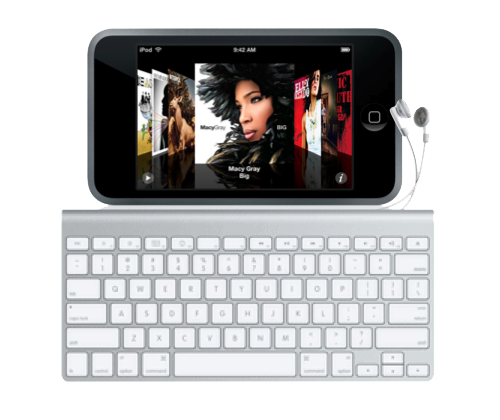
Apple also sells its mobile devices in the $300 to $400 price range, compared to the $600 to $1500 price range of UMPC devices. A consumer, entertainment-oriented iPod Slate (below) in the area of $600 could leverage Apple's iPod platform along with the patented central software distribution model involving iTunes and pattered after iPod games described in The New Apple Patent: WGA Evil or iPhone Knievel?, all without falling into the pit of indifference as other UMPC and Tablet PC vendors have. Whether the market would respond in volume sales still remains to be seen.
Every Rose Has Its Silverthorne
One significant barrier standing in the way of an idealistic ultra mobile partnership between Apple and Intel is that Silverthorne isn't a guaranteed success. While currently riding high on the desktop with the Core architecture, Intel has stumbled as often as it has delivered successful products, as noted in Paul Murphy's "Intel Macs Are Killing the Planet Myth". Just in the last decade:
- Intel's desktop Pentium 4 ended up a disappointment that AMD was able to run circles around, as noted in Inside Apple TV: A Brief History of Intel Processors.
- its IA-64 Itanium workstation processor was a disaster that AMD derailed with its own 64 bit architecture, which Intel was then forced to support. This was described in PE U: The Mac OS X Leopard Windows API Myth: EFI and Itanium.
- Intel's attempt to enter the mobile phone processor business with XScale was also a tremendous failure. After investing around $5 billion to acquire and develop a mobile processor business to rival mobile leader Texas Instruments, Intel was forced to back out of that arena completely. It sold the remains of its XScale PXA business boondoggle to Marvel for just $600 million last year. XScale is an implementation of the ARM architecture, originally based upon Digital's StrongARM designs.
Gadi Singer, the senior Intel engineering manager behind Silverthorne, also oversaw the catastrophic Itanium and XScale projects. In addition to problems in delivering technology as planned, Intel has also faced problems in selling good chip technologies in a very competitive market, as well as in trying to co-develop new products that consumers and businesses have any interest in buying. All three factors line up against Silverthrorne.
A partnership with Apple could give Intel the practical products and marketing push to sell the new chip in quantity, solving two issues out of three. As the WinTel domination of the PC industry has proven over the last fifteen years, volume sales can also make up for the problem of technical deficiencies by allowing the sales leaders to invest in catching up with the technology leaders.
The Silverthorne Road Map
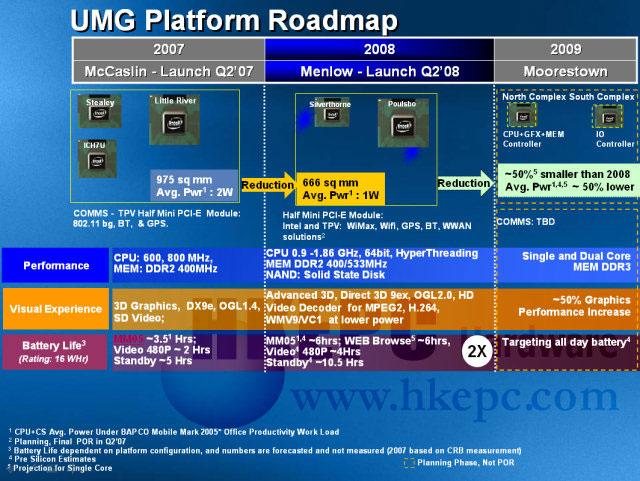
Apple is most likely to use Silverthorne in a larger slate form factor iPod, an ultra mobile laptop, or in new devices along the lines of Apple TV. Silverthorne is a low power, x86 compatible chip slated for launch early next year. Intel plans to follow the Silverthorne/Menlow platform in 2009 with Moorestown.
The new Silverthorne chip offers major advances over Intel's first generation UMPC processors used in Microsoft's Origami products earlier this year: a smaller die size, significantly lower power requirements resulting in roughly double the battery life, faster core processing and memory pipelines, and options for embedding integrated 'system on a chip' features such as WiFi, WiMAX, GPS, Bluetooth, and video decoding features.
Apple's current iPod and iPhone relationships with Samsung combine ARM processors with a PowerVR MBX graphics core at a price Intel will be pinched to match in Silverthorne and the Menlow architecture, but Intel also has a lot to gain in getting its chips inside the hardware that is currently selling rather than just shipping new generations of processor designs as an engineering exercise.
Interestingly, while Intel's Microsoft-centric ultra mobile roadmaps (below) highlight support for graphics and video software proprietary to Windows, including Direct 3D and Windows Media/VC-1 decoding, Intel has also quietly licensed the PowerVR graphics technology from Imagination Technologies, the leading mobile graphics core among mobile devices and the architecture Apple uses in the iPhone. This spring, an Imagination Technologies Press Release announced, "Our partnership with Intel in the personal computing/UMPC segment is progressing well, with additional projects committed. We expect this to lead to product shipment towards the latter part of our 07/08 financial year."
If Intel were only planning Silverthorne to be used in a few hundred thousand UMPC devices running a tablet version of Microsoft Windows, licensing PowerVR wouldn't make much sense. It appears Intel is planning to rapidly expand its mobile business by partnering with the leader in mobile graphics and the leading maker of smartphone, internet, and entertainment devices. The entire existing UMPC market was estimated to be around a third of a million units this year, while Apple itself sold five times that many iPhones in just one quarter. It also sold a lot of iPods.
Could favorably competitive pricing from Intel persuade Apple to significantly redesign the iPhone within just a year in order to use an unproven processor architecture, rather than continuing to use the same, well known components shared by the vast majority of of smartphones, available from multiple suppliers at competitive prices? That remains to be seen.
Apple could also ride the white hot competition between the x86-compatible Silverthorne and ARM licensees such as Samsung by using both families of processors in its products, particularly given the company's unique ability to repeatedly bridge the processor compatibility chasm with its flexible operating system technology. Apple's ability to design, deliver, and sell products will certainly keep Intel's fingers crossed that the company picks its new chips for whatever it has up its sleeve.
As the article Ten Big Predictions for Apple in 2008 suggests, Apple appears to have plenty of surprises ready for 2008 that could easily make this year's explosive growth and expansion look dull by comparison.


 Malcolm Owen
 William Gallagher and Mike Wuerthele
 Christine McKee
 William Gallagher
 Marko Zivkovic