
Apple said to hold 'iPad 3' event first week in March

  • Apple employee says upcoming new iPad 3 to have "truly amazing" screen

  • Pictured Sharp LCD panel claimed to be Retina Display for Apple's 'iPad 3'

  • Doubts cast on likelihood of quad-core A6 CPU in third-gen iPad

  • Lowest Prices ANYWHERE on MacBooks with exclusive AI coupons: Mac Price Guide updated Feb. 9th. (Find the best prices on Macs)
    Thursday, March 29, 2007

    Intel details upcoming processor generations

    By AppleInsider Staff

    Published: 09:00 AM EST (06:00 AM PST)

    Intel Corp. said this week that it remains on track to begin producing its next-generation Penryn family of processors in the second half of this year, marking the next step in its "tick-tock" product rhythm of delivering a new process technology or entirely new microarchitecture every year.


    The world's largest chipmaker said the new processors benefit from enhancements to the Intel Core microarchitecture and also Intel's industry-leading 45nm Hi-k process technology with its hafnium-based high-K + metal gate transistor design, which results in higher performance and more energy-efficient processors.

    The Santa Clara-based firm said it holds more than 15 45nm Hi-k product designs in various stages of development, and will have two 45nm manufacturing fabs in production by the end of the year, with a total of four in production by the second half of 2008 that will deliver tens of millions of these processors.

    Below are many of the details of the Penryn processor family and a glimpse into some of the key features of Intel's future generation of processors, codenamed Nehalem.

    Penryn Family Microarchitecture Innovations
  • A Range of Products -- Six Penryn family processors, including dual and quad-core desktop processors and a dual core mobile processor are all under the Intel Core processor brand name as well as new dual and quad-core server processors under the Intel® Xeon® processor brand name. A processor for higher-end server multiprocessing systems is also under development. As previously noted, Intel already has a total of 15 45nm products scheduled.

  • Technical Marvel -- 45nm next-generation Intel® Core™2 quad-core processors will have 820 million transistors. Thanks to our high-k metal transistor invention, think of 820 million more power efficient light bulbs going on and off at light-speeds. The dual-core version has a die size of 107mm2, which is 25 percent smaller than Intel's current 65nm products - and quarter of the size of the average U.S. postage stamp - and operate at the same or lower power than Intel's current dual core processors.

  • Deep Power Down for Energy Savings, Improved Battery Life -- The mobile Penryn processor has a new advanced power management state called Deep Power Down Technology that significantly reduces the power of the processor during idle periods such that internal transistor power leakage is no longer a factor. This helps extend battery life in laptops. This is a major advancement over previous generation industry leading Intel mobile processors.

  • Intel Dynamic Acceleration Technology Enhanced Performance for Single Threaded Apps -- For the mobile Penryn processor, Intel has enhanced the Intel® Dynamic Acceleration Technology available in current Intel Core 2 processors. This feature uses the power headroom freed up when a core is made inactive to boost the performance of another still active core. Imagine a shower with two powerful water shower heads, when one shower head is turned off, the other has increased water pressure (performance).

  • Speeding Up Video, Photo Imaging, and High Performance Software -- Penryn includes Intel® Streaming SIMD Extensions 4 (SSE4) instructions, the largest unique instruction set addition since the original SSE Instruction Set Architecture (ISA). This extends the Intel® 64 instruction set architecture to expand the performance and capabilities of the Intel® Architecture.

  • Other Technical Features to Improve Performance
    • Microarchitecture Optimizations -- Increases the overall performance and energy efficiency of the already leading Intel Core microarchitecture to deliver more instruction executions per clock cycle, which results in more performance and quicker PC responsiveness.

    • Enhanced Intel® Virtualization Technology -- Penryn speeds up virtual machine transition (entry/exit) times by an average of 25 to 75 percent. This is all done through microarchitecture improvements and requires no virtual machine software changes. Virtualization partitions or compartmentalizes a single computer so that it can run separate operating systems and software, which can better leverage multicore processing power, increase efficiency and cut costs by letting a single machine act as many virtual "mini" computers.

    • Higher Frequencies -- Penryn family of products will deliver higher overall clock frequencies within existing power and thermal envelopes to further increase performance. Desktop and server products will introduce speeds at greater than 3GHz.

    • Fast Division of Numbers ? Penryn-based processors provide fast divider performance, roughly doubling the divider speed over previous generations for computations used in nearly all applications through the inclusion of a new, faster divide technique called Radix 16. The ability to divide instructions and commands faster increases a computer's performance.

    • Larger Caches -- Penryn processors include up to a 50 percent larger L2 cache with a higher degree of associativity to further improve the hit rate and maximize its utilization. Dual-core Penryn processors will feature up to a 6MB L2 cache and quad-core processors up to a 12MB L2 cache. Cache is a memory reservoir where frequently accessed data can be stored for more rapid access. Larger and faster cache sizes speed a computer's performance and response time.

    • Unique Super Shuffle Engine -- By implementing a full-width, single-pass shuffle unit that is 128-bits wide, Penryn processors can perform full-width shuffles in a single cycle. This significantly improves performance for SSE2, SSE3 and SSE4 instructions that have shuffle-like operations such as pack, unpack and wider packed shifts. This feature will increase performance for content creation, imaging, video and high-performance computing.

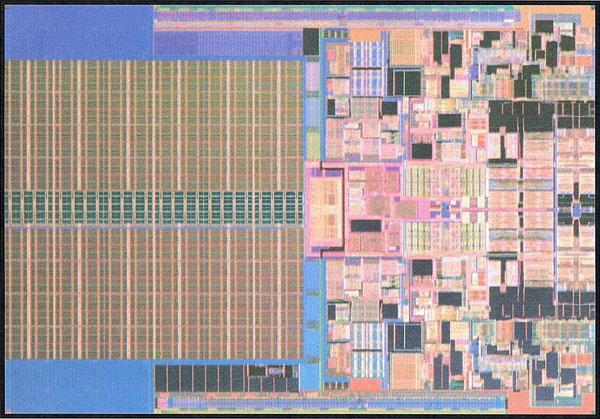
    Penryn Die Photo
    Photo of the Intel Penryn Die

    Nehalem Microarchitecture
    After Penryn and the 45nm Hi-k silicon technology introduction comes Intel's next-generation microarchitecture (Nehalem) slated for initial production in 2008. By continuing to innovate at this rapid cadence, Intel will deliver enormous performance and energy efficiency gains in years to come, adding more performance features and capabilities for new and improved applications. Here are some new initial disclosures around our Nehalem microarchitecture:
    • Dynamically scalable for leadership performance on demand with energy efficiency

      • Dynamically managed cores, threads, cache, interfaces and power
      • Leverages leading 4 instruction issue Intel® Core microarchitecture technology
      • Simultaneous multi-threading (similar to Intel® Hyper-threading technology) returns to enhance performance and energy efficiency
      • Innovative new Intel® SSE4 and ATA instruction set architecture additions
      • Superior multi-level shared cache leverages Intel® Smart Cache technology
      • Leadership system and memory bandwidth
      • Performance enhanced dynamic power management

    • Design scalable for optimal price/performance/energy efficiency in each market segment

      • New system architecture for next-generation Intel processors and platforms
      • Scalable performance: 1 to 16+ threads, 1 to 8+ cores, scalable cache sizes
      • Scalable and configurable system interconnects and integrated memory controllers
      • High performance integrated graphics engine for client

  • Filed under : Future Hardware 54 Comments ] 
    Story topics: Nehalem   Print ] [ Story Link ] 


    RSS
    Mac Connection End of Summer Sale
    MacBook Pro Model
    Apple
    Price
    Discount
    2.4GHz dual 13" MacBook Pro $1,199.00 $1,096.05* $102.95
    2.8GHz dual 13" MacBook Pro $1,499.00 $1,382.19* $116.81
    2.2GHz quad 15" MacBook Pro $1,799.00 $1,647.06* $151.94
    2.4GHz quad 15" MacBook Pro $2,199.00 $1,983.65* $215.35
    2.4GHz quad 17" MacBook Pro $2,499.00 $2,288.23* $210.77
    Early 2011 MacBook Pro Model
    Apple
    Price
    Discount
    2.7GHz dual 13" MacBook Pro $1,499.00 $1,258.53* $240.47
    2.0GHz quad 15" MacBook Pro $1,799.00 $1,503.49* $295.51
    2.2GHz quad 15" MacBook Pro $2,199.00 $1,695.99* $503.01
    2.2GHz quad 17" MacBook Pro $2,499.00 $2,035.49* $463.51
    *Instant 3% AppleInsider Reader Discount Applied When Adding Items To Your Cart

    AppleInsider Features
    Hot Forum Topics

    Recent Articles
    Apple said to be in 'crunch mode' to ready 'iPad 3' apps for on-stage demos, ads
    Google reportedly working on wireless home entertainment system
    Samsung Galaxy 10.1N cleared for sale in Germany
    Apple deadline for sandboxing in Mac App store arrives March 1
    AT&T throttling unlimited data users starting at 2 GB per month based on location
    Apple employee says upcoming iPad 3 to have "truly amazing" screen
    Workers' rights petitions delivered to Apple's Grand Central store
    US NOAA ditches BlackBerry, chooses Apple's iPhone and iPad
    FBI file on Steve Jobs reveals he was considered for White House position
    Apple now worth more than Google and Microsoft combined [u]
    Apple exploring 3D frame-of-reference iOS interface based on eye, light location
    Apple said to hold 'iPad 3' event first week in March
    Pictured Sharp LCD panel claimed to be Retina Display for Apple's 'iPad 3'
    Leaked photo allegedly shows outside back cover of Apple's next iPad
    Alleged Foxconn hack allowed bogus orders to be placed for vendors
    White MacBook sales come to close as Apple ceases sales to education institutions
    Google says it won't support fair licensing in open standards as Apple, Microsoft, Cisco have
    Cisco backs Apple's ETSI request for fair and open licensing of standards patents
    Doubts cast on likelihood of quad-core A6 CPU in third-gen iPad
    Path apologizes, offers opt-out for address book uploading
    iTunes Match generates 'magic money' for music copyright holders
    Siri rumored to gain support for Mandarin, Japanese and Russian in March
    US Air Force may buy 18,000 Apple iPads for cargo aircraft
    Purported 'iPad 3' back panel shows space for larger battery, new LCD
    Worker abuse petitions to be delivered Thursday at Apple's Grand Central store
    Microsoft joins Apple in pledging support for injunction free, FRAND patent licensing
    iPhone best at retaining resale value and offers lowest total cost of ownership
    iTunes-sponsored live Paul McCartney concert to stream for free on Apple TV
    Mobile carriers hate not having iPhone, pay premiums to get it
    Viacom deal brings MTV, Comedy Central, Nickelodeon shows to Amazon Prime
    European Apple resellers say lack of inventory is putting them out of business
    Sprint sold 1.8M iPhones in holiday quarter, 40% to new subscribers
    Apple continues adding Lion Internet Recovery support to 2010 Macs
    Amazon nears deal with Viacom as it readies standalone video subscriptions
    Apple asks ETSI standards body to set rules for standards essential patents
    Path app under fire for unauthorized address book upload
    Google to continue Motorola's FRAND licensing that seeks to monopolize H.264, UMTS
    App developers forced to submit Retina Display screenshots
    Final Cut Pro X named PCMag's Editors Choice for high-end video editing
    Apple-sparked 'App Economy' created 466K U.S. jobs in 4 years


    AppleInsider RSS Feed
    AppleInsider © 1997-2011
    Please review our Privacy Policy.
    Written/Edited/Compiled by the AppleInsider Staff.