Special Report: Apple's touch-sensitive iPod ambitions disclosed in filing
 AppleInsider Staff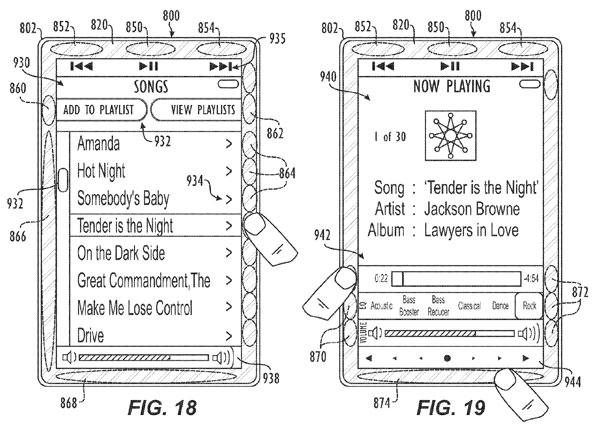
A new patent filing by Apple Computer for a touch sensitive digital media player is the most comprehensive to date, intertwining several previous filings in describing iPod-like devices with touch sensitive bezels, displays and sensors for determining orientation.
Apple goes to great lengths to describe an electronic device, which can be a digital media player, picture frame, personal digital assistant, cell phone or handheld gaming unit, where areas of the device's housing bezel are designated as the primary user interface controls used for operation.
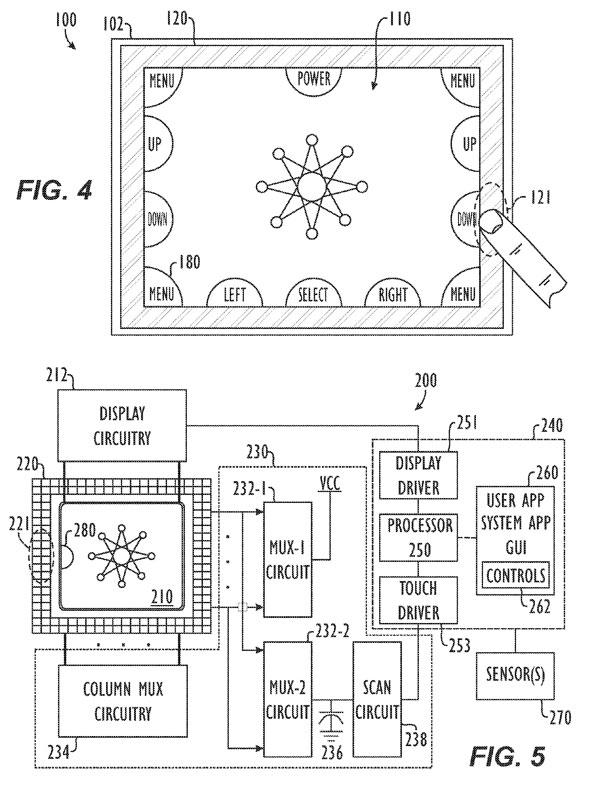
In one example of such a device, visual guides corresponding to the controls are displayed on the display adjacent the areas of the bezel designated for the controls. Touch data would be generated by the bezel when a user touches specific areas of the device's enclosure, Apple said. The device would then determine which of the controls has been selected based on which designated area is associated with the touch data from the bezel.
Apple explained that the device can have a sensor for determining the orientation of the device, i.e., whether a user is holding it horizontally or vertically. "Based on the orientation, the device can alter the areas designated on the bezel for the controls and can alter the location of the visual guides for the display so that they match the altered areas on the bezel," the company said.
The electronic devices described in the filing "may be multi-functional hand-held devices" with a user interface that requires "no physical buttons, keys, or switches so that the display size of the electronic devices can be substantially increased." Preferably, Apple said, the electronic device would eliminate such physical buttons from a front surface so that additional surface area becomes available for a larger display on the electronic device.
"Ultimately, this strategy allows the electronic device to house a substantially full screen display," the company explained. "As used herein, a full screen display is a display that consumes, or at least dominates, a surface of the electronic device."
Because a limited number of physical buttons are provided, Apple said the display of the hand-held device may also employ a transparent touch screen as the primary input mechanism. Operating under this method, a graphical user interface "may present an on-screen button or user control on the display" and the touch screen display may detect when a user presses the on-screen button.
The hand-held device may also be constructed with only cross-functional physical buttons, where there are no buttons specifically dedicated to individual device functionalities, the iPod maker said. Physical buttons could be limited to only the sides and back surface of the device or to the upper and lower portion of the sides. Alternatively, physical buttons may be located only on the front surface bezel area or on only on the top and bottom surfaces of the device.
Apple took caution in explaining that because the side surfaces of handheld devices are used for grasping, it may be preferred to leave the sides surfaces free from buttons to prevent accidental actions in the event a user inadvertently presses a button while supporting the device. "Although the top and bottom surfaces would not typically be used to hold the device, these surfaces are not ideal locations for buttons that are often actuated because it would be awkward to reach these buttons when operating the device with one hand," the company noted. "Instead, the top surface may be reserved for buttons that have limited action and generic functions that are cross-functional, for example, power and hold switches."
In some cases, Apple said it may be desirable to place buttons in the upper or lower regions of the side surfaces out of the way of the grasping hand of the user. "This may be particularly well suited when the housing of the device is elongated more than the standard width of a user's grasping hand."
By placing a button in the upper region, it tends to be out of the way of the grasping hand and therefore accidental activation is substantially eliminated, Apple said. The button, which could be a dial, wheel or switch, could then be configured to switch the functionality of the multi-functional device.
Depending on the implementation, particular user controls designated for areas of the bezel may not have any visual indications appearing directly on the bezel itself, the company said. "Instead, the designated user controls may be in a logical or predetermined location on the bezel that the user may know or expect."
Taking things a bit further, Apple said the electronic device "may be capable of rotation and may have an orientation sensor for determining the orientation of the device." Based on the sensed orientation, the areas on the bezel designated for the user controls could then be altered or relocated to match the current orientation. Likewise, the company said, the user interface software operating on the device can alter the location of the visual guides to match the current position of the areas on the bezel designated for the user controls.
In another example presented in the filing, one or more sensors can include ambient light sensors for detecting the level of ambient light around the device. Preferably, two ambient light sensors would be employed for redundancy. "Based on the level of ambient light detected, the electronic device can automatically adjust the contrast and/or brightness of the display accordingly," Apple said. "In yet another embodiment, the one or more sensors can include a motion sensor, such as a passive pyroelectric sensor. The motion sensor can be used to detect motion of the electronic device from a stationary state so that the device can 'wake up' or can show previously hidden visual guides on the display in response to being moved."
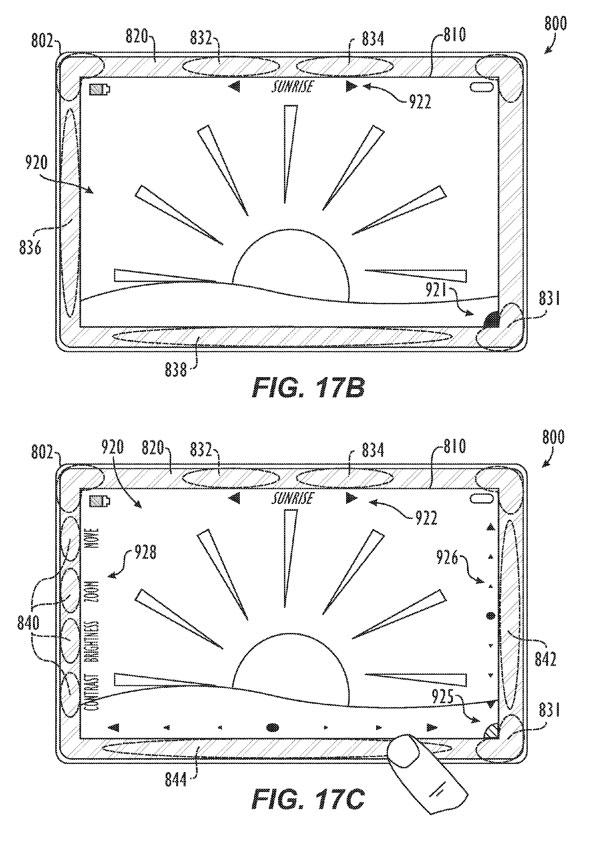
According to the filing, a rectangular device and can be oriented in either a "portrait" or a "landscape" mode, where it could display a picture or other content in either orientation. In some circumstances, the orientation of what is displayed may not match how the device is currently orientated, but the user may rotate or changes the orientation to correct the issue.
"Depending then on the desired or required orientation for particular content to be shown on the display, the electronic device can alter the designation of the areas for the user controls and the location of visual guides according to the 'portrait' or 'landscape' orientations," Apple explained. "In other words, when the device is preparing to display particular content, the electronic device can determine the particular orientation for that content. Then, when the device switches to show that new content on the display, the electronic device alters the designation of the areas for the user controls and the location of visual guides if the orientation of the newly displayed content is different from that previously displayed. Thus, the user can naturally rotate the device to better view the newly displayed content in its preferred orientation, and the visual guides and designated areas will be already matched to the content's orientation."
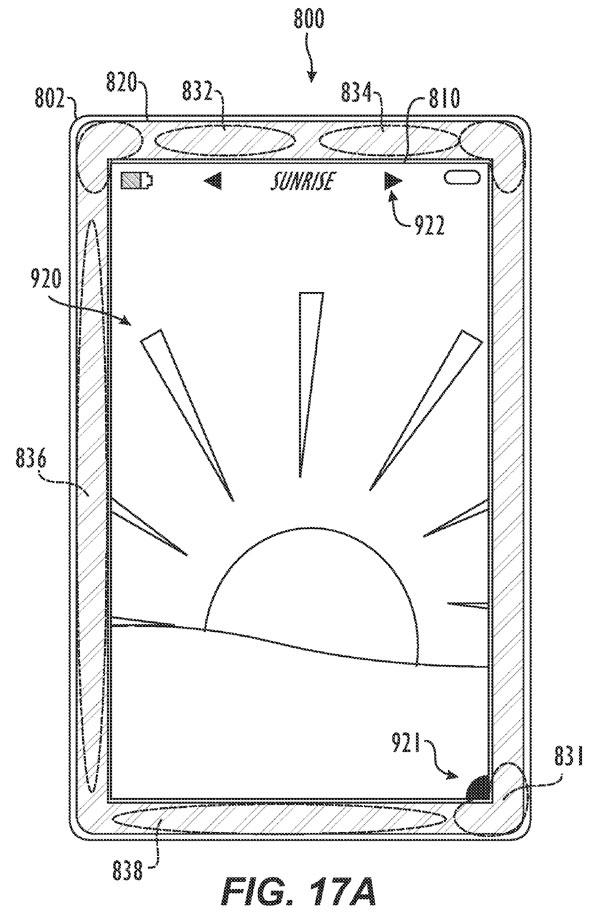
The devices processing circuitry could also store information tracking how long touch data has occurred on portions of a touch sensitive bezel and/or how many adjacent, designated areas have had repeated touch data, according to the filing. "Then, after a predefined time limit, the processing circuitry can begin to ignore that consistent touch data in the portion of the bezel when determining what user controls the user is implicating. Furthermore, the processing circuitry can designated new locations for areas of the bezel for user controls that are part of the ignored portion of the bezel."
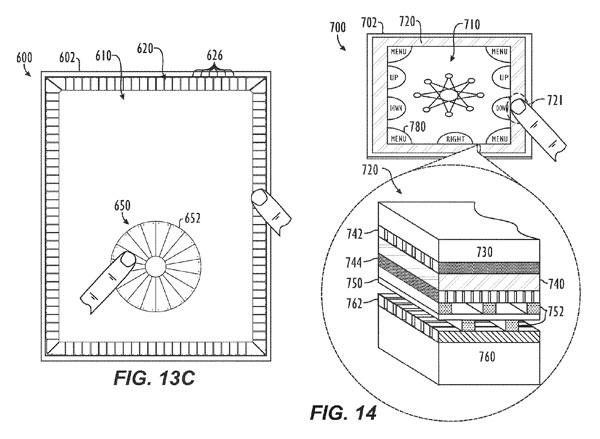
"For example," Apple said, "the touch sensitive bezel can be used to sense touch gestures, such as touch and drag operations, made by the user. Using the touch gestures, a user can perform a number of user controls, such as move portions of an image that are being displayed, move a curser to drop and drag visual elements displayed scroll up and down through a screen, skip through images in an album or series of images, adjust the setting or value of a user control, or perform similar operations."

In addition, because the touch sensitive bezel can also be configured to detect force, the pressure that a user applies to a designated area of the bezel can also be used to determine the amount, extent, or level of a setting, adjustment, or value of a user control," the company said.
Furthermore, Apple said the touch sensitive bezel can be used to obtain touch data corresponding to multiple user controls simultaneously: "For example, the user controls of the bezel can be configured so that one side of the bezel controls brightness with a touch and drag motion by the user, while the other side of the bezel controls contrast with a touch and drag motion by the user. Thus, using both of these sides of the bezel, the user can simultaneously adjust both the contrast and the brightness of the display using touch and drag motions on the sides of the bezel."
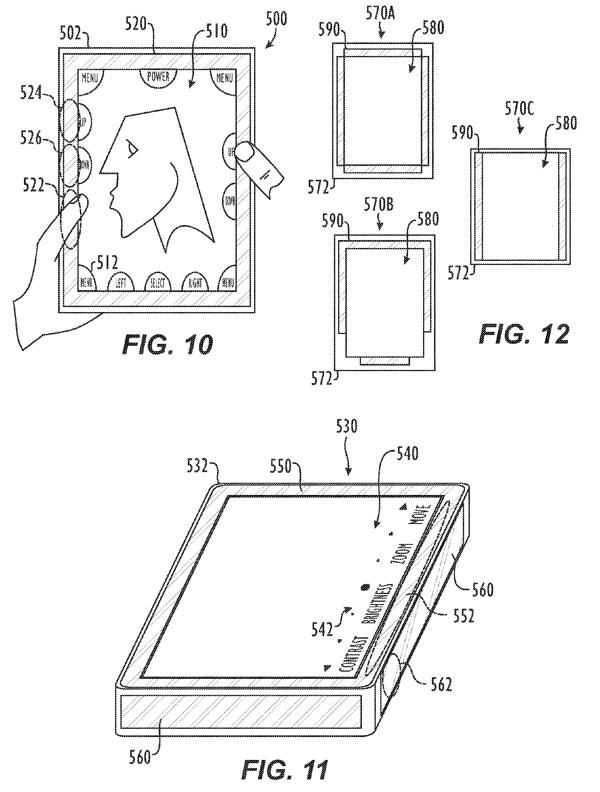
Apple noted that its latest filing shows several different configurations of electronic devices, each of which contain certain features, details, and configurations. "However, one skilled in the art will understand that such features, details, and configurations can be used with the various different embodiments, even if such features, details, and configurations were not specifically mentioned in conjunction with a particular embodiment, and that this disclosure contemplates various combinations of the features, details, and configurations disclosed herein," the company wrote. "More specifically, the foregoing description of preferred and other embodiments is not intended to limit or restrict the scope or applicability of the inventive concepts conceived of by the Applicants."
In exchange for disclosing the various inventive concepts, Apple said it is seeking all patent rights afforded by its claims.
The filing is credited to four Apple employees: Nick King, Duncan Kerr, Paul Herbst and Steven Hotelling.


 William Gallagher
 Andrew Orr
 Sponsored Content
 Malcolm Owen

 Mike Wuerthele